





 Portuguese
  English
  Spanish
  2 min of reading
  0 comments


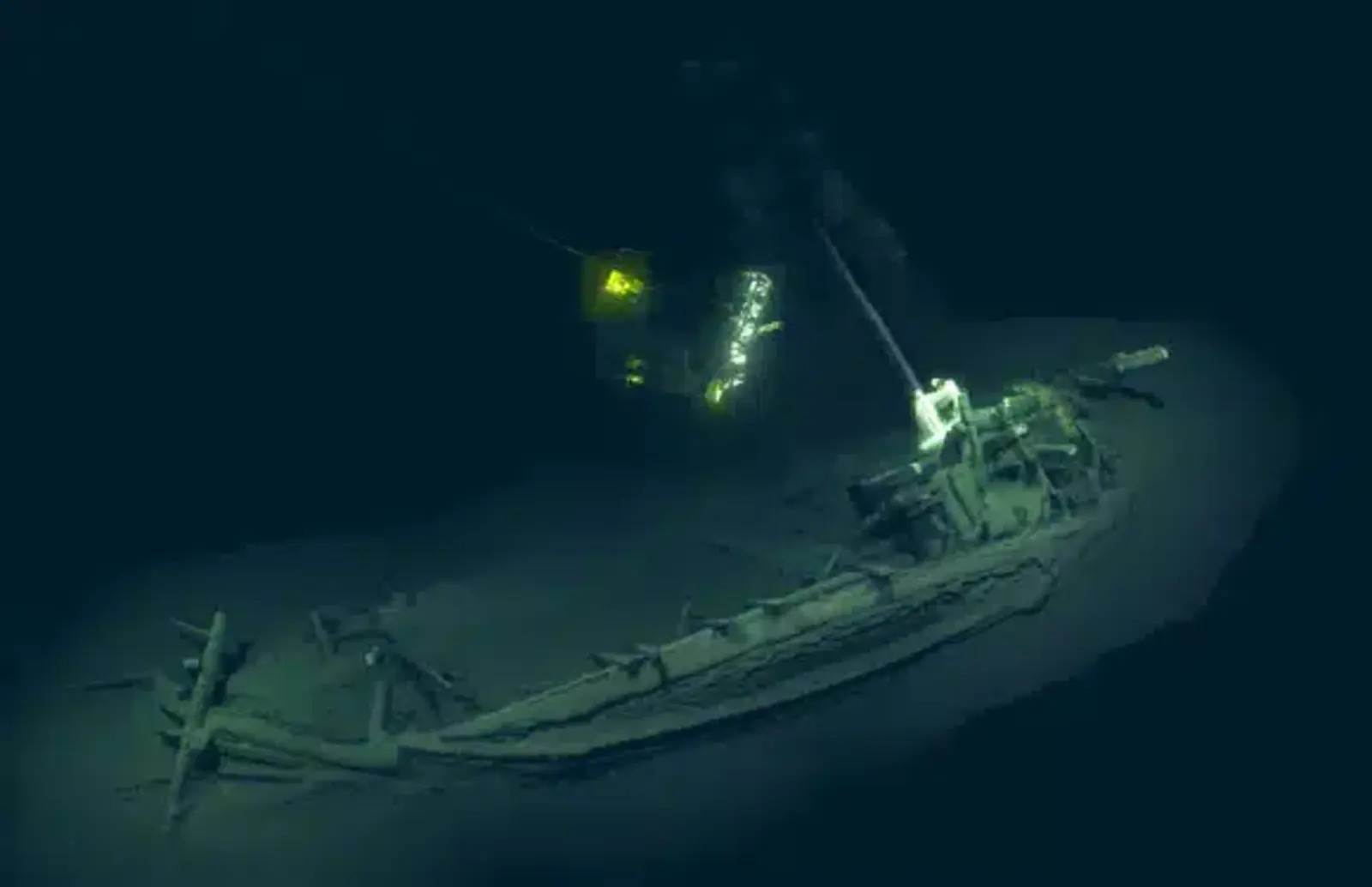
Discovery of 2,400-year-old Greek ship, preserved more than 1.9 kilometers deep in the Black Sea, expands the scope of the Black Sea MAP project, which has already identified more than 60 shipwrecks and remains of an ancient submerged village in Bulgaria
A 2,400-year-old Greek merchant ship, measuring 23 meters in length, has been found almost perfectly preserved at more than 1.9 kilometers deep in the Black Sea, where it is now regarded as the oldest intact shipwreck ever discovered.
Discovery in the Black Sea
The discovery was made by the Black Sea MAP project, which has already identified more than 60 shipwrecks from different periods in the region.
The collection includes everything from Roman merchant vessels laden with amphorae to a 17th-century Cossack attack fleet.
-
Scientists find a methane-free ecosystem in the Peru-Chile Trench, sustained by unique microorganisms that live off sulfur and challenge theories about life in extreme environments.

-
Two wheelchair batteries, Arduino, and Bluetooth transformed garage junk into an iPhone-controlled electric “mini-tractor” capable of pulling a twin-engine aircraft weighing over 2.2 tons without relying on a professional tug.

-
Scientists have just discovered a new family of magnetism, and this fundamental physics discovery could pave the way for faster memories, advanced sensors, and more energy-efficient electronics.

-
Advance against cancer: USP scientists develop revolutionary biosensor that identifies pancreatic cancer in 10 minutes at low cost and can save thousands of lives in Brazil





According to researchers, the findings show how the Black Sea was an intense route for trade and movement over the centuries.
The newly discovered Greek ship, dated to the classical period, adds another record to this maritime history.
Together, the discoveries reinforce that different vessels crossed the region at various times, leaving a preserved material trace at extreme depths there.
Ancient preserved shipwreck
The ship rests more than 2 kilometers deep, in oxygen-free waters. This anoxic environment prevents the decomposition of organic matter, such as wood, and helps explain why the vessel has remained upright for over two millennia.
For Professor Jon Adams from the University of Southampton and the principal researcher of the project, finding a ship from the classical world preserved in this way is something he never would have believed possible. The structure has remained almost intact, which is rare in ancient finds.
More than 60 vessels
The more than 60 shipwrecks identified by the Black Sea MAP belong to distinct eras. According to the team, they encompass Roman vessels and others linked to later regional conflicts, forming a collection that helps reconstruct human circulation in the Black Sea.
The project is not limited to ships. Researchers are also exploring ancient coastlines now submerged, seeking to understand how human communities adapted as sea levels gradually rose over time.
Submerged village in Bulgaria
Near Ropotamo, Bulgaria, the team found the remains of an ancient settlement from the Bronze Age. The site, once a coastal village, became buried under the seabed after the water advanced.
According to the project, remains of houses, hearths, and pottery are located about 2.5 meters below the surface.
With the rise in water levels, the area became a bay and was used by Greek colonists, Byzantine sailors, and the Ottoman fleet.
With information from Daily Galaxy.







Be the first to react!