





 Portuguese
  English
  Spanish
  5 min of reading
  0 comments


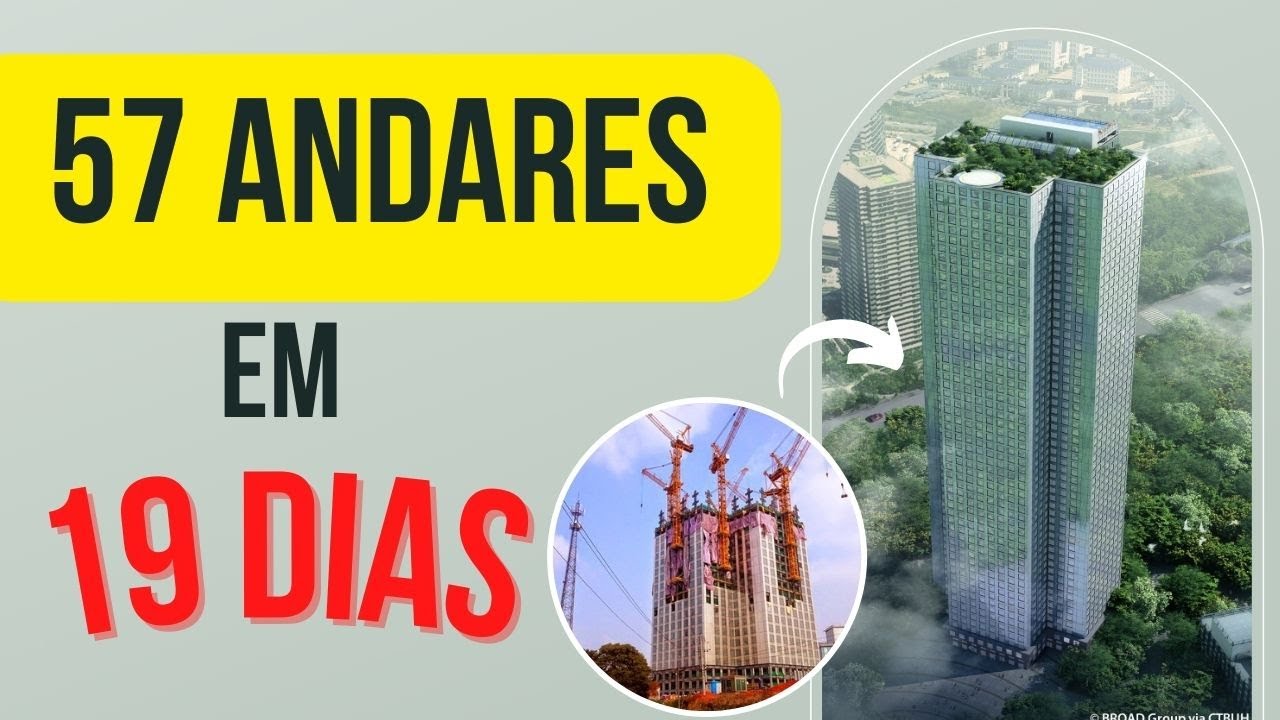
China Completed a 57-Story Building in 19 Days With Pre-Fabricated Modules Assembled Like Industrial Parts, Changing Paradigms in Construction.
When, in 2015, the Chinese company Broad Sustainable Building Co. (BSB) announced the structural completion of a 57-story skyscraper in just 19 days, the construction world turned its eyes to Changsha, the capital of Hunan province in central China. The building, called Mini Sky City, represents a qualitative and quantitative leap in how high-rise buildings can be assembled from factory-prefabricated units, reducing construction time and generating potential for profound changes in global architecture and urban planning methods.
What makes this achievement so relevant and challenging to traditional construction paradigms is not just the speed but the combination of industrial techniques, modular assembly, and integrated engineering that allowed for the erection of a tower with 800 apartments and space for up to 4,000 people in less than three weeks.
A Vertical Factory: The Strategy Behind the Speed Record
The key to the project was modular prefabricated construction. Unlike the conventional method, which involves foundation, on-site concrete structure, and a long sequence of finishing steps, the process adopted by BSB consisted of producing most components off-site in factories equipped for this type of manufacturing.
-
The lack of welders, electricians, and operators becomes a structural threat in 2025, with the construction industry and manufacturing already suffering from delays, cost pressures, and labor shortages in Brazil.
-
Brazil and Paraguay are just 46 meters away from a historic union on the bioceanic bridge that promises to revolutionize trade between the Atlantic and the Pacific.
-
With 55 km over the sea, a cost of US$ 20 billion, and enough steel to build 60 Eiffel Towers, China’s largest project has connected Hong Kong, Zhuhai, and Macau in a colossal bridge that defies the logic of engineering.

-
A trick with joint compound transforms a Styrofoam ceiling into a plaster-like ceiling: leveled panels, wires and mesh at the joints, sand, paint, and change the environment while spending little today.

Before any assembly on-site, the company dedicated about four and a half months to manufacturing 2,736 steel modules, each with structural parts, electrical installations, plumbing systems, insulation, and other integrated elements.
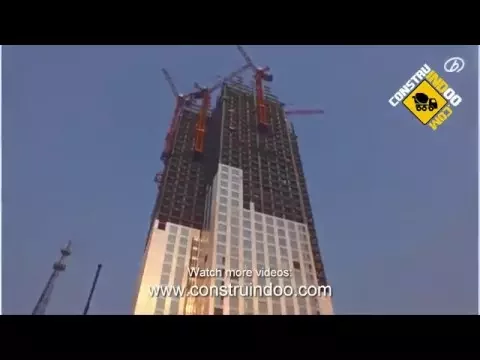

When all these pieces were ready, a team of 1,200 workers began assembly directly on-site, with the modules being stacked and connected as if they were huge Lego pieces, achieving an average of three floors constructed per day until the final 37 floors were completed in 19 days.
This method not only accelerated construction time but also functioned as a kind of “vertical factory”: with much of the technical work being done in a controlled environment before arriving at the site, assembly became a process of logistics and precise fitting of units that were already practically ready.
Mini Sky City: More Than Speed, A New Paradigm
What many people saw in the viral videos of 2015 was just the tip of the iceberg. The 208-meter-tall building in Changsha is an example of how engineering and mass production can be applied on a large scale to dense urban constructions.
In addition to 800 apartments and offices, the project incorporated 19 internal atriums, open spaces within the tower that function as “social channels” and common areas — a concept reminiscent of a vertical city within a single building.
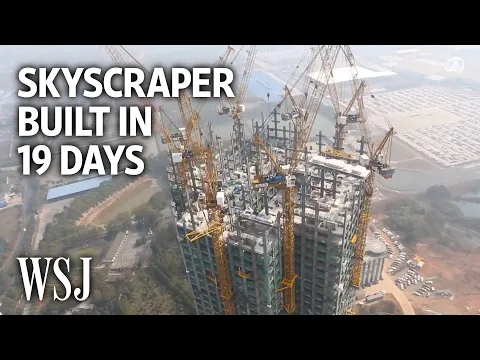
This modular process, in addition to being fast, also has environmental and energy efficiency impacts: according to the company itself, modular construction can significantly reduce material waste, decrease dust and debris generation on traditional sites, and allow for greater control over the quality of components produced in an industrial environment.
Another important point is structural safety. Despite initial doubts about such fast constructions — something that curious observers and critics sometimes mention on social media, the technique used by BSB, with a rigid steel structure and meticulously designed modules, results in a building capable of withstanding earthquakes and lateral loads typical of high-rise buildings, according to reports from the company and engineering related to the project.
The Human and Urban Reach of Accelerated Assembly
The manufacturing and modular assembly strategy used in Mini Sky City is not exclusive to China, but the achievement of completing the structure of a 57-story tower in 19 days established a new benchmark in the global debate about productivity and sustainability in construction.
To understand the magnitude, imagine the traditional steps of a high-rise building: deep foundations, concrete framing, sequential processes that involve weeks and months, coordination of dozens of teams, and lengthy curing periods for materials like concrete.
In the modular method applied by BSB, parallel events — factory manufacturing and foundation preparation simultaneously with module development — drastically reduce the overall timeline.

This combination of factory production + rapid assembly is analogous to assembly lines of the Industrial Revolution, but applied to complex urban infrastructures instead of consumer goods manufacturing.
For global architecture, this represents a possible alternative to the long conventional construction cycle, especially in rapidly growing urban environments where the demand for housing and commercial space grows faster than can be built by traditional methods.
Impacts on the Future of Architecture and Global Adoption Challenges
Although the technique has been successfully demonstrated in the case of Mini Sky City, its large-scale adoption faces some practical challenges.
The need for specialized manufacturing infrastructure, the logistics of transporting and assembling heavy modules, local building and safety standards, and the market perception of modular constructions still being uncommon are barriers that need to be considered.
Furthermore, many modern architects value customization, complex curves, and unique aesthetics, something that may be more difficult to achieve when construction follows a highly standardized modular system, as some specialists have already commented.
Even so, the achievement of 2015 remains a technological and architectural milestone. The ability to transform construction sites into vertical assembly lines, where hundreds of prefabricated units fit together precisely, has changed the global conversation about efficiency, sustainability, and scalability in tall buildings.
A New Model for Fast and Industrial Growth
The episode in Changsha with Mini Sky City serves as a turning point in the debate about urban construction.
By showing that it is possible to erect a tower of dozens of stories in less than a month using prefabricated modules that function as pieces of a massive structural puzzle, China signals a future in which buildings can be planned, manufactured, and assembled with speed, quality, and lower environmental impact.
This is not just a record for the books; it is a practical example of how 21st-century construction can combine industrialization, logistics, and innovative design to respond to the increasing demand for efficient, sustainable, and quickly implemented urban spaces.









Seja o primeiro a reagir!