





 Portuguese
  English
  Spanish
  6 min of reading
  4 comments


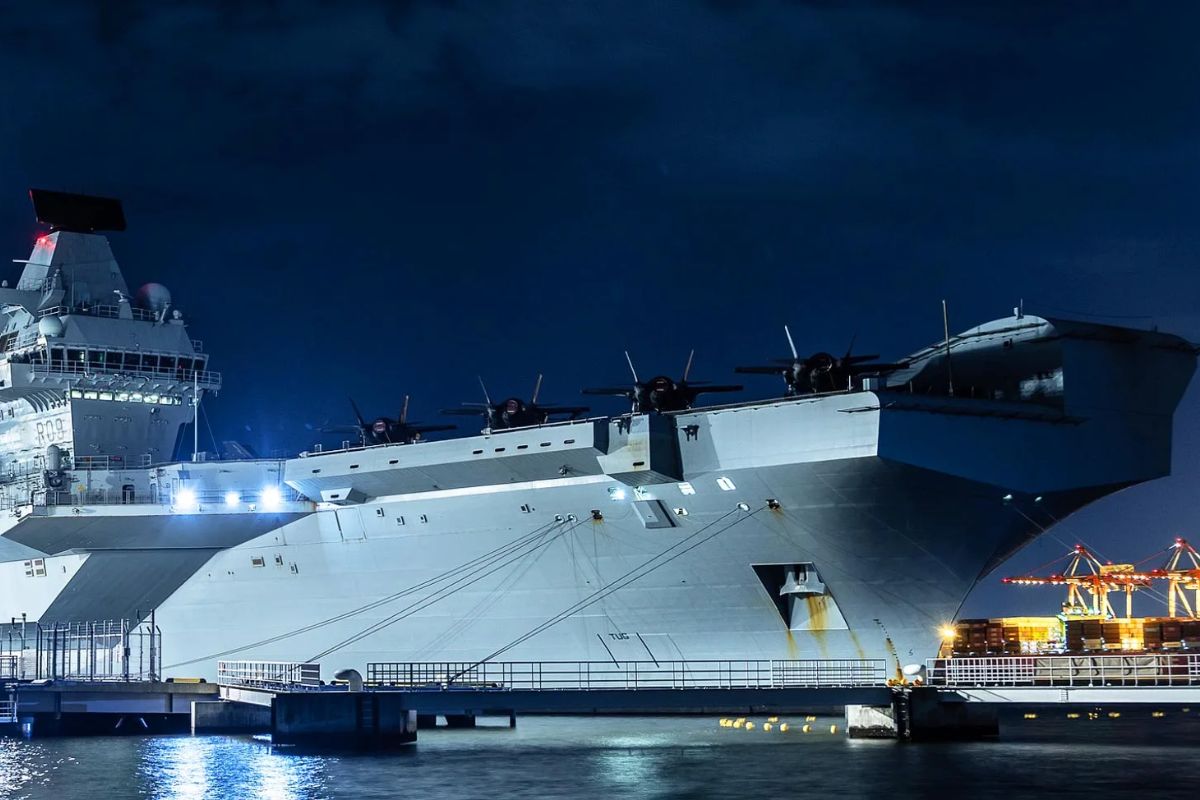


The HMS Prince of Wales, one of the two ships of the Queen Elizabeth class, combines a 280-meter flight deck, speeds over 25 knots, the capacity for up to 72 aircraft, and a range of 10,000 nautical miles, redefining the British operational weight in global and permanent ocean presence missions.
The HMS Prince of Wales occupies a central place in the United Kingdom‘s attempt to regain presence among navies operating large ocean projection ships. With a displacement of 65,000 tons, a length of 284 meters, and a range of 10,000 nautical miles, the ship stands as one of the cornerstones of the Queen Elizabeth class, the largest ever built for the Royal Navy.
More than a symbol, the HMS Prince of Wales embodies scale, air capability, and sea endurance in a single hull. This is what changes the strategic weight of the ship: it was designed not just to sail, but to command operations, sustain intense air tempo, and return to the United Kingdom a naval presence instrument that reposition it in the debate about large aircraft carriers.
The Largest Class Ever Built by the Royal Navy

The Queen Elizabeth class consists of two twin ships, HMS Queen Elizabeth and HMS Prince of Wales. Together, they represent the largest and most powerful ships ever produced for the Royal Navy, a leap in scale that goes beyond physical size.
-
In a flooded well, archaeologists found a 1,700-year-old Roman egg that still contains clear and yolk intact inside the very thin shell.

-
Something is happening around the Earth: Inside the huge explosion of fireballs in 2026

-
A hot air bubble coming from Argentina expands over Brazil, causing thermometers to exceed 38 degrees with a thermal sensation of 40 degrees in late March, affecting 6 states at once.

-
The radish leaf that almost everyone throws away has more polyphenols, flavonoids, and fiber than the consumed root, and a 2025 study showed that the leaf contains compounds that protect the intestine, combat inflammation, and may inhibit the growth of cancer cells.


The design repositions the United Kingdom in a range of naval capability reserved for countries that can maintain large aircraft carriers with expeditionary purpose and fleet command.
Each unit of the Queen Elizabeth class displaces 65,000 tons, reaches maximum speeds of over 25 knots, and operates with a range of 10,000 nautical miles. These numbers matter because they combine mass, autonomy, and mobility at an oceanic level.
This is not a ship for coastal presence or limited patrol, but a platform designed to stay away from base, lead groupings, and protect national interests in vast areas of the sea.
In the case of the HMS Prince of Wales, this weight is also in how the ship presents itself as a leader of a larger structure.
The very description by the Royal Navy treats the class as the center of gravity for its fleets. This means the ship does not operate in isolation. It functions as the core of operations around which other units, aircraft, and systems revolve.
For the United Kingdom, this return is relevant because it speaks to status, but primarily to capability. A large aircraft carrier does not just change the image of the fleet.
It alters the political and military reach of a country, the speed of response in crises, and the ability to project power without solely depending on fixed bases on land.
Deck, Aircraft, and Air Operation Tempo

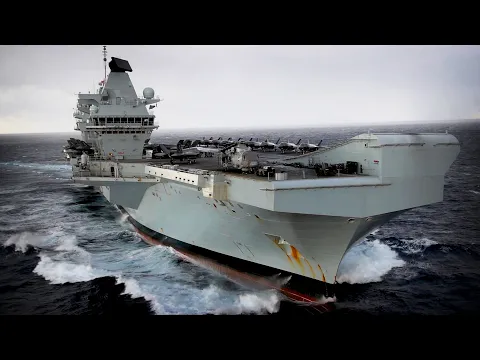
The HMS Prince of Wales measures 284 meters in length, but the flight deck of the Queen Elizabeth class extends 280 meters in length and 70 meters in width, approximately the size of three football fields.
This space allows for the operation of up to 72 aircraft, including a maximum of 36 F-35B fighters and any type of helicopter used by the United Kingdom armed forces.
This combination transforms the ship into a mobile airbase, and not just a large hull with a runway on top.
The operational logic of the deck is designed for speed. Each ship of the Queen Elizabeth class is capable of conducting 72 air combat missions per day, a number that can still be increased for limited periods.
This shows that the HMS Prince of Wales was not designed to exhibit stationary aircraft, but to maintain a launch cadence that sustains pressure and operational presence over long windows of time.
Two elevators can transport four F-35 fighters from the hangar to the deck in just 60 seconds. This speed is decisive because it reduces the interval between preparation and launch, shortening the transition between the interior of the ship and aerial operation.
In a large aircraft carrier, this mechanical detail turns into concrete military capability. When internal logistics accelerate, air power leaves the drawing board faster and gets into the air quicker.
Takeoff occurs from a six-meter-high ramp, the so-called “ski jump” at the end of the deck.
This technical choice distinguishes the Queen Elizabeth class and helps to understand how the HMS Prince of Wales is adjusted to the F-35B and the need to launch aircraft without relying on conventional catapults.
For the Royal Navy, this means operating its own model of airborne power generation, with a high tempo and specific structure.
Crew, Defense, and Sensors That Support the Ship

The HMS Prince of Wales can operate with a crew of 679 people, but has the capacity to accommodate up to 1,600 individuals, including a full air group, marines, and, if necessary, refugees. This data helps to understand the ship’s actual scale.
A large aircraft carrier is not just a fighter platform. It needs to be at the same time a runway, base, accommodation, coordination center, and response space for multiple scenarios.
This flexibility in accommodation enhances the utility of the ship within the structure of the United Kingdom. The HMS Prince of Wales can sustain traditional military operations but can also absorb additional contingents in special situations.
The greater the embarkation capacity, the greater the strategic flexibility, and this flexibility is one of the factors that explain why the Royal Navy treats the Queen Elizabeth class as the pinnacle of its naval architecture.
In close defense, the ships of the Queen Elizabeth class use three Phalanx CIWS turrets to deal with maritime and aerial threats.
The system combines a radar-guided 20 mm Vulcan cannon mounted on a rotating base, with a firing rate of 3,000 or 4,500 rounds per minute.
The reported range is up to one mile. This does not turn the ship into a bulletproof unit against everything, but offers a layer of quick reaction for the most critical scenario, the one where the threat has already come close.
In the field of detection, the Crowsnest radar installed on the Merlin MK2 helicopters provides long-range aerial, maritime, and ground surveillance for the fleet.
The large dome under the helicopter fuselage is part of this early warning system.
For the HMS Prince of Wales, this is vital because an aircraft carrier is worth as much for what it launches as for what it can see ahead. Without early detection, the deck impresses; with early detection, it operates with more security and greater strategic depth.
What the HMS Prince of Wales Changes for the United Kingdom at Sea
The return of the United Kingdom to the group of navies with large aircraft carriers does not depend solely on the size of the hull.
It depends on the combination of autonomy, air tempo, command capability, close defense, and integration with sensors.
The HMS Prince of Wales brings together exactly this package. Therefore, its weight goes beyond the public image of a monumental ship.
It represents a tool of persistent presence, something that the Royal Navy can project into areas of interest without losing operational scale.
The Queen Elizabeth class also helps to reorganize how the United Kingdom appears on the maritime board.
A ship with a range of 10,000 nautical miles is important not only because it can go far but because it carries with it air power, command, and deterrence.
Instead of relying solely on fixed installations, the country begins to carry part of that capacity with it.
This is what repositions the British fleet in the game of large ocean-going ships.
The HMS Prince of Wales also concentrates an internal symbolic effect. By leading the largest class of ships ever built for the Royal Navy, it reinforces the idea of continuity of naval ambition in an island power historically defined by the sea.
This symbolism, however, only has value because it is backed by objective numbers: 65,000 tons, 284 meters, up to 72 aircraft, 72 air missions per day, expandable crew, and multi-layered onboard defense.








E toda essa “potência” vulnerável a três ou quatro mísseis hipersônicos 🙄
Bem isso.
Um único cruzador Russo, da classe Slava, com 16 mísseis P-1000 Vulkan, já dá cabo desse monte de ferro, lerdo e vulnerável.
Rússia e uma piada senhores
Dois navios da classe HMS Queen Elizabeth são o suficiente?
Quantos F-35B foram adquiridos pela Marinha do Reino Unido?