





 Portuguese
  English
  Spanish
 4 min of reading
  0 comments


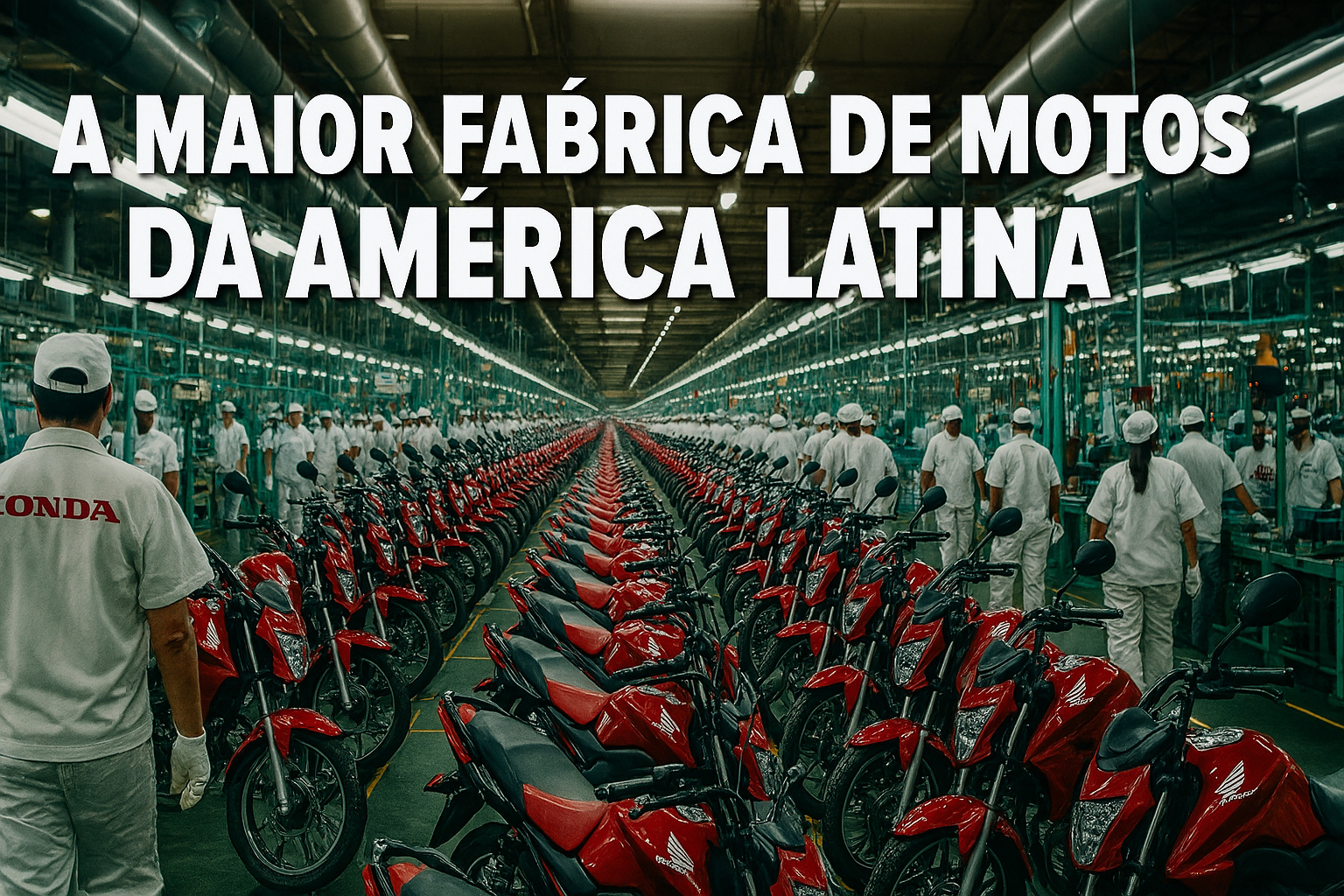
With 800 Thousand M² and 1.6 Million Motorcycles Per Year, the Largest Factory in Latin America Transforms Manaus into a Global Power of Honda and a Symbol of the Brazilian Industry.
In the industrial heart of Manaus, one of the largest motorcycle production complexes on the planet stands tall. This is Moto Honda da Amazônia, considered the largest motorcycle factory in Latin America and one of the largest in the world by production volume. With 800 thousand square meters of total area and an installed capacity of 1.6 million units per year, the complex is a true industrial city with internal streets, its own transportation, cafeterias, a medical center, laboratories, and thousands of employees who keep the operation active 24 hours a day.
Since its foundation in 1976, the plant has symbolized the success of the Free Trade Zone of Manaus, created to boost the economic development of the Northern region and attract major global industries. The project was so successful that, decades later, Honda transformed Manaus into the epicenter of motorcycle production in Latin America, exporting to dozens of countries and supplying nearly the entire Brazilian market.
A Giant on Two Wheels
Moto Honda da Amazônia is more than just a factory: it is a complete ecosystem of engineering, technology, and logistics.
-
Historic bankruptcy of Centauro shocks the market, and the century-old company puts more than 500,000 products, machines, and complete infrastructure up for online auction.

-
New shoe factory in Ceará is expected to create 400 jobs and strengthen the local economy.

-
No one imagined it, but a mixture of sawdust with a mineral that fights fires surprises scientists with a result that changes the course of fire-resistant construction.

-
From empty land to a high-end house, wooden construction uses a lightweight system, metal structure for the foundation, ventilated ceramic cladding, and special windows to create an efficient and comfortable living space throughout the year.



Within its gates, the production process is divided into stages that include stamping, welding, painting, assembly, performance testing, and quality control, with a fully automated and digitally integrated line.
The pace is intense with about 1.6 million motorcycles coming off the assembly line each year, meaning over 4,000 units produced per business day. Iconic models such as CG 160, Bros, Biz, Pop 110i, and CB 300F Twister are manufactured there, catering to both urban audiences and the off-road segment.
Honda also invests heavily in automation and sustainability. Part of the energy consumed comes from renewable sources, and the company maintains water reuse programs, waste recycling, and strict emission controls. The complex also has R&D laboratories that develop national components and enhance more efficient engine technologies.
An Industrial City That Never Sleeps
With staggered shifts and teams working continuously, Moto Honda’s operation never stops. The cafeterias function as complete food courts, there is exclusive public transport for employees, internal medical services, and even leisure spaces.
It is estimated that over 6,000 workers operate directly within the plant, not counting the indirect jobs generated by suppliers, freight companies, and logistics businesses in the region. According to data from the automaker itself, each direct job within the complex creates five indirect jobs in its supply chain.

This productive force has made the Manaus hub responsible for over 80% of the motorcycles manufactured in Brazil, consolidating the country as the largest motorcycle market in Latin America.
The Economic Impact of Manaus
Honda’s presence in Manaus has completely changed the economic profile of the Amazon capital. Previously dependent on trade and river navigation, the city now houses one of the largest industrial concentrations in the country, with a focus on the two-wheel sector.
The industrial GDP of Manaus has grown steadily over the past decades, driven by the performance of Moto Honda. It is estimated that the motorcycle sector generates billion of reais per year, not only in production but in exports, logistics, dealerships, and associated services.
Moreover, the industrial hub has brought infrastructure, urbanization, and training opportunities for thousands of people, consolidating one of the most emblematic success stories in the national industry.
Technology and Constant Innovation
The factory in Manaus is also a living laboratory of innovation. In recent years, Honda has begun investing in the electrification of motorcycles, with projects for electric and hybrid motorcycles being tested within the complex.
The digitalization of production is also a reality. The smart assembly system allows robots and sensors to work together, monitoring torque, temperature, and execution time for each process.
This data is sent in real-time to the control center, ensuring efficiency and quality in every motorcycle produced.
A Power That Moves Brazil
Moto Honda da Amazônia is not just the largest motorcycle factory in Latin America — it is a symbol of Brazil’s productive capacity. Every minute, new units roll off the assembly lines, ready to travel the roads and cities across the country.
The combination of Japanese technology, Brazilian engineering, and local labor has transformed Manaus into a model of industrial efficiency. Even in the face of economic and logistical challenges, the complex continues to grow, innovate, and export quality to the world.
Today, looking at the horizon of Manaus, one can see the reflection of an industry that never stops — an engine that drives the economy, creates jobs, and positions Brazil prominently in the global two-wheeler mobility landscape.






-

Uma pessoa reagiu a isso.