





 Portuguese
  English
  Spanish
  6 min of reading
  74 comments


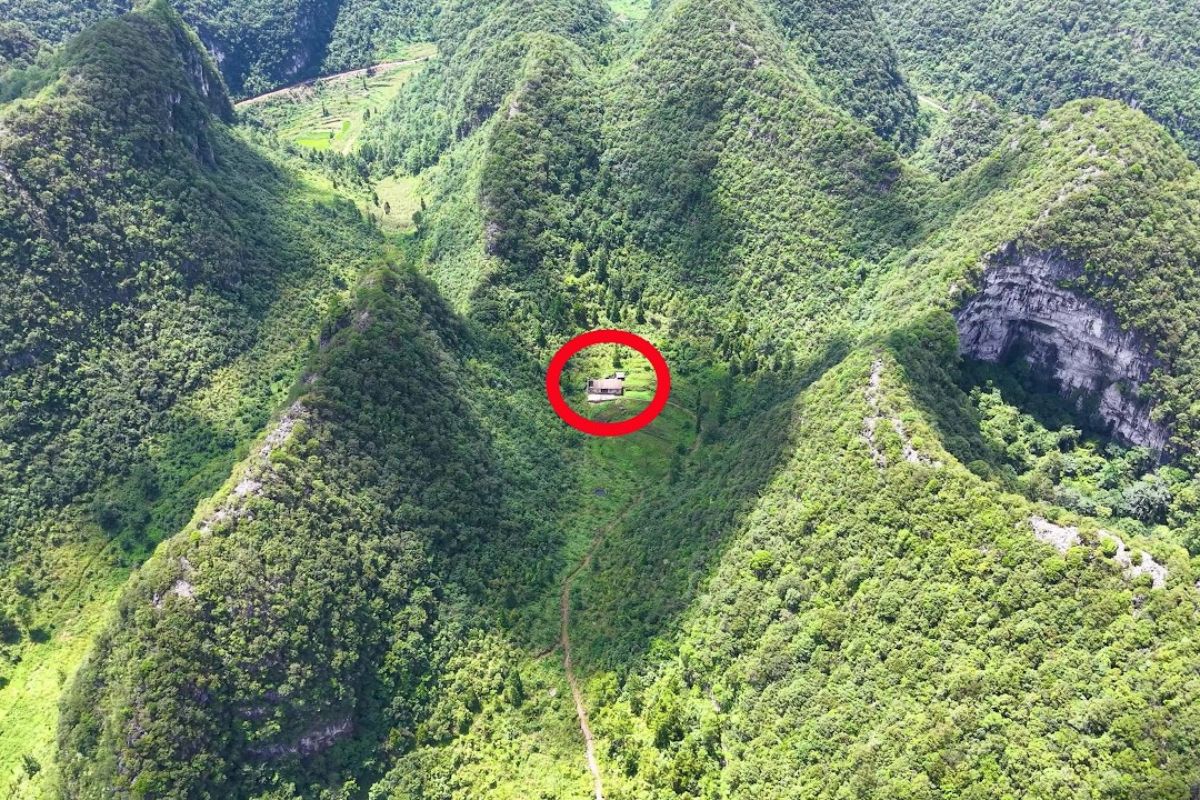


At 83 Years Old, The Elderly Woman Living In An Isolated Valley Surrounded By Mountains In Guizhou, China, Resists Change Incentives, Walks For Hours To The Market, Collects Water From Distant Sources And Keeps The House Running Alongside Her Youngest Son, Refusing To Abandon The Countryside As A Form Of Resistance
The life of this isolated elderly woman begins long before aerial images reveal the hidden valley among the Chinese mountains of Guizhou. In a region where access is only possible on foot, along a trail overgrown with weeds, she remains the last link of a community that has practically disappeared from the map.
Among steep slopes, abandoned fields, and a narrow path that cars cannot reach, this silent routine has been repeating itself for over half a century. While most have surrendered to urban life and the houses offered by the government in nearby cities, she chose to return to the valley and continue taking care of her own land, even at an advanced age and with family living in the urban area.
The Valley Where Only One Family Remains

The surrounding scenery of the elderly woman’s house blends beauty with extreme isolation.
-
Material present in millions of kitchens raises global alarm after causing severe lung disease and leading to multimillion-dollar lawsuits in the United States.
-
A person became a millionaire with just a 10-hour video of a lit fireplace on YouTube.

-
The Finnish armored vehicle Patria AMV 8×8 with eight wheels stands out with mine protection, advanced armor, modular design, and high mobility in military operations that redefine modern combat.

-
Workers manually excavate 6 million kilograms of ice to open a cave that allows observation of how a glacier is melting from the inside.

The valley is surrounded by tall mountains, the air is fresh, the clouds seem within reach, and the path to the house is narrow, covered with vegetation, like a green carpet that signals little use.
Before, other families used to cultivate the nearby fields, sharing the same rural space with different surnames. Today, only the surname Dai remains in that valley bottom, after neighbors moved to Huishui County and other areas.
What was once a collection of rural houses has turned into practically a single family unit, surrounded by stone walls, old wooden structures, and reduced crops.
The main house combines traditional techniques with improvisation. Parts of the construction are almost 50 years old.
The original wooden structure has been reinforced, and stone walls have been built to withstand the wear of time.
Displaced tiles, gradually repaired areas, and simple additions reveal maintenance carried out with local resources, extracted from the mountains and the immediate surroundings.
Why Refuse The City And Stay In The Mountains

When public policies encouraged remote residents to accept housing in urban areas, the elderly woman living in isolation did move to Huishui County with her family.
The government offered housing in the city, more access to services, and proximity to hospitals, in line with the strategy of relocating residents from regions deemed difficult and expensive to service.
But the choice did not solidify.
The children argued they did not want to live permanently in the city, and the family decided to return to their old house in the valley, repurposing the rural structure as the basis of their daily life.
The residence in the countryside was not demolished, allowing for the return.
Today, the elderly woman’s children live in other locations: one is associated with the city of Diji, with grandchildren already in their 20s, while the youngest son stays with her in the valley, sharing daily work and providing companionship.
This combination of family ties spread between countryside and city reinforces the mother’s choice to keep her base in the place she has lived for over 50 years.
Routine, Transportation, And Access To Basic Services

Despite her age, the elderly woman living in isolation still essentially relies on her own effort and long walks to access basic services.
To reach the nearest market, she and her son walk a route that takes over an hour just one way, following steep and slippery trails on rainy days.
Water does not come from a stream next to the house but from a simple collection system. The family uses pipes connected to a distant source, replacing the old habit of fetching water directly from the well located behind one of the mountains. This solution reduces trips but relies on constant maintenance in an irregular terrain subject to weather conditions.
For food, the family alternates between their own cultivation and external purchases.
In recent years, the elderly woman has planted corn in sufficient quantity to harvest several thousand kilograms, selling the surplus and keeping some for consumption.
In another season, she preferred to reduce cultivation and buy rice and vegetables on the street, adjusting the physical effort to her own age.
Reduced Agriculture And Possible Autonomy

The fields around the house show the contrast between past and present.
The elderly woman remembers a time when the land was cultivated more intensively, with annual harvests of dozens of bags of grains.
Today, the planted area is much smaller.
She selects specific sections for corn, sorghum, wheat, pumpkins, and some products that can be sold or consumed with little labor demand.
In the yard, dried corn, peas, shallots, and peppers are spread over improvised structures, outdoors, indicating a traditional storage pattern dependent on sun and climate.
Even with lower production, the model still ensures some level of food autonomy and supplemental income in certain harvests.
The livestock, which once occupied a significant area of the valley, is now mainly maintained by neighboring outsiders.
To protect the few remaining crops, the family has built wooden fences at the entrance of the area, preventing cows and sheep from invading the yard and destroying the crops.
The option of raising their own animals is dismissed by the elderly woman, who considers the herding work on the slopes and daily management too burdensome.
Life Away From Extreme Cold, Air Conditioning, And Hurry

The climate in the valley is another factor reinforcing the elderly woman’s permanence.
According to her, the cold there is never as severe as in other parts of the region, requiring no sophisticated heating or devices like air conditioning.
At night, the environment is described as cool but bearable, making the daily routine less costly in terms of energy and household equipment.
In practice, the routine resembles a kind of active retirement in the countryside.
With no major planting, no livestock, and occasional trips to the market, the family organizes their life around the house, maintaining the yard, preparing food, and handling small daily tasks.
The absence of traffic, urban noise, and close neighbors creates an atmosphere of almost total isolation, broken only by trips to the city and occasional visits from relatives.
Solitude, Choice, And Sense Of Belonging
Even though she lives in a place where no other family has remained, the elderly woman living in isolation does not describe her life in terms of abandonment but rather continuity.
The valley where almost everyone has gone continues to be her reference of home, family history, and identity.
The presence of her youngest son helps to dilute the solitude, providing companionship, physical assistance in heavier tasks, and daily conversation.
From a social perspective, the trajectory of this family shows how resettlement policies do not always manage to break the deep bond between rural residents and their land, especially when the original house remains standing and the cost of living in the city is perceived as high.
Between the closer health posts and the autonomy of cultivating their own corn, the choice was to stay in the valley.
Even at 83 years old, walking over an hour to the market, relying on pipes to bring water from the mountain, and adapting agricultural production to the limits of physical strength has become an acceptable routine.
For someone who grew up and aged in that setting, the combination of silence, mountains, and memory weighs more than the promise of urban convenience.
In your place, would you exchange this life in a remote valley for a house in the city, or would you also choose to stay where you have spent practically your entire life?








Com certeza ficaria no vale, longe da cidade.
Os sábios sempre quizeram viver assim com a mãe natureza ..
Eu tbm gostaria de viver assim. Sò eu e meu marido. Hoje , è muito dificil conviver na sociedade.