





 Portuguese
  English
  Spanish
  7 min of reading
  7 comments


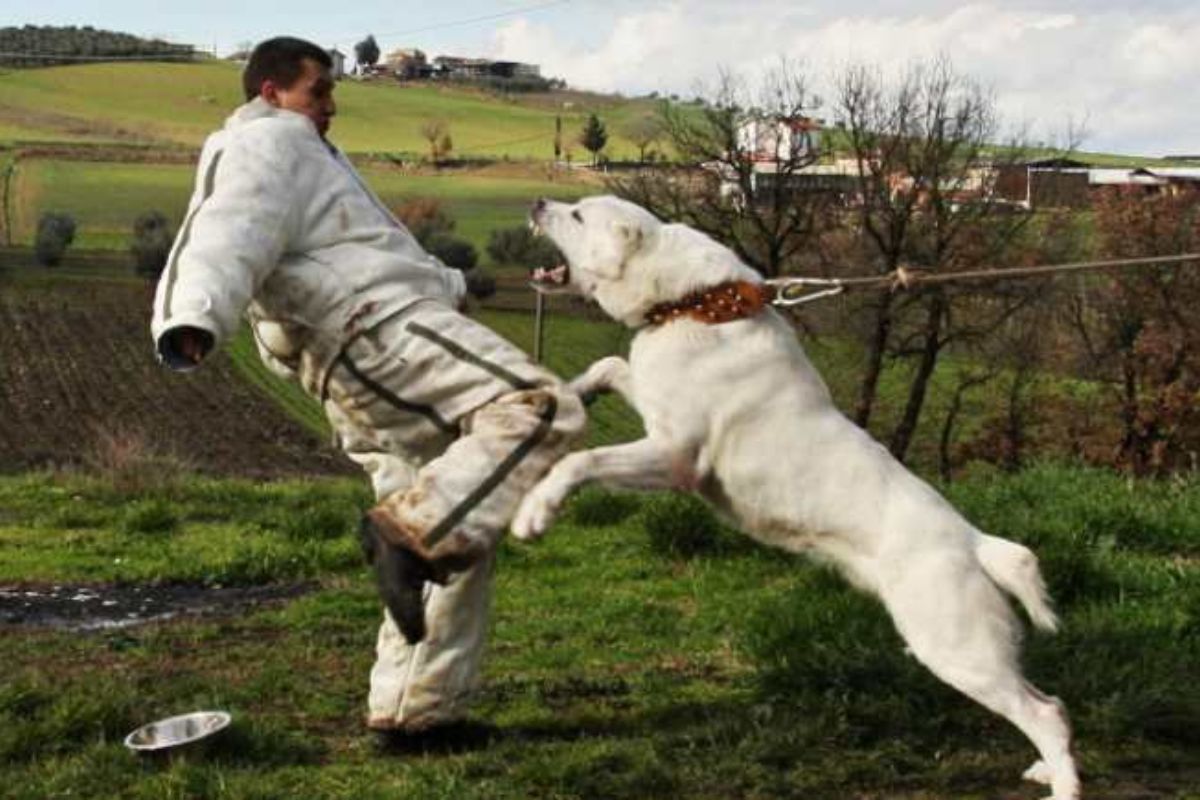


Created by the Red Army to Patrol Borders and Protect Livestock in Extreme Territories, the Alabai Arrives in Brazil as an Elite Guard Dog, Capable of Facing Predators but Requires an Experienced Handler, Adequate Structure, Responsible Management, and Zero Room for Socialization Errors in Urban Environments Full of Surprises
The Alabai, also known as the Central Asian Shepherd, is one of the most extreme symbols of what a guard dog can be. With individuals weighing around 90 kg, a reputation as a “wolf killer,” and a history connected to the Red Army, the breed mixes myth, physical power, and a level of responsibility that few handlers can actually assume.
In specialized kennels in Brazil, the contrast is clear: on one side, viral videos showing Alabai facing wolves and even bears in rural areas; on the other, breeders and trainers repeating the same warning, almost like a public safety mantra. The Alabai is not a dog for the curious, trends, or insecure handlers. It is a dog shaped for quick decisions, vast territories, and real conflicts, not for selfies in the condo.
Origin: From the Red Army to Brazilian Kennels

The modern Alabai, presented in Brazilian kennels, comes from the line recognized as the Central Asian Shepherd.
-
China is building a city in Brazil: a complex with an investment of R$ 5.5 billion comes to light, but allegations involving workers draw attention.

-
While Argentina buys old war equipment, Brazil is keeping an eye open and joins the select group of nations with advanced military technology by investing $5.2 billion, producing 36 Gripen fighters in the country, and reducing operational costs.
-
Brazil on alert? Why invading Brazil is a NIGHTMARE for the USA: 8.5 million km², 213 million inhabitants, Amazon covering 60% of the territory, trillion-dollar war, and resistance that even 13,000 aircraft could not control.

-
How to build a floating island from scratch with reeds, giant blocks, and stakes in the lake in a process that needs to be repeated almost every day.


Bred from working dogs in the region and subjected to genetic selection conducted by the Red Army, the goal was straightforward: a dog capable of protecting herds, combating wolves, and, if necessary, facing bears in inhospitable areas.
In the field, this function translates into long patrols, entire nights in open terrain, constant threat assessment, and proportional reaction.
Instead of urban dogs that bark behind gates, the Alabai was designed to hold a large predator, withstand extreme weather, and keep livestock alive.
When this genetics arrives at a Brazilian kennel, under a strong sun and reinforced pens, it appears in very concrete details: males over 100 kg, females above 85 kg, and a structure aimed at containment, technical management, and distancing from curious onlookers.
There is no glamour in this backstage; there is protocol.
Extreme Physique: Between 85 kg and Over 100 kg at Full Activity
At the core of the breed is the size: females like Romena and Lisa, cited as some of the largest in the world, exceed 85 kg, with cases managing to go beyond 90 kg. In males like Rock, a male from Romania, the breeder talks about weight possibly exceeding 100 kg without losing mobility.
This size is not “show exaggeration.” It is part of the function. A dog that needs to hold a wolf or react in front of a bear cannot be fragile. But there is an important technical cost: rapid growth, joints still forming, and the need for heavy supplementation between 8 and 9 months, when some already reach 70 or 80 kg with a puppy skeleton.
For this reason, serious breeders insist on a minimum tripod for any Alabai puppy:
correct and size-adjusted feed
specific supplementation for joints
impact and effort control during the growth phase
Without this, what was meant to be a functional dog becomes a giant in pain, with movement compensations and compromised behavior.
Temperament: Pack Dog, Social and Brutally Territorial


The contrast that stands out the most in the field is psychological.
The Alabai is, at the same time, very social with its group and extremely reactive to strangers.
In the kennel, females like Romena and Lisa appear in an almost disconcerting way: playful, gentle with children, seeking affection when the handler is present.
The report is straightforward: with the handler present, the visitor enters, receives licks, and sees a dog that seems “gentle.”
But just changing the context causes the reality to hit.
A mason who enters on his own, without warning: bitten hand.
A person who suddenly runs up from behind on a walk: startled attack.
A stranger who approaches the territory at night: a much stronger reaction than during the day.
The Alabai reads intention, assesses distance, observes posture. It is a pack dog that seeks companionship from its human group, but does not tolerate invasion or pressure from strangers. Practically, this means:
not a dog for an open gate
not a dog for a house without access control
not a dog for “neighbors coming in and out”
Breeders also reinforce the characteristic of possessiveness: the Alabai is extremely jealous of food and resources.
The operational rule is clear: separate feeding, supervision, and no improvisation like “let them sort it out.”
“Wolf Killer”: What This Fame Really Means
The label “wolf killer” is not just social media marketing. It arises from the historical use of the breed as a herd protection dog, the so-called LGDs (Livestock Guardian Dogs).
In these situations, the Alabai is trained not to back down in front of predators like wolves and, in extreme cases, even bears.
Experienced trainers describe an important technical difference compared to “grip” breeds like Argentine Dogo or Presa Canario:
the Dogo enters, bites, and maintains the bite, shaking like a catch dog
the Alabai tends to deliver successive bites, let go, and bite again, frightening and neutralizing the threat more through pressure and repetition than through continuous immobilization.
Trying to force the Alabai to work as a grip dog, “nipping” bites to turn it into something it is not, can disorganize the psychology of the animal and produce an unbalanced, unpredictable, and dangerous dog.
In summary: the fame of being a wolf killer is real within its original function. Outside of it, especially in an urban context, this same courage becomes a risk if there is no structure, scenario assessment, and technical command.
Life in the Kennel: Rock, Thanos, Romena, and the Fine Line of Control
Behind the scenes, the routine of a specialized kennel shows why the Alabai is not an “Instagram dog.”
Rock, a Romanian male over 2 meters tall when standing, is described as having “a very strong temperament, quite aggressive,” with a late guard opening, close to 2 years old.
Employees need days of approach, staggered entry into the pen, and constant body language reading.
Thanos, raised indoors since a puppy, is the counterpoint.
He is the dog that the handler claims to trust with his own life, enters the pen, guides, and demonstrates fine control.
The difference is not just genetic; it is contextual:
- adult dog bought, with no clear history, requires maximum protocol
- dog raised from a puppy, with planned socialization, allows for a greater degree of trust
Females like Algodão and the young white offspring of Cronos and Tuia show another side of the breed: high degree of socialization possible when there is proper management, coexisting with people, other dogs, and kennel routines without collapsing into unnecessary reactivity.
But even in these cases, the guidance is always the same: remember that this is a dog capable of facing large predators and that it was not designed to live in urban improvisation without rules, without a secure fence, and without clear leadership.
For Whom the Alabai Is NOT: The Trainers’ Warning
Trainers and breeders repeat without mincing words: “if you do not know what a dog is, do not buy an Alabai”.
In practice, this means:
not a breed for first-time dog owners
not a breed for those who confuse dogs with children
not a breed for apartments with continuous circulation of strangers
not a breed for those who do not accept rules, routine, and limits
The recommendation is almost a safety protocol: before thinking about an Alabai, interested parties should live with more “forgiving” breeds for human errors, such as Labradors and companion dogs, learn the basics of body language reading, hierarchy, resource management, and introduction of new animals.
Only after understanding that a dog is not a person, not a toy, and not a status symbol, would it make sense to consider an Alabai.
And even then, only with professional support, adequate physical structure, and full awareness that any handling failure, at this size, has real consequences.
Between Trends, Viral Videos, and Responsibility
The increased exposure of the Alabai in internet videos, running with heavy chains, reacting to figures, and showcasing brute strength, has brought with it a wave of curiosity.
Kennel profiles flooded with messages from interested parties after the dissemination of content about “wolf killers” and the “largest guard dog in the world.”
This interest, in itself, is not necessarily bad. It can help preserve the breed, professionalize breeders, and educate the public about what it actually means to live with a dog of this level.
The problem begins when the fascination for the extreme outweighs responsibility.
Between a gentle female like Romena, who gets along well with children and accompanied visitors, and a male like Rock, who does not accept strangers without careful construction, there is a fine line of technique, reading, and experience.
It is on this line that the future of the Alabai in Brazil will be defined: as a symbol of conscious work and guarding or as just another statistic of preventable accidents.
In the end, the Alabai continues to be exactly what it was created for: an extreme guard dog, a pack dog, social with its own and relentless with real threats.
The rest depends less on genetics and more on who holds the leash.
Do you honestly see yourself as a prepared handler to face the responsibility of living with an Alabai, or do you think that this level of guard dog should be restricted to very specific profiles?








Mais um **** irracional que será usado por um **** que se diz racional de forma irresponsável como fazem com o pitbull. A culpa nunca é do cão mas do tutor que se acha o máximo conduzindo um cão de quem não exerce nenhum controle.
Já estou vizualizando os donos andando com estes cães pelas ruas sem coleira e sem mordaça, dizendo que é manso, igual aos tutores de pitbull, vira e mexe matam um cãozinho ou atacam uma criança, esquecem que o cão tem instinto e o comportamento está ligado à genética do ****, e não necessariamente à criação.
Não deveria liberar a entrada no Brasil, país onde tem mais tutor ignorante e sem noção por metro quadrado do mundo, evidências não faltam, nos parques o poodle manda no tutor e anda puxando a guia. Mesmo sendo fã da raça rottweiler e tive 3 exemplares em 20 anos, gostei das informações sobre o Alabai.