





 Português
  Inglês
  Espanhol
  6 min de leitura
  6 comentários


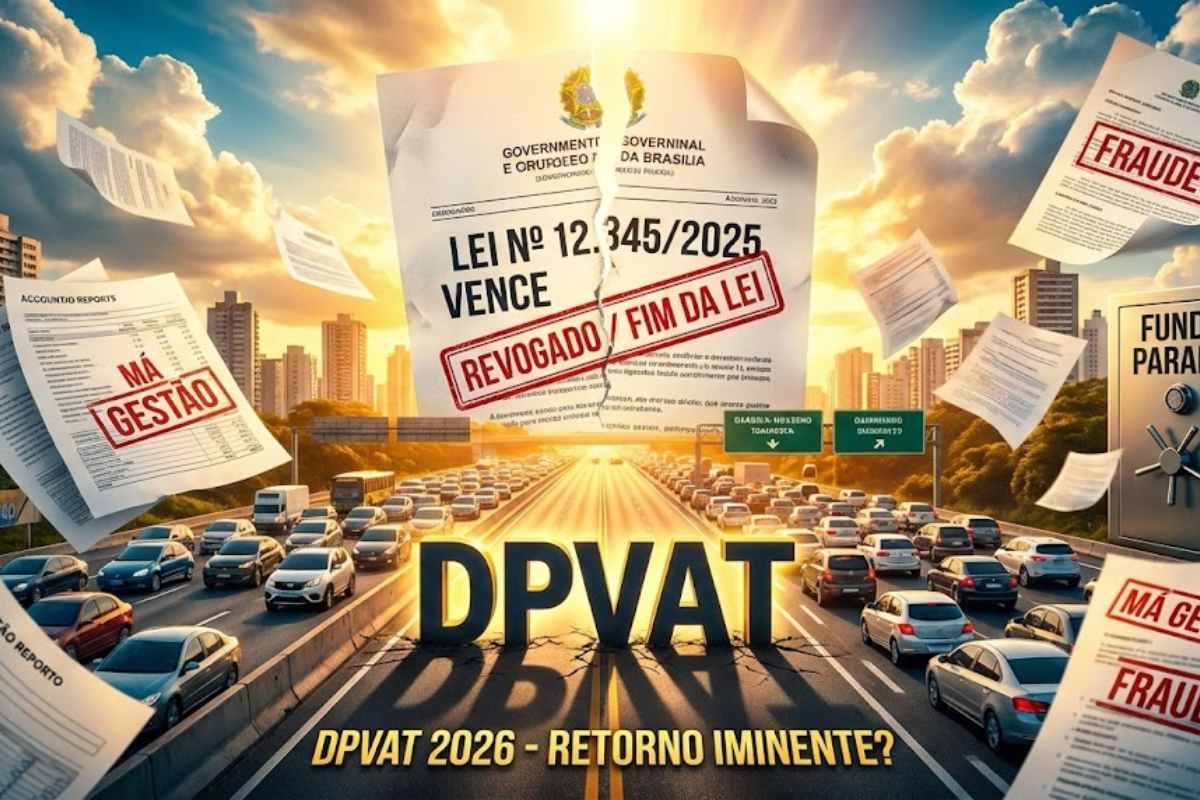


With the Law Freezing Extra Charges in Traffic Valid Only Until 2025, Drivers Fear the Return of Mandatory Insurance DPVAT in 2026, After Frauds, Mismanagement, Repeal of SPVAT, and a Fund Completely Stopped and Not Compensating Victims in the Country and Without Political Clarity, Defined Budget, or Schedule.
The law that froze the collection of additional charges related to traffic expires in 2025 and opened a flank of uncertainty that frightens drivers throughout Brazil. While the old mandatory insurance DPVAT continues without active collection and the SPVAT was revoked before being implemented, the discussion about what will take its place has been loose in Congress and the Executive.
Meanwhile, the history of frauds, mismanagement, and a fund that is now completely halted reinforces the feeling that if nothing is redesigned, 2026 could mark either the hasty return of DPVAT or some new format of mandatory insurance for traffic accidents created in haste by another law, bringing more confusion than solutions for those who depend on public compensation.
How DPVAT Worked Before the Suspension and What the Role of the Law Was
For decades, DPVAT was the typical mandatory insurance that everyone paid and almost no one fully understood, yet it made a difference in times of need.
-
The Senate approves a bill that criminalizes misogyny, hatred, or aversion towards women, and includes the crime in the Racism Law with a penalty of up to 5 years.

-
Chamber Approves Bill That Allows Pepper Spray for Women Over 16 and Imposes Strict Rules for Purchase, Possession, and Use as Self-Defense

-
Chamber Approves Law to Combat Leucaena, Fast-Growing Plant That Dominates Land and Threatens Native Species in Various Regions of the Country

-
Asset Division: Know What Cannot Be Divided in Case of Divorce


Created in 1974, it compensated victims of traffic accidents for death, permanent disability, and reimbursed medical expenses, without requiring blame definition.
In practice, it was enough to prove that a traffic accident had occurred to be entitled to predefined amounts by law, which was crucial for families without health plans or income to cover hospital expenses.
Even those without private insurance received minimal protection, precisely because DPVAT was a mandatory insurance for the entire fleet.
Furthermore, the law that structured DPVAT allocated part of the revenue to the SUS and to traffic education actions.
In other words, even those who never activated DPVAT benefited indirectly, through the public health system and prevention campaigns.
It was a public policy arrangement that mixed individual compensation with collective financing.
Frauds, Mismanagement, and the Political Decision That Paralyzed Mandatory Insurance
The collapse began when DPVAT came under scrutiny for frauds, mismanagement, and irregular transfers.
The combination of administrative problems and suspicions about the use of funds undermined confidence in the governance of the fund and opened space for a political shift.
Under Jair Bolsonaro’s government, the law was amended to suspend the annual collection starting in 2020, under the pretext of combating distortions and easing the burden on drivers.
However, what did not stop immediately were the compensations, because there was still an accumulated balance in the fund of the old mandatory insurance.
For a period, the system continued paying without collecting, like a reservoir that keeps supplying the network even without replenishment.
Over time, however, the balance ran out, and DPVAT simply ceased to operate.
Without a new law structuring a sustainable model, the result was direct: recent victims of traffic accidents were left without any public compensation alternative, relying solely on private insurance or legal action.
What was once an automatic right tied to mandatory insurance disappeared, leaving a legal and social void.
SPVAT: The Law That Tried to Recreate Mandatory Insurance and Died Before It Started
In the face of the void left by DPVAT, Congress approved a new law in 2023 creating the SPVAT, the so-called Mandatory Insurance for Traffic Accident Victims.
The idea was to reformat the structure of the old mandatory insurance, with more control, adjusted rules, and a new revenue model that would allow for the resumption of compensations starting in 2025.
On paper, SPVAT would be the direct successor to DPVAT, maintaining the logic of support for traffic victims, preserving the allocation of part of the resources to the SUS, and attempting to correct the distortions that had marked the final phase of the previous insurance.
Drivers spent 2023 and early 2024 hearing that SPVAT would be the “organized return” of mandatory insurance.
In practice, however, the story stalled. By the end of 2024, the very law that would allow the resumption of SPVAT was repealed.
Fiscal pressures, disputes among powers, and lack of consensus on how collection would be conducted, who would manage the fund, and what the total cost linked to traffic would be came into play.
With the repeal, what was already planned for 2025 simply vanished.
Result:
SPVAT did not go into effect,
the fund remained completely halted,
there is no regular collection,
and the country returned to square one in the discussion about mandatory insurance for traffic accidents.
The Law That Expires in 2025 and the Fear of What May Come in 2026
It is in this context that the law that seized extra charges in traffic expires in 2025.
It has thus far prevented drivers from receiving a new bill related to the old DPVAT or any other format of mandatory insurance while there is no more solid arrangement.
It served as a temporary brake amid regulatory chaos.
With the approaching end of this law, the fear of a “last-minute solution” for 2026 grows.
Without an in-depth debate about the format of mandatory insurance, the governance of the fund, the role of the SUS, and the participation of traffic victims in building a new design, the risk is to swap a mismanagement problem for a legislative improvisation problem.
Today, there is no concrete and detailed proposal approved for 2026.
The legal basis itself is fragmented: DPVAT is no longer collected, SPVAT was revoked before it started, and the fund that should support the victims remains completely halted, despite the historical social relevance that mandatory insurance once had in the country.
Who Loses with the Fund Halted and No Mandatory Insurance Functioning
In the short term, those who lose are the real victims of traffic accidents.
Without DPVAT and SPVAT, there is no standardized public compensation mechanism, as existed under the full validity of the old mandatory insurance law.
Low-income families, without private coverage, are particularly exposed.
The public health system also suffers.
The SUS stops receiving that dedicated share of the old DPVAT, as provided by law, which helped finance care related to traffic accidents.
In practice, the cost remains, but without a specific source tied to mandatory insurance.
There is also the impact on traffic education policies.
Without a permanent flow of resources, prevention campaigns and programs lose their financing base, especially in a country that still reports high accident numbers.
The halted fund means less money for compensation, less money for treatment, and less money for prevention.
What Drivers Can Monitor While the Law Doesn’t Change
Until a new law is approved, the situation remains marked by three main factors:
First, there is no active collection of DPVAT, nor is SPVAT functioning, which keeps the mandatory insurance fund without regular collection.
Second, any resumption or creation of a new model for 2026 depends on progress in Congress, negotiation with the Executive, and clear definition on who manages and oversees the resources linked to traffic. Without this, the risk of repeating mismanagement errors and frauds remains.
Third, the discussion involves public money, social impact, and fiscal justice.
Changing the law of a mandatory insurance that affects the entire fleet is not a technical detail; it is a political choice with a direct effect on the bill for all drivers and on the protection of traffic victims.
Conclusion: Between the Fear of Charges and the Void of Protection
The combination of law expiring in 2025, DPVAT suspended, SPVAT revoked, and a completely halted fund puts Brazilian drivers in an uncomfortable crossroads.
On one side, the legitimate fear of seeing a charge for mandatory insurance resurface in 2026 without management clarity.
On the other, the current void, where traffic victims are left without the support that DPVAT once guaranteed.
The debate that should be at the center is less about “paying or not paying” and more about how to design a transparent, sustainable, and supervised law capable of ensuring compensation, strengthening the SUS, and financing prevention, without opening gaps for new scandals.
Until then, the feeling is that the country is parked on the shoulder while the number of accidents continues to grow.
Given this scenario, do you think Brazil needs a new mandatory insurance by law, even with the risk of higher charges in traffic, or would you prefer to keep everything halted as it is today?









O Brasil está na contra mão de todos os países da América do Sul, pois sem as indenizações de um seguro obrigatório para amparar as vítimas do trânsito, deixa os usuários desamparados… lamentável
O seguro dpvat tem que voltar a ser cobrado com mais fiscalização
Segue alguns motivos para existência de um novo “seguro obrigatório”.
– Brasil ocupa 3º lugar no mundo em violência no trânsito.
– Apenas 25% dos proprietário de veículos possuem um seguro RCF ( mesmo assim, só indeniza se provar culpa do condutor)
– Grande parte das vítimas são pedestres outras motociclistas.
– 90% dos acidentes são provocados por fator humano ( imprudência, imperícia e negligência )
– No Brasil mesmo com provas, os acidentes são enquadrados como “culposo”, o que dificulta em uma indenização em caso de óbito, amputações, paraplegias, pois nenhum motorista que assumir a culpa.
– Em 2020 – IBGE apresentou que 90% aprova dpvat
– DPVAT e muito importante, pois além de cobrir o próprio condutor, ele cobre todas as pessoas envolvidas no acidente, independente de culpa.
– Valor previsto no projeto era uma arrecadação de apenas R$ 60,00 por ano, ou seja apenas R$ 5,00 por mês, para proteger financeiramente condutores, passageitos e pedestres independente de culpa, sem limitação de números de acidente ou perfil,,,,
Então estranhamento a quem interessa acabar com DPVAT ? a justificativa de fraudes no sistema não se sustenta, porque mesmo com erros de gestão, indenizava cerca de 600 mil vitimas por ano sequeladas e umas 40 mil caso de óbito.
Problema vai aumentar!!! pois a vinda dos entregadores e mototáxi sem regulamentação vai trazer problemas graves no trânsito, na saúde publica e na questão social.
Brasil já tem o SUS pra cobrir a saúde seja por acidente ou doença! Alias, diga-se de passagem, um serviço bem caro! Eu que trabalho na área da saúde sei bem disso!
Uma verdadeira aberração querer cobrar ainda mais por serviço que já existe. Nenhum outro país do mundo cobra isso justamente porque é irracional e é extremamente pesado, porque começa com pouco e depois vai aumentando o valor até ficar insustentável!
Mais uma vergonha vinda desse governo!
Negativo! Todo país de primeiro mundo, tem um seguro obrigatório para indenizar vítimas do trânsito, inclusive o Brasil é o único da América Latina a não ter, sendo que está entre os primeiros com o trânsito mais violento do planeta, então um seguro é essencial pra dar um alívio aos acidentados e as famílias que perdem um ente querido, sem contar o repasse pro sus e pro denatran para as campanhas de prevenção!
Que remova o DPVAT , IPVA e obriga a ter um Seguro Privado de qualquer seguradora com cobertura mínima de 200k em dano material / estético e moral
E esses valores após sinistros sejam usados para indenizar o SUS, Vitima / INSS. ate mesmo o veiculo de terceiro.
Agora uma **** de DPVAt que paga mal mal 2800 para uma pessoa se tiver todas as notas ou 13500 se a pessoa morrer (vale nada isso)