





 Portuguese
  English
  Spanish
  6 min of reading
  0 comments


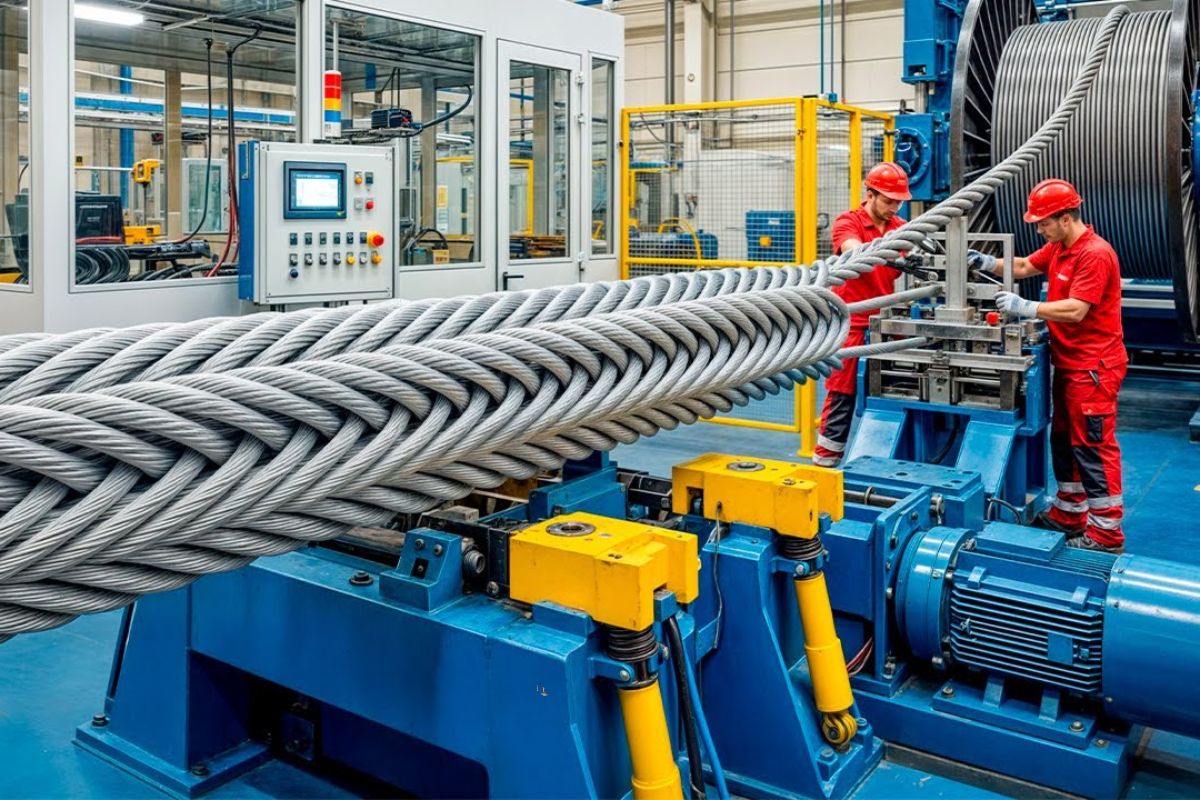
With High-Alloy Steel, Micrometer-Calibrated Wires, and Tests Simulating Hundreds of Tons, the 50 Million Dollar Cable is Born in Colossal Machines to Lift Modules and Structures on Oil Platforms Where Error is Simply Not an Option
In large-scale offshore operations, a single component connects ships, marine cranes, and entire platforms: the 50 million dollar cable. It is not a simple steel rope, but a system of extreme engineering, where each wire is calculated, tested, and tracked to withstand massive loads in highly aggressive environments.
Behind every 50 million dollar cable is an industrial chain that starts with high-alloy steel, goes through rolling, tempering, micrometer calibration, and ends with tests that simulate hundreds of tons of traction, torsion, and fatigue. This is the invisible technology that keeps suspended modules of oil platforms, offshore wind turbines, and heavy mining equipment, in scenarios where failure can mean million-dollar losses and direct risk to human life.
Why a Cable Can Cost 50 Million Dollars

The first answer lies in the context of use.
-
These living root bridges and ladders are over 700 years old and help indigenous people survive in one of the rainiest regions in the world.

-
From sertanejo star to international investor: Ana Castela invests millions in a mansion in the USA, creates a themed accommodation in Orlando, and shows that the “boiadeira” also wants to grow away from the stage.

-
The 10 most stunning motorhomes in the world: a $3 million trailer with a rooftop nightclub and garage for a Ferrari, “palaces on wheels” with Italian marble, private cinema, and five-star hotel luxury for billionaires.
-
Trump wanted to spend $400 million on the White House, but the courts prohibited the million-dollar construction.


The 50 million dollar cable is designed for environments where each operation involves hundreds of tons and a chain of multimillion-dollar projects.
It may be connected to marine cranes lifting entire modules of oil platforms, to offshore wind turbine installation systems, or to large cargo movements in heavy construction.
Beyond the load, the environment is crucial.
Sea water, constant humidity, sharp temperature variations, and repetitive work cycles require a material that withstands not only brute force but also corrosion, mechanical fatigue, and aging.
This explains why the 50 million dollar cable is made from special alloys, fine control processes, and strict international certifications, instead of just being a “reinforced steel cable.”
From High-Alloy Steel to Micrometer-Calibrated Wire

The base of the 50 million dollar cable is a high-alloy carbon steel, enriched with elements like chromium, nickel, and in some projects, molybdenum.
Each additive serves a specific purpose: chromium improves corrosion resistance, nickel increases mechanical strength and plasticity, and other elements adjust hardness and toughness.
The goal is to transform the steel into a true engineering armor, capable of working for years under extreme stress.
The process begins with rolling. Steel bars or billets are successively passed through rollers that reduce the diameter until reaching wires of exact thickness.
Then comes the heat treatment: the wire is heated to high temperatures and rapidly cooled, a stage that adjusts the internal structure of the metal so that it is both hard and elastic.
After that, the wire receives protective coatings, which can be galvanization for corrosive environments or specific polymer layers for continuous contact with sea water.
Only then does the most critical phase of this base begin: the computerized calibration.
Each wire that will be part of the 50 million dollar cable passes through high-precision machines that measure diameter in micrometers, micro-curvatures, tension, and symmetry.
A deviation of hundredths of a millimeter can become the weak point of the whole when thousands of wires are braided together.
A single defective segment is the natural candidate for breaking under load, which is why it is eliminated at this stage.
Weaving in Giant Machines: Where the Cable Takes Shape

With the calibrated high-alloy steel wires ready, the visually most impressive stage begins: weaving.
The 50 million dollar cable is not just a twisted bundle, but a mathematically calculated layered construction to distribute loads and prevent stress concentrations.
At the core lies the heart of the cable, which can be metallic or organic, depending on the application.
Around it, layers of wires are spirally wrapped at defined angles, with dozens or hundreds of wires per layer.
The combination of thickness, number of wires, and twisting angle determines whether the cable will be more flexible or more rigid, whether it will better withstand twisting, direct tension, or alternating load cycles.
This weaving takes place in giant carousel machines, which continuously spin while pulling wires from dozens of spools.
Each wire is tensioned with a pre-defined force and controlled in real time by automatic systems.
If a single wire twists too much or becomes loose, the machine halts the process to prevent an out-of-spec section from proceeding.
Some models combine internal metal layers with external fireproof or polymer coatings, creating hybrid cables for even more severe applications, such as emergency cranes, military equipment, or critical structures in extreme environments.
Tests Simulating Hundreds of Tons: The Moment of Truth
When it leaves the machine, the 50 million dollar cable is still not cleared to lift oil platforms.
It enters a testing phase that simulates, in the laboratory, everything it will encounter at sea and in real operations.
The first major test is the break test.
The cable is secured in hydraulic jaws and subjected to increasing traction until it reaches loads of hundreds of tons.
The objective is to measure the maximum resistance limit and confirm that it withstands forces three to five times greater than the expected working load.
Next comes the fatigue test. In this test, the cable is repeatedly tensioned and loosened, in cycles that reproduce the routine of a marine crane, a drilling platform, or an industrial lifting device.
It is in this type of test that micro-cracks, internal deformations, and performance loss are revealed before the cable reaches the sea.
Models used in systems that suffer twisting also undergo specific tests where the cable is subjected to rotation under load.
If there is unraveling, irregular wear, or internal rupture throughout the cycles, the design fails or needs adjustment.
Environmental tests complete the routine.
The cable is immersed in salt water, cooled to negative temperatures, heated to about 100 degrees, and exposed to ultraviolet radiation or chemical agents, depending on the application.
The idea is to anticipate, in just a few hours or days of laboratory work, years of real field aggression, ensuring that the 50 million dollar cable maintains performance within the expected range.
Certification, Traceability, and the Cost of Not Failing
Only after this battery of tests can the 50 million dollar cable receive international class certifications, such as those issued by technical entities in the naval and offshore industries.
These certificates attest that the product can be used in shipbuilding, oil towers, lifting equipment, and other critical applications.
Each cable receives a serial number linked to all its testing protocols and, in many cases, even to the steel mill that produced the steel for each wire.
This traceability allows oil platform operators and shipowners to know exactly which batch, which composition, and which test results are behind each cable installed in their operations.
At the final stage, the cable is wound into reels of dozens of meters that weigh several tons and are transported in special vehicles to the ports and construction sites.
At the destination, assembly is done with hydraulic cranes, alignment systems, and millimeter measurements.
Before entering service, there is still a final verification of integrity and tensioning.
Only then does the 50 million dollar cable become part of the invisible routine of lifting platforms, modules, and structures where the margin of error is zero.
In the end, what increases the cost of this type of cable is not just high-alloy steel, but the sum of engineering, control, testing, certification, and embedded risk in each operation it carries out.
And you, would you dare to see a 50 million dollar cable working just a few meters away on an oil platform in the middle of the ocean?








-

-

-

-

18 pessoas reagiram a isso.