





 Portuguese
  English
  Spanish
  4 min of reading
  0 comments


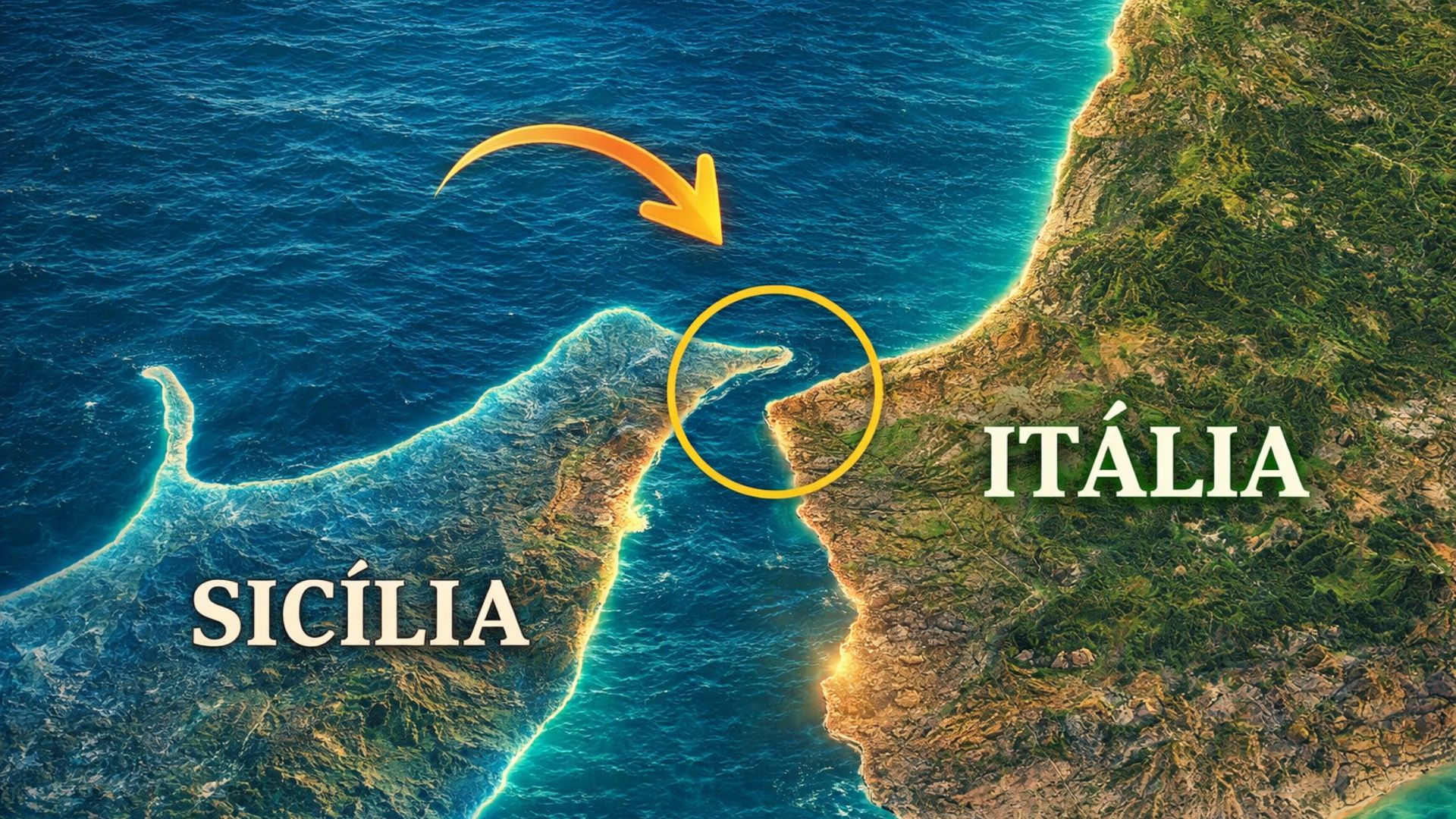
Project Crosses Centuries, Governments, and Technical Studies, but Remains Stuck Due to Geological Risks, High Costs, and Political Discontinuity, Even with Short Distance and Strategic Importance in the Mediterranean.
The physical connection between mainland Italy and Sicily remains nonexistent despite the Strait of Messina being just over three kilometers at its narrowest point.
The proposal for a bridge crossing this stretch of sea has traversed different historical periods, accumulating technical studies, official announcements, and successive revisions, but has never advanced to the construction phase.
The deadlock involves geological, environmental, administrative, and political factors, according to public documents and technical analyses produced over decades.
-
Created by George Lucas with over $1 billion, a futuristic museum in the shape of a spaceship with 1,500 curved panels is about to open in Los Angeles and will house one of the largest private collections of narrative art in the world.
-
Couple shows how they built a retaining wall on their property using 400 old tires: sloped land turned into plateaus, tires are aligned, filled, and compacted with layers of soil, with grass helping in support and at almost zero cost.

-
Engineer explains drainage during the rainy season: the difference between surface water and deep water, ditches, gutters, and water outlets on the road, as well as drains and drainage mattresses, to prevent erosion, aquaplaning, and flooding at the construction site today.

-
With 55 floors, 177 meters in height, a 15-meter walkway between the twin towers, ventilated facade, and 6,300 m² of leisure space, Ápice Towers already has one tower completed and another nearly at the top.

Located between Sicily and the Calabria region, the Strait of Messina is a strategic maritime corridor in the Mediterranean.
The short distance between the shores, however, does not correspond to the complexity of the natural conditions of the location.
Italian engineers and authorities often point out that the challenges of the strait go beyond the length of the crossing and require structural solutions outside the standards adopted in conventional bridges.
Strait of Messina and the Historical Separation Between Sicily and the Mainland
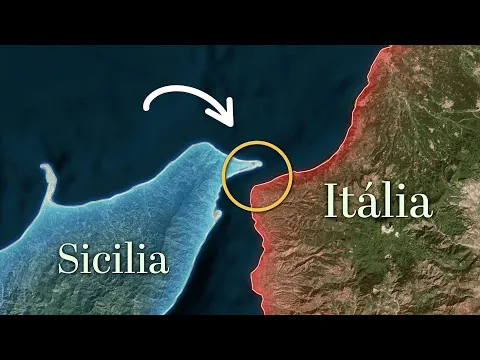

Since ancient times, the strait has served as a point of commercial and military passage, but also as a physical boundary between territories with distinct political trajectories.
Over the centuries, Sicily has been under Greek, Carthaginian, Roman, Arab, and Norman rule, while the mainland has followed different administrative paths.
This geographical separation has been reinforced by crossing solutions based on boats and ferries, which have met the needs of each era without requiring permanent structures.
Even during the Roman period, known for great engineering works, there are no records of attempts to create a fixed connection over the strait.
Historians point out that, despite the technical capacity of the Empire, the site was regarded as a natural boundary subject to intense currents and geological instability, making any permanent construction a high risk.
Unification of Italy and the First Proposals for a Bridge
With the unification of Italy in the 19th century, the bridge began to be mentioned as a symbol of territorial integration.
From then on, the first modern studies emerged, multiplying throughout the 20th century.
At different times, governments commissioned projects, hired engineering firms, and announced schedules that did not materialize.
Public policy researchers highlight that the project has rarely been treated as a long-term state policy.
Instead, each new government reassessed previous decisions, altered technical models, or halted contracts, preventing the institutional continuity necessary for an undertaking of this scale.
Seismic Activity and Structural Risks in Southern Italy

Among the main obstacles is the seismic activity of the region.
Southern Italy houses some of the country’s most sensitive areas in geological terms, and the vicinity of Messina is frequently cited in studies on earthquake risk.
The history of tremors, including major magnitude events in the past, is used as a reference by structural engineers when assessing the feasibility of a bridge.
In addition to more intense earthquakes, technical reports mention the frequent occurrence of minor tremors.
These records indicate the need for a structure capable of absorbing continuous vibrations without compromising its integrity over time.
This scenario imposes additional demands on cables, towers, foundations, and the bridge deck, increasing the complexity level of the project.
Suspension Bridge Design and Cost Estimates
The most recent proposals defended by the Italian government foresee a suspension bridge with a central span exceeding three kilometers.
If built, the structure would rank among the largest in the world of this type of engineering.
According to officially released data, the project would include road and rail lanes, expanding the logistical impact of the work and the structural safety demands.
The estimated budget, which has been revised several times, is another sensitive point.
The billion-dollar figure frequently cited in documents and public announcements fuels debates about financing, economic return, and investment priorities.
These discussions gain weight in a country facing recurring fiscal challenges and historic regional inequalities.

Winds, Maritime Currents, and International Traffic
In addition to geology, the natural environment of the strait imposes additional limitations on the project.
Technicians involved in the studies highlight the presence of intense maritime currents, strong winds, and the need to maintain the traffic of large vessels.
The Strait of Messina is an active maritime route in the Mediterranean.
For this reason, any bridge would need to ensure sufficient height for the safe passage of large ships, without compromising international navigation.
While the fixed connection does not exist, the crossing continues to be made by ferries.
These services daily connect Sicily to the mainland and serve both passengers and cargo.
According to operators and users, the system is subject to delays caused by weather conditions, peaks in demand, and operational limitations.








-

-

-

3 pessoas reagiram a isso.