





 Portuguese
  English
  Spanish
  5 min of reading
  2 comments


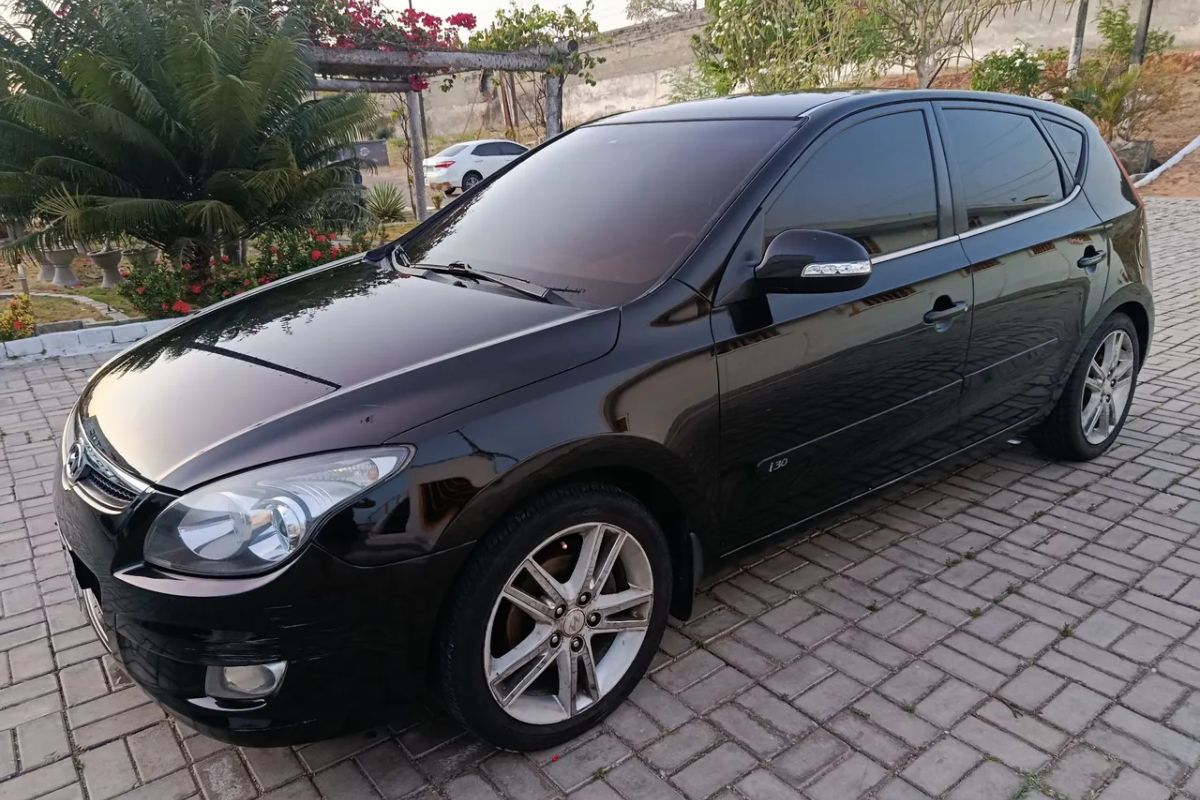


Hyundai Hatch With Complete Package for Up to R$ 40 Thousand Becomes a Highlight Among Used Cars and Challenges Newer Rivals
With up to R$ 40 thousand in hand, the Hyundai hatch i30 is gaining traction among buyers looking for comfort, many features, and a feel of a “above average” car in the used market. With independent suspension, a generous list of standard items, and consistent reports of reliability even with high mileage, the model emerges as a real alternative to newer and much simpler popular compacts.
In practice, the Hyundai hatch has established itself as a sort of “shortcut” for those who want a medium car experience while spending a compact car price. Testimonials from owners and experts highlight units with over 180,000 km delivering good performance, solid driving, and few relevant issues, as long as maintenance has been respected. On the other hand, higher urban fuel consumption and the increased care in choosing the right unit remain points of attention for those thinking about investing in the i30.
Why So Many People Still Bet on the Hyundai i30 Hatch

Among enthusiasts and automotive content creators, the consensus is recurring: within the R$ 35 to 40 thousand range, the Hyundai hatch i30 remains one of the most interesting purchases on the market.
-
OMODA & JAECOO grows in Europe in 2026 with an integrated strategy of sales, innovation, local production, and technological advancement in the United Kingdom, Italy, and Spain.

-
OMODA & JAECOO expands after-sales service in Brazil with competitive maintenance, a 7-year warranty, and high availability of parts for technological SUVs.

-
OMODA & JAECOO appoints Alessandra Souza as executive marketing director in Brazil and accelerates brand expansion with a focus on innovation, networking, and hybrid portfolio.

-
Jaecoo 7 with super hybrid SHS system exceeds 1,200 km of combined range with a 1.5 turbo engine, high-density battery, and intelligent energy management.

There are reports of models with over 185,000 km that continue running without any significant headaches, maintaining comfort, safety, and mechanical robustness comparable to higher segments.
Content creator Paulo César, known as Pequeno Gênio, is one of those who openly defends the model.
He reports that his i30, even with high mileage, continued to operate reliably and felt like a complete car.
From his perspective, it is difficult to find another Hyundai hatch or direct competitor that delivers the same set of features, performance, and stability in this price range.
Features That Make the Hyundai Hatch Seem More Expensive

One of the main cards up the i30’s sleeve is its equipment package.
In many units, even with a value around R$ 40 thousand, it is possible to find a Hyundai hatch with features that typically only appear in more expensive or recent models.
Among the most mentioned highlights are:
17-inch alloy wheels
Sunroof
Power folding mirrors
Projector headlights
Digital air conditioning
Multifunction steering wheel with audio controls
Cruise control in some versions
Leather seats and multiple airbags in the more complete versions
Additionally, disc brakes on all four wheels and independent suspension reinforce the perception of a more sophisticated car, both in terms of stability and active safety.
In many scenarios, the buyer can find a Hyundai hatch with a “near premium” package at the same price they would pay for a basic popular 1.0, with fewer features and comfort.
Performance, Consumption, and Behavior in the City and on the Road
In daily use, the Hyundai hatch i30 delivers solid performance for the category, even in versions equipped with a four-speed automatic transmission.
The combination of a strong engine, well-tuned independent suspension, and disc brakes on all wheels helps the car provide confidence in accelerations, curves, and more demanding braking.
Regarding fuel consumption, the reading needs to be realistic. Data from usage and surveys from automotive portals indicate that the i30 typically records between 10 and 11 km/l on the highway, under favorable conditions.
In urban traffic, especially in automatic versions, the averages hover around 6.5 to 8 km/l, which can weigh on those who drive a lot in the city.
The manual versions tend to show a slight advantage, with quicker responses and somewhat more contained fuel consumption.
In other words, the Hyundai hatch may not be the champion of fuel economy, but it compensates with comfort, safety, and a robust car feel on the road.
For those who travel more on highways than in congested urban areas, this equation tends to be more favorable.
Maintenance, Parts, and Care for the Used Hyundai Hatch
Another point in favor of the i30 is regular maintenance.
Common wear parts such as spark plugs, filters, cables, and coils can be found at competitive prices, especially when the buyer thoroughly researches quality parallel brands or specialized distributors.
However, it is important to highlight that suspension, transmission, and specific electronic components of the Hyundai hatch tend to cost more than those of a national popular compact.
This is particularly sensitive in more complete versions or in units that have undergone poorly executed repairs.
Therefore, before buying, it is essential to:
Check maintenance history and service notes
Inspect the bodywork and structure to avoid damaged or patched cars
Test all electrical and electronic components
Take the Hyundai hatch to a trusted mechanic for a pre-purchase evaluation
When everything is in order, the cost of maintaining an i30 tends to be consistent with the category and with what it delivers in comfort and features.
Does It Make Sense to Choose the Hyundai Hatch Over a Newer Popular Car?
In comparison with cars like Palio, Ka, or Onix in the same price range, the Hyundai hatch i30 stands out particularly in three areas: comfort, safety, and a superior car feel. And
while popular models rely on cheaper maintenance and more contained fuel consumption, the i30 offers a more refined structure, stable driving, and a set of features that enhances the driving experience.
Direct competitors with a more “average” proposal, such as Civic and Corolla, usually appear at higher prices or in worse condition in this same price range.
Given this, the i30 occupies a unique space: it is the Hyundai hatch that resonates with those who want something better than a compact but are still not willing to pay for a well-conditioned mid-size sedan.
Is It Worth Betting on the Hyundai i30 Hatch Today?
If the priority is extreme fuel economy and very cheap maintenance, perhaps a simpler 1.0 popular car makes more sense.
But if the goal is to drive a more complete Hyundai hatch, with good stability, many features, and a feeling of “above average” car, the i30 continues to be a strong bet within R$ 35 to 40 thousand.
It all depends on the choice of the unit. A well-maintained i30, with timely service and a transparent history, is likely to reward the investment with comfort, honest performance, and safe usage even with high mileage.
On the other hand, a poorly maintained example can turn the purchase into a headache. The key is to filter diligently, seek technical support, and not rush to close the deal.
And for you, is a well-equipped Hyundai i30 hatch for up to R$ 40 thousand worth more than a simpler brand-new popular car in the same price range?










Quero um mais não tenho condições me de um de presente
Tudo o que foi dito na matéria é a mais pura verdade. Amo o meu “pretinho básico” 2010 (que de básico não tem nada).🥰