





 Portuguese
  English
  Spanish
  5 min of reading
  6 comments


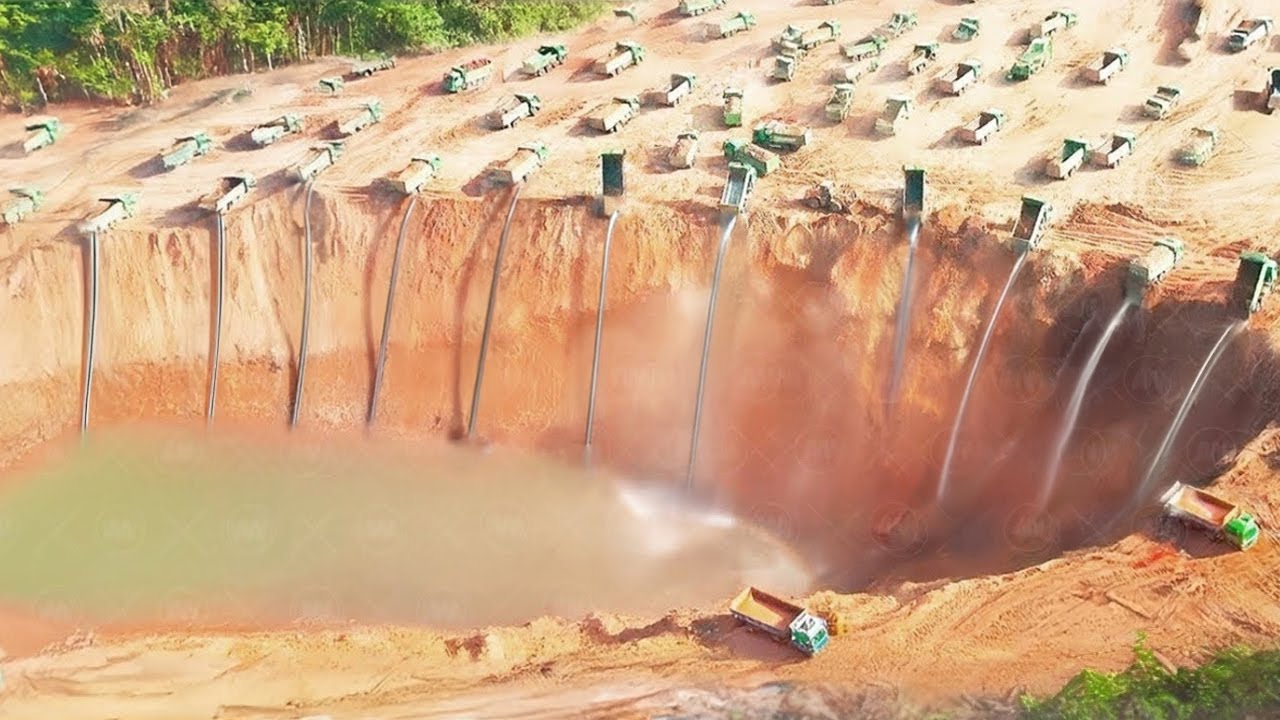


Subterranean Reservoir with Billions of m³ of Fossil Water Formed Over 30,000 Years Extends Under the Desert and May Ensure Supply for Centuries, but Imposes Strategic Dilemmas.
For a long time, the idea that desert regions hid colossal reserves of freshwater seemed almost a paradox. Arid surfaces, absence of permanent rivers, and rare rains created the perception that certain territories were doomed to eternal water scarcity. What geology revealed, however, was something completely different. Beneath kilometers of sand and rock lies one of the largest freshwater reservoirs ever identified by modern science: the Nubian Sandstone Aquifer System.
It is an immense reserve of fossil water, formed in much wetter climatic periods when the desert that today dominates the north of Africa was traversed by rivers, lakes, and savannas. This water became trapped underground, protected by thick geological layers, and remained virtually intact for tens of thousands of years.
Fossil Water: What This Means in Practice
Unlike modern aquifers, which are regularly replenished by rainfall, the Nubian Sandstone Aquifer System holds water that is not being replenished on a human scale. It seeped into the soil in past eras, during interglacial periods when the climate of the Sahara was radically different.
-
With a cost per shot close to zero, the DragonFire laser could change naval warfare in 2027 and provide British ships with nearly unlimited defense against drones.

-
A British startup creates tires that generate electricity in electric vehicles when passing over potholes, speed bumps, and cracks.

-
Scientists have created robots made with living cells that have their own nervous system, swim on their own, explore the environment, and self-organize without any genetic engineering, and now they want to do the same with human cells.

-
Students create a solar-powered ambulance that operates without a plug, without fuel, and still keeps medical equipment running in remote areas.


Isotopic studies indicate ages exceeding 30,000 years, with parts of the system possibly containing even older water. In practical terms, this means we are talking about a finite reserve, though gigantic, accumulated over deep climatic cycles.
Continental Scale Hidden Beneath the Desert
What makes this reservoir impressive is not just its age, but its physical scale. The aquifer stretches over hundreds of thousands of square kilometers, crossing national borders and occupying an area comparable to that of entire countries.

It is distributed under deep layers of the desert in thick sedimentary formations that function like a gigantic natural safe. Scientific estimates point to billions—possibly trillions of cubic meters of freshwater stored within it.
For comparison, this volume is enough to:
- Supply megacities for centuries
- Sustain large-scale agricultural projects for decades
- Ensure water security for entire regions in scenarios of extreme scarcity
All of this in a place where, at the surface, there is almost no visible water.
How This Water Has Been Trapped for So Long
The explanation lies in geology. Layers of highly porous sandstone allow for water storage while less permeable upper formations act as natural seals, preventing rapid dissipation or contamination.
With the advance of desertification, these upper layers have become increasingly dry, completely isolating the deep reservoir. The result has been a practically closed system, stable for thousands of years, protected from evaporation and modern pollution.
A Reservoir That Ignores Political Borders
Another strategic aspect of the Nubian Sandstone Aquifer System is that it does not belong to a single country. The reserve extends beneath multiple nations, making it a sensitive geopolitical resource.
This means that extraction decisions at one point in the system can affect regions far away. Unlike surface rivers, where the impact is visible and immediate, deep aquifers operate on slow time scales, making management even more complex.
Deep Extraction and Technological Challenges of the Nubian Sandstone Aquifer System

The water from this reservoir is not accessible through shallow wells. In many places, it lies hundreds or even thousands of meters deep, requiring complex drilling, high energy investment, and heavy infrastructure.
Each cubic meter extracted involves:
- Deep drilling
- High-powered pumping
- Strict pressure control
- Continuous geological monitoring
This transforms the aquifer into a strategic resource, not a simple or cheap solution.
Can It Sustain Entire Countries for Centuries?
From a purely volumetric standpoint, yes. Estimates indicate that the stored volume is sufficient to ensure human supply for centuries, even without significant recharge.
The issue is not the absolute quantity, but the extraction rate. Taking water out faster than the system can naturally redistribute it may lead to pressure drops, land subsidence, and local depletion.
In other words: it is a gigantic reserve, but not infinite.
Agriculture, Cities, and the Dilemma of Intensive Use
Agricultural and urban projects are already using parts of this system for irrigation and supply. In arid regions, it has become the backbone of entire cities and productive areas in the middle of the desert.
The dilemma is clear: use it now to ensure development or preserve it for long-term water security. Since the water does not regenerate on a human scale, each usage decision is, in practice, an irreversible choice.
The Nubian Sandstone Aquifer System is a powerful reminder that the planet holds physical records of its own climatic cycles. The water present there is a direct vestige of a Sahara that once was green, fertile, and humid.
Today, in a world facing rapid climate change, this reservoir is becoming a global strategic asset, both from a scientific and political standpoint.
Water Security or Dangerous Dependence?
Experts warn that relying excessively on fossil water may create a false sense of security. While the reservoir exists, it supports growth. When it begins to deplete, the transition can be abrupt and painful.
For this reason, many see the aquifer not as a definitive solution, but as a temporary bridge, capable of buying time for investments in desalination, reuse, and efficient water management.
Few people imagine that, beneath one of the driest environments on the planet, lies one of the largest freshwater reserves ever identified. Invisible, silent, and ancient, this reservoir challenges surface logic and shows how the deep past of the Earth continues to influence present decisions.
The Nubian Sandstone Aquifer System is not just a geological phenomenon. It is a wake-up call: natural resources may be vast but are not eternal. Understanding them is the first step to preventing a 30,000-year legacy from being consumed in just a few decades.







Verdade pura. A minha preocupação como cidadão e geógrafo é para com o que poderá acontecer com os rios voadores da Amazonia cuja vazão poderá diminuir, prejudicando em muito a produção de alimentos na região Centro sul do Brasil além da Argentina, Paraguai e Uruguai se não forem contidos os desmatamentos produzidos por pecuária, construcao de ferrovias, rodovias levando junto a praga mortal dos grilheiros. Esta prevenção tem que se sobrepor a ganância obtusa levando a tragédia anunciada agindo sobre todos, sejam consumidores ou produtores da agropecuaria,mineração,etc.
if I’m not mistaken didn’t Omar Kadafi of Lybia tap this reserve prior to his sadistic take down by HRC about 15 years ago ?
You maybe correct , he ran a pipe line for miles.. So it may be the one he tapped,
They could use just enough of the water to help regrow a new Forest to be able to encourage rain and refill the aquifers it would take many years but in the end it would be worth it
I like it … Direct usage nothing else…