





 Portuguese
  English
  Spanish
  6 min of reading
  3 comments


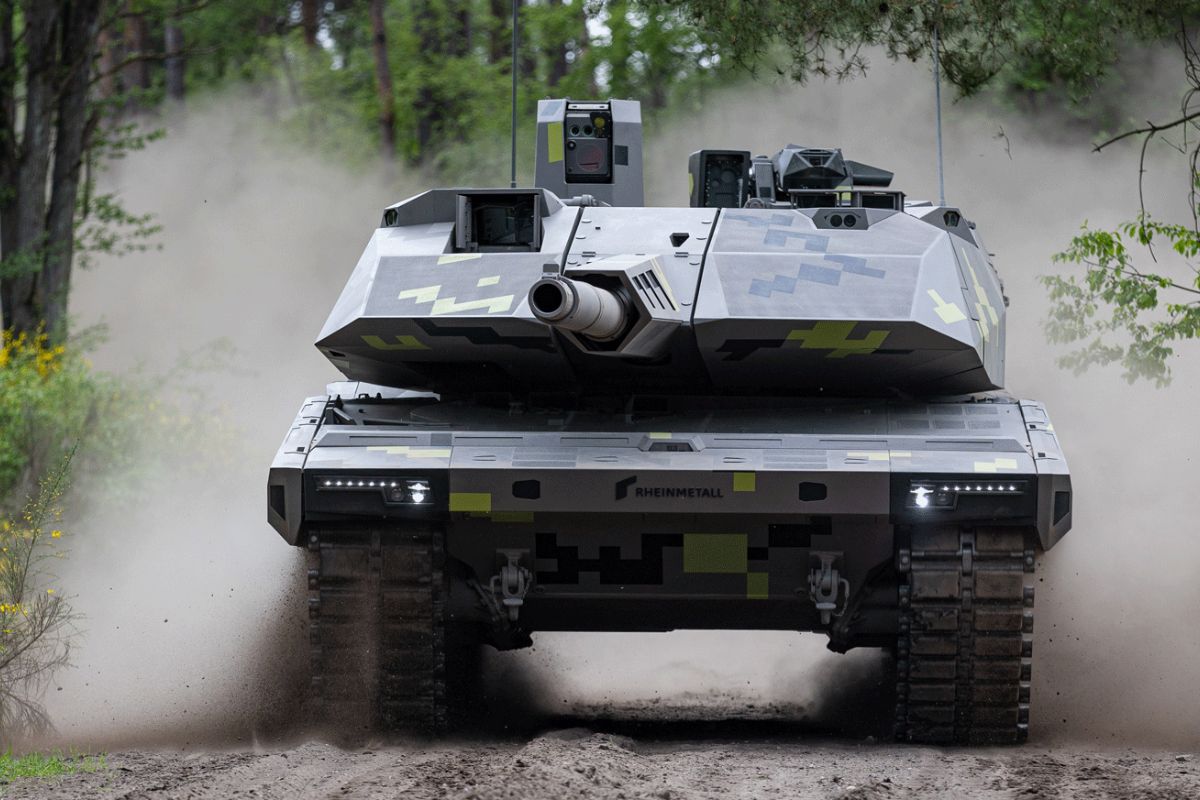


The KF51 Panther Was Conceived by Rheinmetall as a 59-Ton Main Battle Tank with NGVA Digital Architecture, Increasing Automation, a Three-Person Crew, a 130 mm Gun, Active Protection, and Integration with Drones, Targeting the Next Generation of European Armored Vehicles for Future High-Intensity Ground Combat.
The KF51 Panther emerges as Rheinmetall’s most ambitious attempt to reposition the European main battle tank into another technical category. Introduced as a 59-ton armored vehicle concept, it combines 130 mm, comprehensive digitalization, increasing automation, and a survivability package that aims to merge high lethality and rapid response within the same system.
In practice, the KF51 Panther‘s proposal is to break away from the incremental upgrade logic of current MBTs. Instead of starting from the past, the design aims to be ready for the next cycle, with NGVA infrastructure, a smaller crew, future possibility of an uncrewed turret, integrated active protection, and the ability to operate in a connected environment with drones, sensors, and decision support.
What Makes the KF51 Panther Different from the Armored Vehicles That Came Before

According to the technical presentation from Rheinmetall, the KF51 Panther is the first of a new family of MBTs and was conceived as a software-defined system. This changes the vehicle’s starting point.
-
Something is happening around the Earth: Inside the huge explosion of fireballs in 2026

-
A hot air bubble coming from Argentina expands over Brazil, causing thermometers to exceed 38 degrees with a thermal sensation of 40 degrees in late March, affecting 6 states at once.

-
The radish leaf that almost everyone throws away has more polyphenols, flavonoids, and fiber than the consumed root, and a 2025 study showed that the leaf contains compounds that protect the intestine, combat inflammation, and may inhibit the growth of cancer cells.

-
A planet that seemed to defy the laws of physics has intrigued scientists for decades, until the James Webb revealed what is really affecting Saturn’s rotation.


Instead of a tank organized into more rigid blocks, the design relies on an open digital architecture, aimed at integrating sensors, weapons, communication systems, and future layers of automation without requiring a complete rebuild of the platform.
This NGVA foundation is what allows the KF51 Panther to operate as something more than a classic armored vehicle.
The tank was designed to collect, process, and disseminate information on the multi-domain battlefield, connecting sensors and shooters across different platforms.
This digitalization is not just electronic embellishment. It is the condition that supports the instantaneous transfer of functions between crew members, integration with drones, and the promise of future decision support through artificial intelligence.
The designed crew also reflects this conceptual shift. The vehicle has been planned for three people, with one station for the driver and another in the chassis that can be used by the company commander, drone operator, or support pilot.
As sensor and weapon control can be redistributed among the stations, the design paves the way for greater automation and a much deeper human-machine interaction than seen in traditional tanks.
This point is central to understanding Rheinmetall‘s ambition.
The KF51 Panther does not aim to be just a stronger tank. It seeks to be an armored vehicle structurally ready to take on new roles, new functions, and new command forms.
That’s why the vehicle presents itself less as a finished product and more as an evolving platform.
The 130 mm Gun and the Logic of Enhanced Lethality

The offensive core of the KF51 Panther lies in Rheinmetall’s Future Gun System, consisting of a 130 mm gun and a fully automated ammunition handling system.
The company claims that this setup increases the destruction range by 50% compared to 120 mm systems while maintaining a high rate of fire thanks to the automatic loader.
This combination of larger caliber and ammunition automation supports the promise of lethal superiority.
The main armament does not operate alone. The tank also features a 12.7 mm coaxial machine gun and can integrate remotely controlled weapon stations to deal with nearby targets and drones.
Furthermore, there is an option to install the HERO 120 rapid attack ammunition, enhancing the KF51 Panther‘s ability to engage targets beyond line of sight, depending on the mission.
This creates a far more flexible offensive package than the simple frontal firing logic among armored vehicles.
The digital architecture reappears here strongly. All weapons of the KF51 Panther are connected to sight systems and the fire control computer through a fully digitized infrastructure.
This enables “hunter-killer” and “killer-killer” operations, with continuous engagement and rapid redistribution of tasks among operators.
In theory, the lethality of the 130 mm does not come solely from the caliber but from the speed at which the tank detects, decides, and fires.
That’s also why Rheinmetall insists on presenting the KF51 Panther as an armored vehicle for multi-target and long-range combats.
The advantage of the 130 mm appears as the most visible symbol, but it directly depends on the onboard electronics, autoloader, and sensor integration. Without this, the larger caliber would merely be a number.
Thus, it becomes a central argument for the new generation of European armored vehicles.
Active Protection, Sensors, and the Idea of Integrated Survivability
If lethality is the first major axis of the project, the second is survivability.
The KF51 Panther has been described as the first MBT to adopt an integrated survivability capability concept with sensors both inside and outside the platform, combining reactive, passive, and active protection into a unique architecture.
The logic here is not just to react when the impact comes, but to try to see beforehand, obscure beforehand, and neutralize beforehand.
Among the mentioned systems are TAPS, targeted at superior attack threats, and ROSY, a smoke obscuring system integrated into the digital architecture.
The vehicle has also been configured with pre-launch detection capability, specifically to increase the chance of engaging first.
This combination reinforces the idea that the KF51 Panther wants to survive less through sheer thickness and more through anticipation, masking, and coordinated reaction.
The most emphasized point by Rheinmetall is the active protection against large caliber kinetic energy, something treated as a differential because it raises the level of defense without pushing the system’s weight up.
In a tank weighing around 59 tons, this is decisive.
Active protection here does not enter as a secondary complement but as a structural element of the concept.
There is also protection against anti-tank missiles, mines, superior attacks, and cyber threats, as the KF51 Panther has been designed to operate in contested electromagnetic spectrum.
This reveals a contemporary reading of the battlefield: it is not enough to armor the hull and turret.
The armored vehicle needs to withstand hostile sensors, attacked networks, and vectors descending from above, where MBTs have historically been most vulnerable.
Mobility, Reduced Crew, and Connected Warfare
Even with all this package, the KF51 Panther maintains a combat weight of less than 59 tons, according to the manufacturer’s description.
For Rheinmetall, this places it in an advantageous tactical and strategic mobility range, with a range exceeding 500 kilometers and compatibility with the AMovP-4L tunnel without preparation.
The argument is clear: a far more lethal and protected armored vehicle cannot become a prisoner of its own weight.
This mobility needs to be read in conjunction with the rest of the concept.
The KF51 Panther has been designed to operate in a collaborative environment, controlling unmanned aerial vehicles, attack munitions, and unmanned ground vehicles. This means the platform does not just want to traverse terrain.
It aims to command a small combat ecosystem around itself, using its digital architecture to coordinate networked sensors and effectors.
Automation returns to the center at this point.
As each workstation can take on tasks from others without loss of functionality, the tank has been prepared for a reduced crew and the future expansion of remote functions.
The result is a design that aims to alleviate the human weight of operation without sacrificing capability.
Here, automation is not an abstract promise. It is the mechanism that justifies fewer crew members and more simultaneous tasks.
This same reasoning explains why Rheinmetall speaks of future uncrewed turrets and remotely operated Panthers.
The KF51 Panther is still presented as a crewed tank with three people, but the architecture has been designed to keep the door open for other formats.
This is important because it shows that the company does not view the vehicle as the final apex but rather as the first step in a longer path.
What the KF51 Panther Really Aims to Change in Europe
The KF51 Panther attempts to occupy a very specific space: that of conceptual disruption within European armored vehicles.
Rather than just increasing caliber, protection, or sensors in isolation, Rheinmetall’s proposal combines 130 mm, active protection, automation, and digital architecture as parts of the same leap.
This is the central bet of the project: to convince that the next generation of MBTs needs to be born connected, modular, and prepared for constant evolution.







Esse mbt pode se tornar o melhor tanque de guerra de Europa muito a frente do T 14 armata da russia
Pode ser mais tecnológico, mas não vai bater de frente em combate contra o t14
É um conceito muito inovador e que pode colocar o Kf 51 Panther muitos anos a frente de outros projetos de MBT’s podendo inclusive redesenhar a guerra blindada no campo de batalha moderno.