





 Portuguese
  English
  Spanish
  5 min of reading
  86 comments


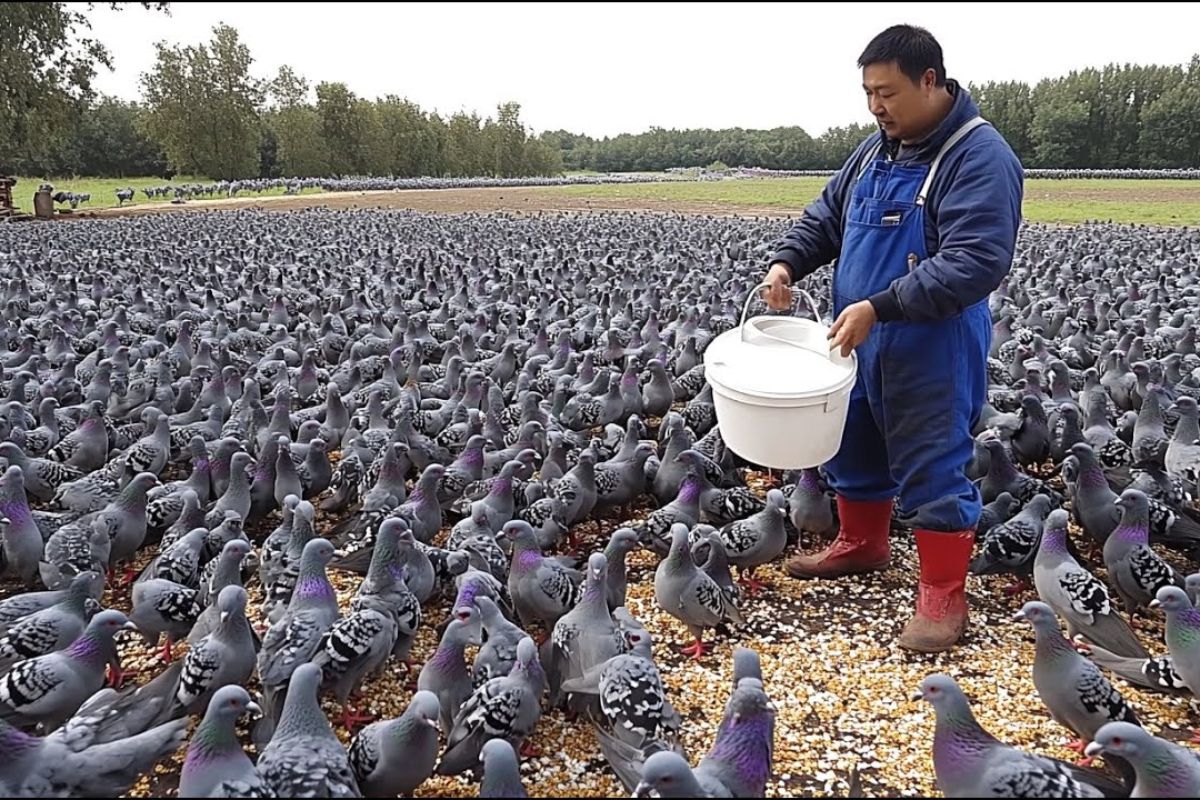


Chinese Pigeon Farms Transform Industrial-Scale Production into a Giant Animal Protein Business
With flocks totaling around 600 million birds and farms housing from 10,000 to more than 500,000 pigeons in a single unit, Chinese pigeon farms demonstrate how simple technology, continuous breeding, and standardized management sustain a multimillion-yuan market aimed at domestic consumption and exports to other Asian countries and the Middle East, with processing lines operating at an industrial pace and strict control over carcass standardization, cuts, and packaging ready to reach the consumer’s plate.
In this model, the pigeon ceases to be merely a bird associated with local traditions and becomes a productive asset managed with agribusiness logic, supported by breeding centers with controlled temperature, multi-tiered cages, continuous technical monitoring, and mechanized slaughtering. Chinese pigeon farms operate as integrated plants, where the entire cycle, from the breeding pair to the packaged and refrigerated product, is organized to extract maximum weight gain in short and predictable cycles.
A National-Scale Pigeon Agribusiness

China has established itself as the largest producer and consumer of pigeon meat in the world, with a national flock estimated at approximately 600 million birds raised annually and hundreds of thousands of tons processed each year to supply a market that combines domestic consumption and exports.
-
With a façade that resembles a giant zipper, the building in Milan creates a sense of strangeness, featuring lighting that transforms engineering and attracts the attention of residents and tourists.

-
The Brazilian city has 319 crooked buildings built on sandy soil without proper deep foundations, houses the largest beach garden in the world, with over 5 km, and is still considered the birthplace of surfing — meet Santos, in São Paulo.

-
New Zealand builds a shimmering building that vibrates, featuring a 62-seat cinema, moving sculptures, and an environment where sound, light, and energy are felt in the body.

-
Two colored cubes of 2.5 m transform a public bathroom into a selfie spot in Western Australia, costing up to 75% less than traditional construction and helping to reduce vandalism in public spaces.


What was once a small-scale activity, based on a few breeding pairs kept on family farms, is now conducted in specialized farms ranging from 10,000 to more than 500,000 pigeons per farm, primarily in provinces like Guangdong, Jiangsu, Hubei, and Fujian.
In these regions, Chinese pigeon farms have been structured with long sheds, stacked cage lines, and feeding and management systems designed to reduce labor and increase production predictability.
How Chinese Pigeon Farms Operate

Inside the sheds, the logic is industrial.
Breeding pigeons are kept in pairs, with each couple occupying standardized compartments, with feeders, drinkers, and nests organized in repeated modules throughout the aviary.
The multi-level arrangement allows for concentrating a large number of birds in a relatively small area, optimizing physical structure, lighting, and management.
Although the technology used is considered simple compared to the highly robotic systems of other protein chains, there is a high degree of basic automation.
Belt conveyors, devices for distributing feed and water, and cleaning and bird collection routines follow strict schedules, which ensure repeatable and measurable workflows in Chinese pigeon farms, an essential factor for maintaining costs and performance metrics under control.
Continuous Breeding as the Basis of the Business Model
Breeding is the heart of this system.
Each pair of breeding pigeons can produce 10 to 12 litters per year, with 1 to 2 eggs in each clutch, under technical supervision and careful management.
This ensures virtually continuous availability of young pigeons, which provides predictability for slaughter and delivery to processing units.
In the first days of life, the chicks are unable to ingest solid food.
They are fed with so-called crop milk, a thick secretion produced by the parents in the crop and regurgitated directly into the chicks’ beaks.
Thanks to this highly concentrated source of protein and energy, the weight of young pigeons can increase 6 to 8 times in just 3 to 4 weeks, even surpassing typical growth rates of broiler chickens in the early stages.
From approximately 20 days old, the chicks undergo a gradual transition and start pecking finely ground grains, entering a fattening phase until they reach market weight.
For the producer, this means short production cycles, high batch turnover, and the ability to plan space allocation and input based on very precise schedules.
From Nursery to Industrial Processing Line
When the pigeons reach the ideal market weight, the routine shifts from the shed to the slaughter and processing chain.
The birds are collected in the early morning hours, when they are calmer, carefully removed from their cages and placed in ventilated boxes for transport to the processing unit.
Upon arrival at the slaughterhouse, an automated conveyor system guides each animal individually, following a line designed to standardize each step.
The birds are stunned, and then their necks are cut for controlled bleeding, which helps to obtain cleaner meat with better preservation.
After that, the pigeons undergo a hot water bath that loosens the feathers, which are removed by specific machines.
The next phase is evisceration, where trained workers remove the internal organs, separating higher-value components such as hearts and livers, often used as delicacies in specific dishes.
The carcasses are then washed with high-pressure cold water jets, possibly receiving a rinse with mild disinfectant to elevate hygiene standards.
Next, they undergo a manual quality check, before being vacuum-sealed or placed in sealed containers, labeled, marked with tracking codes, and sent to refrigerated chambers.
Traceability and Markets of Chinese Pigeon Farms
Once cooled, products from Chinese pigeon farms are directed to various channels: supermarkets, wholesalers, restaurant chains, and international buyers.
Tracking codes allow following the batch from the farm to the point of sale, an important tool for sanitary control, inventory management, and meeting the requirements of importers from Asia and the Middle East.
This level of organization enables a constant flow of pigeon meat, with standardization of size, presentation, and cut characteristics.
The logic is similar to that of other protein chains, but applied to a species often invisible in global statistics.
In practice, the pigeon is treated as another animal protein asset, with production planning, slaughter schedules, and recurring supply contracts.
Simple Technology, Precise Management, and Industrial Scale
What stands out in this model is not the use of sophisticated robotics or advanced sensors at every point, but rather the combination of relatively simple infrastructure, well-defined protocols, and precise management, repeated thousands of times throughout the sheds.
The scale is the element that transforms an apparently basic system into a business with significant economic impact.
The standardization of cages, continuous breeding, the accelerated growth rate of chicks, and integration with slaughter and refrigeration lines create an industrial chain of pigeons that functions similarly to other large poultry chains, but with unique management and consumption characteristics.
Beyond curiosity, this model shows how different species can be incorporated into strategies for food security and diversification of protein sources.
In the end, Chinese pigeon farms reveal the strength of systems that combine traditional knowledge of bird management with industrial processes of cutting, refrigeration, and distribution, connecting small details of animal biology to market and logistical decisions on a continental scale.
And you, how do you view this type of production? Would you consider consuming meat from Chinese pigeon farms knowing it stems from this industrial model of breeding and processing?







“A necessidade é a mãe da sobrevivência” E uniram inteligência com a capacidade de trabalho. …
Lógico que comeria! Me criei comendo ponbos, que eu mesmo os casava em arapucas, no final dos anos 70 e início dos anos 80, no interior do RS.
Enquanto pra China o pombo é proteína para o Brasil é somente um pássaro q contraí doenças.De fato é q a China v sempre uma saída pra empregar,pra sustentar,pra obter lucro e comercializar.