





 Portuguese
  English
  Spanish
  5 min of reading
  7 comments


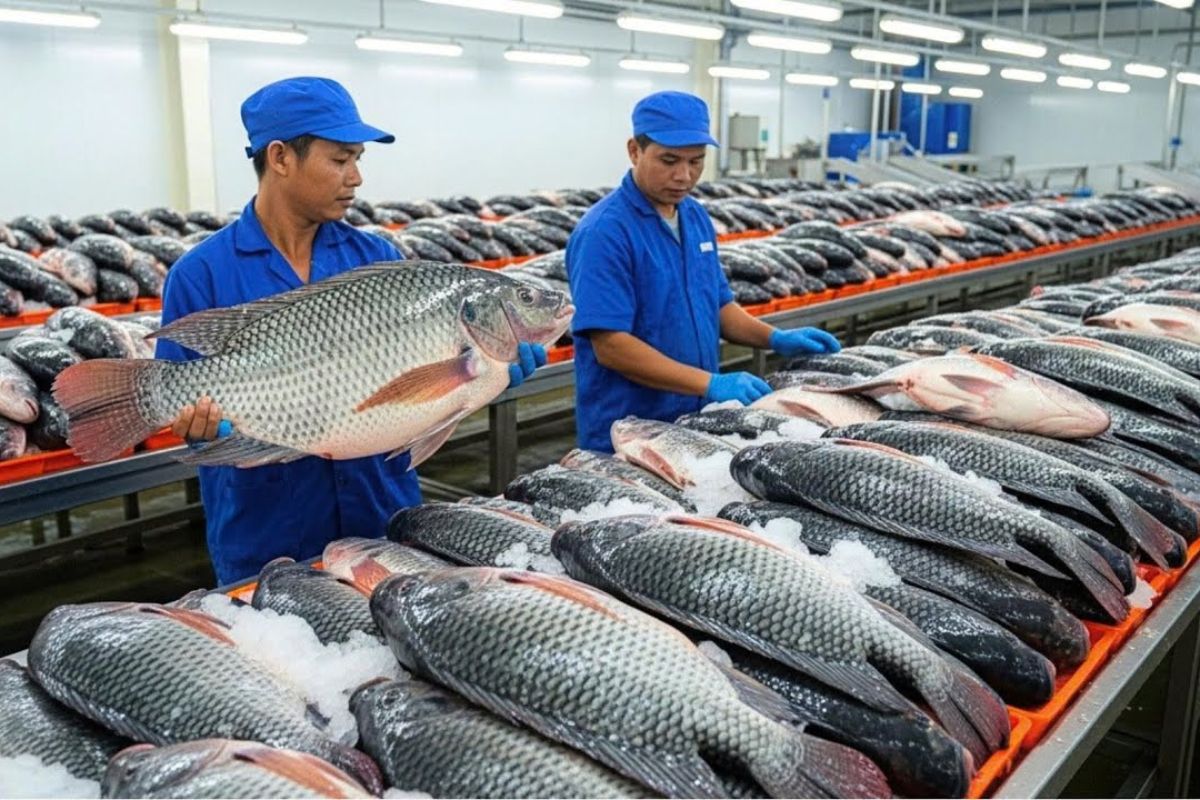


With High-Density Farms, Artificial Intelligence Sensors, Continuous Harvesting, and an Industrial Line Processing Thousands of Tilapia Per Hour, China Transforms a Common Fish into a Global Strategic Product Exported with Traceability, Extreme Standardization, and Focus on Low Cost for Supermarkets, Restaurants, and Fast Foods on Multiple Continents
Tilapia has transitioned from a simple fish on everyday tables to become one of the pillars of the global protein market. In China, which accounts for nearly 70 percent of global production, the cycle goes from nurseries with total water control to factories that receive truckloads and return standardized fillets ready for mass export.
Behind this chain lies a precise industrial design. More than 5.5 million tons of tilapia are produced per year, raised in high density, monitored by artificial intelligence, and processed by lines capable of filleting around 5,000 fish per hour. This marriage of volume, technology, and cost is redefining tilapia’s place in the global food economy.
How Tilapia is Born to Feed the World

The cycle begins with precise genetic improvement.
-
Residents of Australia woke up to a sky completely red like blood before the arrival of Cyclone Narelle, which hit the coast with winds of 250 km/h, tearing off roofs and lifting iron dust in a scene they described as apocalyptic.

-
New 100% clean fuel produced in Brazil could retire diesel.
-
Plastered walls become a trend and end up being the perfect choice for finishing; the secret of the 2 coats that prevent waste in painting.

-
With 333 meters and equivalent to a 20-story building: China launches a supertanker that transports 2 million barrels, has 540,000 m² of area, and saves $5 million per year.

Laboratories select tilapia matrices that grow up to 1.8 times faster and are more disease-resistant than traditional strains, combining directed breeding and genetic editing where regulations allow.
These matrices produce thousands of eggs, fertilized outside the body and then incubated in the females’ mouths, a typical behavior of the species that increases survival rates.
When the larvae hatch, they are transferred to nursery tanks where pH, temperature, dissolved oxygen, and ammonia are continuously measured by sensors.
Automated systems activate aerators and biological filtration to maintain stable water conditions.
At this stage, tilapia receive micro-diets rich in protein several times a day, with quantities adjusted by algorithms that observe school behavior and reduce the risk of feed overage and water quality loss.
Giant Tanks and Recirculation that Saves Up to 85 Percent of Water

After about a month, tilapia are moved to grow-out tanks or aquaculture recirculation systems.
In traditional ponds in rural areas, the model is still extensive, relying on large water bodies.
But where the goal is volume, the closed recirculation system reigns, which can reuse up to 85 percent of the water and support up to four times more tilapia per cubic meter than conventional ponds.
In these systems, biological filters convert nitrogenous waste into less toxic forms and remove suspended solids.
Sensors and cameras record tilapia movement, appetite, water transparency, and oxygen concentration in real-time, while software automatically adjusts aeration rates, recirculation flow, and feed distribution volume.
In addition to reducing water consumption, this automation decreases antibiotic use by up to 30 percent because it allows for early detection of stress and disease signals in the stock.
Management, Nutrition, and Sanitary Control in High Density

Keeping millions of tilapia in high density demands a routine that combines factory precision with field discipline.
Feeding uses pelletized feeds with a balanced formulation of protein, vitamins, and minerals, distributed at calculated times and quantities to maximize feed conversion and minimize leftovers.
In many farms, artificial intelligence itself decides how much to feed based on data from cameras and probes, reducing waste and cost per kilo produced.
Water quality is another critical point.
Temperature, pH, ammonia, and dissolved oxygen are recorded 24 hours a day, with automatic alarms in case of deviations.
In earthen ponds, lime is commonly used to stabilize pH and inhibit unwanted bacteria.
In advanced systems, filtration units and oxygen injectors keep the environment stable, reducing mortality and improving the tilapia’s fillet yield.
Dead or sick fish are immediately removed, and equipment undergoes regular disinfection to contain outbreaks.
Harvesting Up to 12 Tons of Tilapia Per Hour
Tilapia reaches market weight between 500 and 800 grams typically within six to nine months of farming.
From that point on, the clock begins to govern the entire operation, because any delay between harvesting and processing impacts freshness and final value.
In small properties, harvesting is still done with manual nets, in lengthy operations dependent on skilled labor.
In major hubs, the scenario changes in scale.
Specialized harvesters can pull up to 12,000 kilograms of tilapia per hour using controlled suction systems that reduce stress and prevent physical damage.
The fish are transported to trucks or tanks with oxygenated water, where temperature and oxygen are monitored by connected sensors.
Some companies are already integrating this data into digital traceability platforms, recording the date, batch, and rearing location of each tilapia load entering the production line.
Inside the Factories that Filet 5,000 Tilapia Per Hour
Upon arrival at the processing plant, the tilapia enter waiting tanks with controlled temperature and oxygen to maintain freshness.
The line begins with stunning and bleeding, a practice that improves meat quality.
Next, the fish go through scaling, evisceration, and filleting, stages that can be partially manual, fully automated, or hybrid, depending on the factory’s profile.
In high-capacity units, precision cutting machines can process about 5,000 tilapia per hour, delivering standardized fillets in size and weight.
Inspection systems with X-rays complement visual checks to find remaining bones and defects.
Then, the fillets enter quick chilling tunnels or instant freezing, which helps preserve texture and flavor.
From there, they proceed to vacuum packaging, portioning, or IQF freezing, the preferred format for export.
Strict hygiene protocols keep operations within sanitary requirements for markets such as the United States and the European Union.
Tilapia as a $10.2 Billion Business and Environmental Debate
The global tilapia market exceeds $10.2 billion and continues to expand, driven by the fish’s neutral flavor, high supply, and low fat content.
China leads in exports to North America, Europe, and the rest of Asia, focusing on frozen fillets and standardized products.
Thanks to digital traceability and certification seals, tilapia has moved beyond being just a cheap fish and has started to occupy space in premium lines, such as antibiotic-free products and organic versions.
From an environmental perspective, tilapia has a structural advantage over carnivorous fish because it mainly feeds on plants and algae, reducing pressure on wild stocks used in fishmeal.
On the other hand, large-scale farming continues to raise concerns about water pollution, waste disposal, and energy use.
Recirculation systems and dedicated irrigation channels help reduce the impact, but only work optimally with waste management, constant monitoring, and clear rules for occupying aquatic areas.
At the end of the line, the tilapia that comes from these giant tanks and factories is increasingly present in simple dishes, restaurants, and even sophisticated menus, while technology completely reorganizes how the fish is raised, harvested, and delivered to consumers.
The question is whether this high-tech model will manage to balance low cost, brutal volume, and environmental responsibility in the long run.
In your opinion, does this Chinese model of massive tilapia production in high-tech systems make you more confident or more distrustful when buying the fish in the market?




Estou confiável
As pessoas pessoas precisam ler e conhecer mais sobre o assunto para poder dar opinião. A tilápia veio para o Brasil e trata-se de uma espécie invasora que consegue se adaptar a qualquer ambiente. Já foram pescadas tilápias onde a água de lagoas ou rios tem ligação com o mar, e isso mostra sua capacidade de adaptação, podendo realmente afetar o meio ambiente como espécie invasora. O que deve ser feito é o controle de forma responsável e não acabar com quem cria, compra ou vende, e tirar sustento das famílias. Tudo que acontece agora no nosso país é culpa desse ou daquele governo. Não percam tempo com isso. Bora trabalhar porque não é esse e nem aquele governo que vai pagar nossas contas.
Enquanto isso… aqui no Brasil, pais que tem o governo do amor…a tilápia, está sendo classificada como espécie invasor… narrativa normal, de um desgoverno, que além de ****, quer terminar com toda fonte, que produz em grande escala… assim com está querendo acabar com o Agro…mas quer importar tilápia do Vietnã…pais comunista, alinhado a este desgoverno. Essa **** que se instalou no Brasil.