





 Portuguese
  English
  Spanish
  5 min of reading
  17 comments


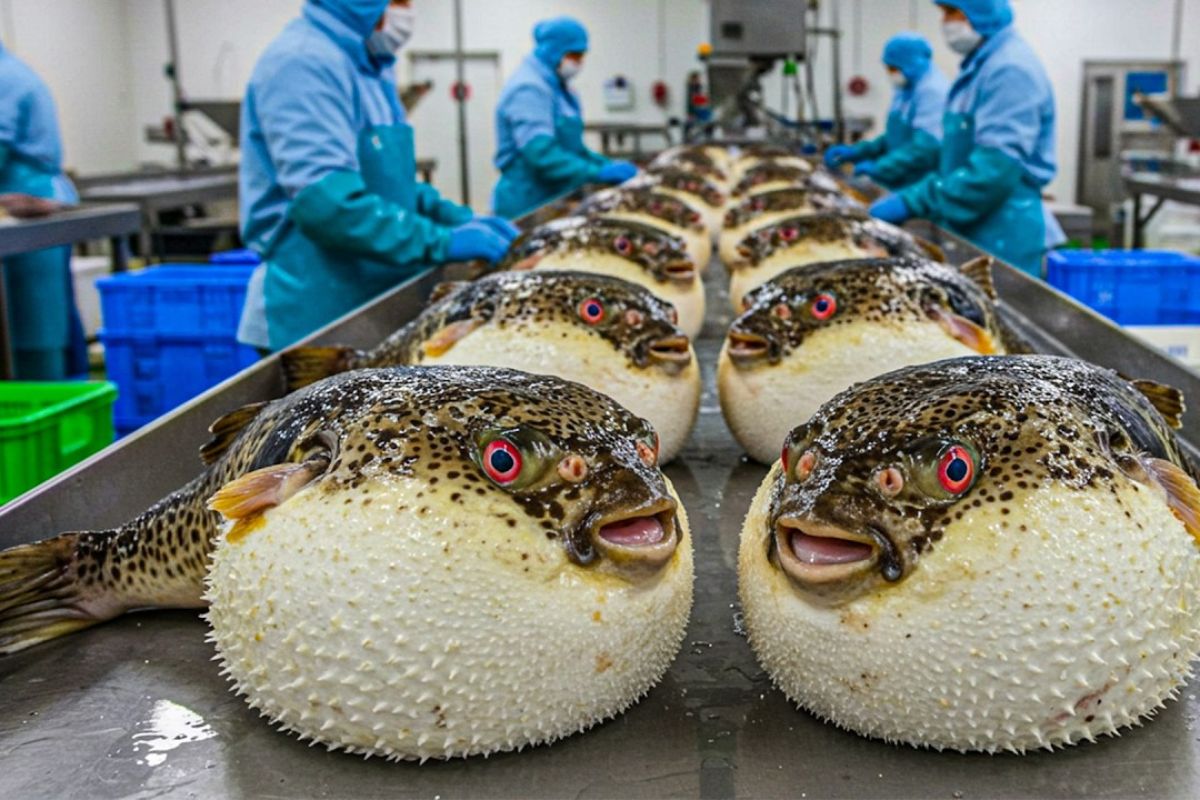


With Semi-Wild Farming in Open Sea, the Japanese Puffer Fish Goes Through Controlled Tanks, Reinforced Ocean Cages, Toxin Monitoring, and Specialized Slaughter with Mandatory Certification, Ensuring Premium Safe, Standardized Meat Ready to Dominate Japanese Aquaculture from 2025, Meeting Global Quality Standards and Reducing Poisoning Risks.
The Japanese puffer fish, which for decades has been synonymous with danger and poisoning, enters 2025 as the star of a new phase of aquaculture. Off the coasts of Japan, highly controlled marine farms are transforming a feared fish into premium meat, focusing entirely on food safety, traceability, and technical certification.
Far from the image of “Russian roulette” fish, this system combines technology, marine biology, and strict handling protocols to control toxins, ensure animal welfare, and deliver an expensive, rare, and extremely valued product. From egg to refrigerated trays, each step of the creation of the Japanese puffer fish is designed to reduce risks and increase the economic value of each kilogram produced.
From Fear to Farm: How the Japanese Puffer Fish Became a Bet in Aquaculture

When talking about the Japanese puffer fish, the first reaction is almost always the same: poison, risk, intoxication.
-
With over 14 million baskets of earth moved, an ancient North American metropolis built a monumental pyramid of 30 meters and established a city with 20,000 inhabitants nearly a thousand years ago.
-
A 1,900-year-old treasure emerges from a Roman house destroyed by fire and sealed since antiquity in Romania, with coins and metals fused among the ashes.
-
The Brazilian colonial city that stopped in time and shares territory with a rocket launch base.
-
79-year-old woman challenges limits, visits 193 countries in the world after 56 years of planning and reveals the behind-the-scenes of a global journey that few have managed to accomplish.


Even so, millions of tons of puffer fish are consumed every year, especially in Asia, where the fish is treated as a high-prestige delicacy.
The leap from extractive fishing to planned farming changes the game.
Instead of relying solely on wild Japanese puffer fish, Japan has established a model where the fish is born in a controlled environment, grows in open sea, and returns to specialized processing units.
This semi-wild logic allows uniting the best of both worlds: laboratory sanitary control and the flavor of ocean-raised fish.
First Phase: Japanese Puffer Fish Is Born in Controlled Tanks with Filtered Seawater

It all starts in the first days of life. About 3 to 7 days post-hatching, Japanese puffer fish larvae are transferred to special rearing tanks.
It’s not fresh water, nor just any water: producers use natural, filtered, and sterilized seawater, rich in oxygen and maintained at stable parameters.
This phase is critical. The Japanese puffer fish is still extremely fragile, sensitive to temperature, oxygen, and water quality variations.
That’s why technicians continuously monitor the system, adjusting flow, renewal, and feeding so that the post-larvae develop with minimal stress.
This is where the survival rate and future performance of the entire batch are defined.
For about four months, the fish spend in these rearing tanks, gaining weight and developing a more robust immune system.
Only after this “protected childhood” is the Japanese puffer fish ready to face the open sea.
Second Phase: Ocean Cages and Semi-Wild Farming in Open Sea

After the period in tanks, the Japanese puffer fish moves to the sea.
The next stage occurs in large ocean cages, reinforced structures designed to withstand strong waves, currents, and storms.

These cages are fixed in strategic areas along the Japanese coast, where water renewal is constant and the sea quality is adequate.
There, the Japanese puffer fish begins to live in a semi-wild regime: in direct contact with the marine environment, but without risk of escape or exposure to predators.
The cages are designed to:
- Prevent the Japanese puffer fish from escaping or invading other areas
- Protect the fish from attacks by large predators
- Ensure constant circulation of clean, oxygenated water
At the same time, feeding continues to be controlled by the farm, preventing contamination and ensuring uniform growth.
In practice, the fish lives in the sea, but within a production system designed like a high-precision industry.
Controlled Harvest: Ideal Weight and Toxin Safety Window

The moment of harvesting the Japanese puffer fish is not random. Generally, producers carry out the slaughter between October and March, when the fish have reached between 800 grams and 1.2 kilograms on average.
This weight range balances meat yield, texture, and batch standardization.
Furthermore, there is a key point: the toxin level must be within safety standards.
By working with selected breeds, controlled feeding, and specific slaughter windows, farms can maintain the toxin within limits compatible with legislation and food safety standards.
Before reaching the table, the Japanese puffer fish undergoes inspections, records, and internal controls. Only the batch that meets the requirements for weight, appearance, health, and safety proceeds to processing.
Processing of Japanese Puffer Fish: Mandatory Certification and Micrometric Surgery

The most sensitive stage of the entire chain happens after the catch: processing. Not just anyone can handle the Japanese puffer fish.
In Japan, cutting the fish requires formal training and specific certification because of the highly toxic organs.
In facilities designed for this purpose, trained workers make precise incisions along the body of the fish and carefully remove the parts that concentrate toxins, such as:
- Liver
- Ovaries
- Intestines
- Certain areas of the skin
These tissues have no food reuse. They are discarded following strict safety and hazardous waste disposal protocols.
What remains is the portion considered safe and most valuable: the dorsal muscle of the Japanese puffer fish, famous for its firm yet tender texture and high nutrient concentration.

This portion is trimmed, standardized, and prepared to be sent for refrigeration, freezing, or immediate use in specialized restaurants.
Premium Meat, High Price, and Totally Reconstructed Image

The result of this entire process is a product very different from the traditional vision of “dangerous fish.” The farmed Japanese puffer fish reaches the market as premium meat, associated with:
- Total control of the production chain
- Processing certified by specialized professionals
- Traceable origin in specific marine farms
- Texture and flavor appreciated in high-end Japanese cuisine
Instead of relying on random fishing, the aquaculture system allows planning production, adjusting supply to demand, and maintaining a constant quality standard.
What was once an individual risk in the hands of a fisherman and a chef is now an organized industrial chain that treats each fish as a high-value asset.

For the consumer, this means access to Japanese puffer fish with much more safety and predictability, without giving up the tradition and gastronomic experience that made the fish famous.
The model that begins to gain strength in 2025 is not just about a fish. It reveals a path for global aquaculture itself: semi-wild farming, applied technology, mandatory certification, and extreme focus on food safety.
The Japanese puffer fish, once seen as an inevitable villain, becomes a living laboratory of how it is possible to take a highly toxic species, understand its biology, control its risks, and transform it into a luxury protein, produced at scale, with standards and traceability.
In the end of the day, these farms show that the future of food may go through more complex systems, but also much safer ones.
Between filtered seawater tanks, reinforced ocean cages, and surgical cutting tables, what is being built is a new pact between risk, science, and gastronomy.
And you, would you dare to try a dish made with farmed Japanese puffer fish, knowing all this toxin control and certification, or would you still be afraid of this ancient “villain” of the sea?







A 50 anos que como baiacus que eu mesmo limpo.
Que tamanho tem esse peixe?
Aqui em Moçambique bem pouco tempo famílias de pescadores morreram.eu não teria coragem de comer