





 Portuguese
  English
  Spanish
  4 min of reading
  0 comments


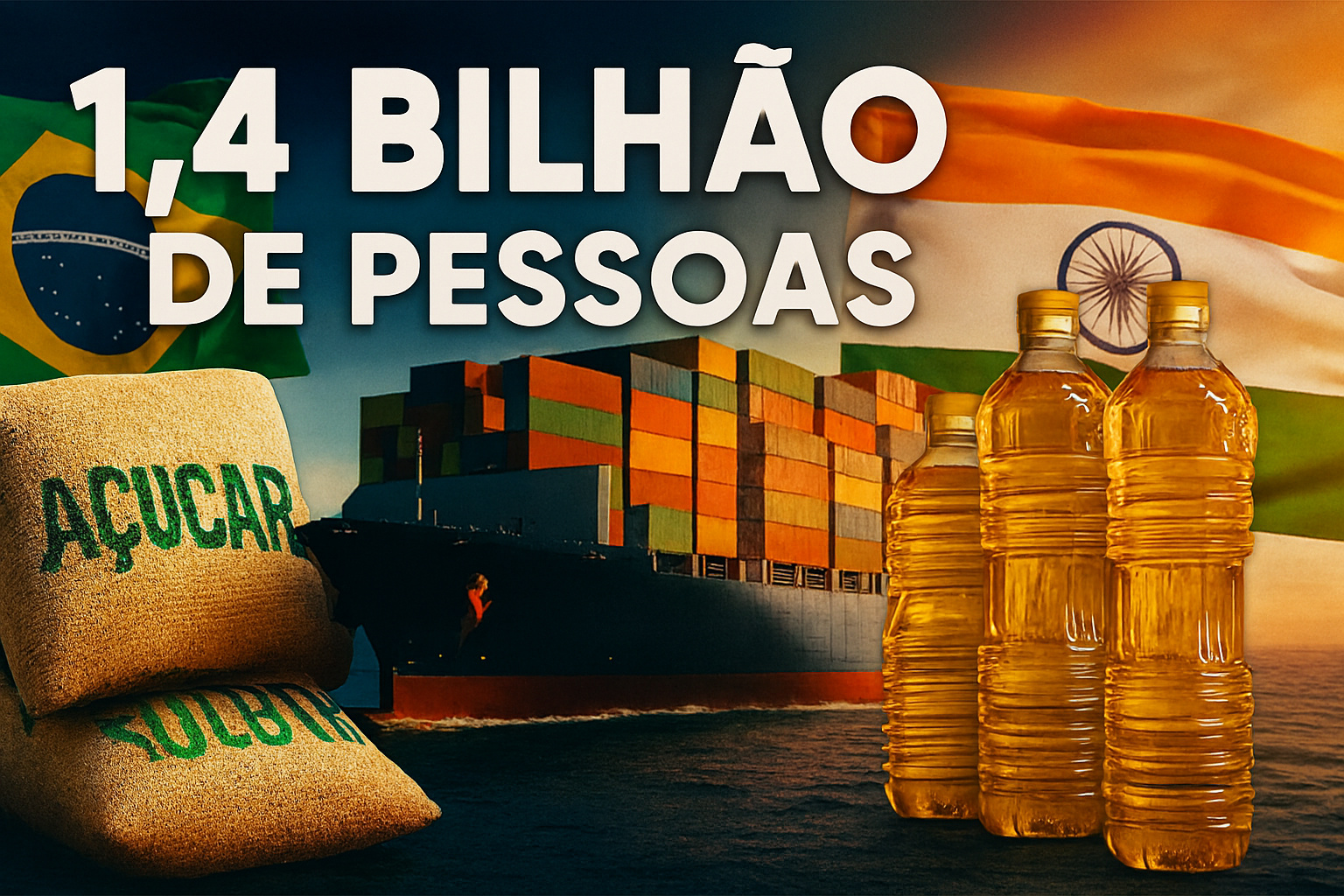
With 1.4 Billion Inhabitants, India Expands Soybean Oil and Sugar Imports, and Brazil Consolidates as a Strategic Partner in Global Food Supply.
India, which has surpassed China and become the most populous country on the planet with over 1.4 billion inhabitants, is now one of the largest food consumption hubs in the world. This enormous internal demand has increased imports of strategic agricultural products, such as soybean oil and sugar, and Brazil is emerging increasingly as a central supplier to meet the Indian market.
The rapprochement between the two countries in food trade reinforces Brazil’s position as a global breadbasket, while consolidating India as one of the main destinations for Brazilian agribusiness exports.
The Size of Indian Demand
India is undergoing a demographic and economic transformation. In addition to housing the world’s largest population, with over 1.4 billion people, the country has an expanding middle class and consumption habits that elevate the need for vegetable oils, sugar, grains, and proteins.
-
“No one will make us change the Pix,” says Lula after the US report.

-
Lula responds directly to Trump and says that Pix is from Brazil and will not change under pressure from anyone, after a report from the United States pointed out the Brazilian payment system as an American trade barrier.

-
Amazon has just announced a new fee on all deliveries, and your online purchases will become more expensive starting April 17, including for those buying from the United States here in Brazil.

-
He sold his share for R$ 4 thousand, saw the company become a giant worth R$ 19 trillion, and missed the opportunity of a lifetime.


According to the Organization for Economic Cooperation and Development (OECD) and the Food and Agriculture Organization of the United Nations (FAO), India is expected to lead the growth in food consumption until 2030, surpassing other emerging economies.
Brazil Gains Prominence in Soybean Oil Exports
Soybean oil is one of the most sought-after items by Indians. As India is a large producer of raw soybeans but not self-sufficient in refining, it needs to import significant volumes of oil to meet domestic demand.
Brazil, the world’s largest exporter of soybeans, has been expanding its share in this market. In recent years, Brazilian soybean oil shipments to India have grown consistently, placing the country among the main suppliers alongside Argentina.
In addition to being used in Indian cooking, the oil is also employed in processed products and the food industry, making India a strategic client for Brazilian agribusiness.
Sugar: A Billion-Dollar Market
Another product connecting Brazil and India is sugar. Although India is one of the largest producers of the sweetener globally, the volatility of its production — influenced by irregular harvests and adverse weather — causes the country to alternate between being a exporter and importer.
In years of deficit, as occurred in 2023 and 2024, India has resorted to imports to balance the domestic market. Brazil, which accounts for about 40% of global sugar exports, has become a natural supplier to fill the Indian gap, strengthening the agricultural partnership between the two countries.
The Geopolitical Impact of the Partnership
The growing presence of Brazil in the Indian food market goes beyond trade. It is a strategic movement that consolidates Brazilian agro-food diplomacy in one of the largest emerging markets on the planet.
As India seeks to ensure food security for its population of 1.4 billion people, Brazil reinforces its image as a reliable supplier amidst global tensions affecting supply chains.
This relationship gains even more weight in the context of the BRICS, an economic bloc that includes Brazil, Russia, India, China, and South Africa, which has recently expanded its members. Agricultural exchange strengthens the South-South cooperation agenda and creates new investment opportunities in logistics and agricultural technology.
Challenges and Opportunities
Despite the rapprochement, there are still challenges to overcome. Tariff and sanitary barriers imposed by India often limit the competitiveness of Brazilian products. Additionally, Brazil’s logistical infrastructure needs investment to ensure lower costs and faster shipments.
On the other hand, the growth potential is enormous. India is expected to consolidate as one of the largest markets for Brazilian agribusiness not only in soybean oil and sugar but also in corn, meats, and ethanol.
Brazil as a Pillar of Global Food Security
The advancement of the Brazil–India partnership reinforces a central point: Brazilian agribusiness is a key player in global food security. With an abundance of natural resources, cutting-edge agricultural technology, and expansion capability, the country positions itself as the main supplier of food to markets that cannot meet their own demand.
In the case of India, this dependence is even more significant, as it involves not only the economy but also the social stability of a population equivalent to almost 20% of humanity.









Seja o primeiro a reagir!