





 Portuguese
  English
  Spanish
  8 min of reading
  0 comments


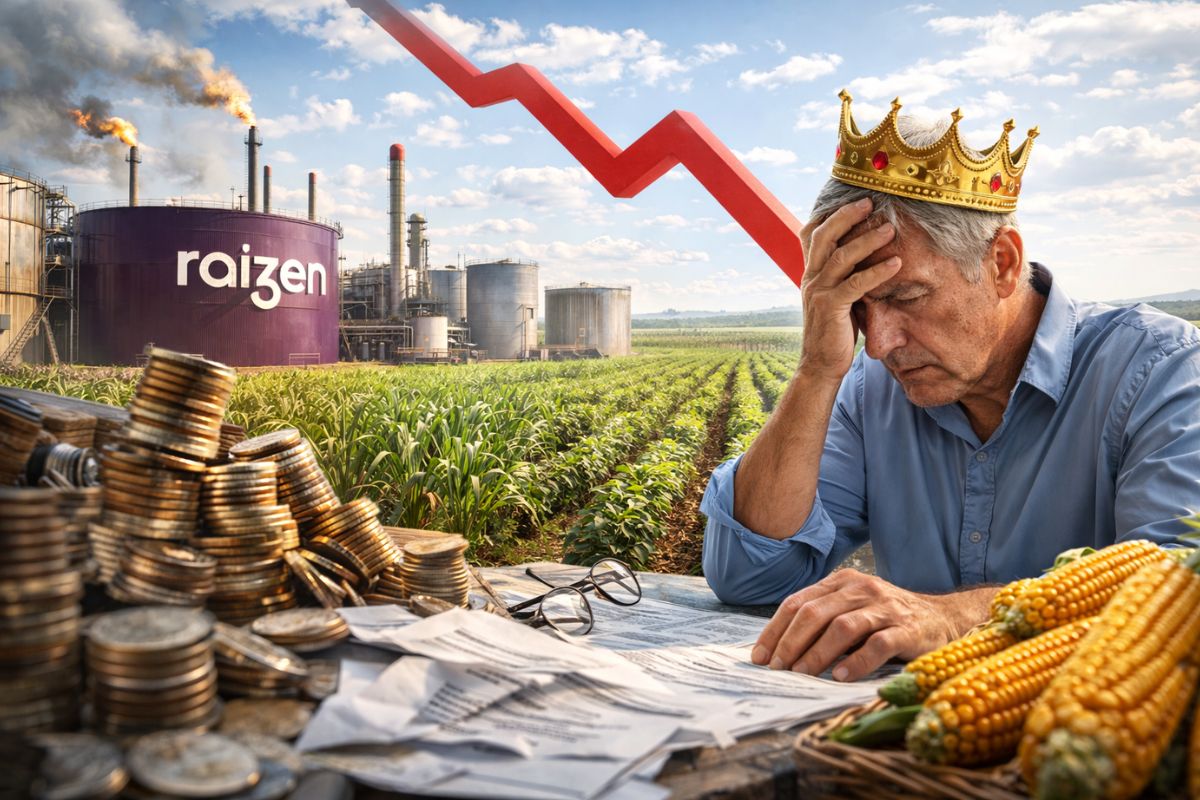
High Debt And Advance Of Corn Ethanol Push Raizen Toward Extrajudicial Recovery At The Center Of The Sector Crisis.
The debt became synonymous with everything that went wrong in Raizen’s recent trajectory. After years of accelerated growth, acquisitions, bets on new areas, and heavy investments, the company reached a point where cash failed to keep up with ambition. The result was a petition for extrajudicial recovery to renegotiate over R$ 5.1 billion in financial debt and try to avoid an even worse worsening of the crisis.
However, the problem did not arise from a single misstep. The company’s situation was built over time by a combination of excessive diversification, costly expansion, lower-than-expected returns on side projects, competitive pressure in the biofuels sector, and a climate and financial shock that deepened vulnerability. The debt became both a consequence and, at the same time, a symbol of a strategy that lost balance.
How Raizen Fell From Peak To Crisis
Founded in 2011 through a joint venture between Cosan and Shell, Raizen emerged with scale, reach, and strength to occupy a prominent position in biofuels, renewable energy, and fuel distribution.
-
Oil surged to $115 a barrel due to the war in the Middle East, and diesel in Brazil has already risen to R$ 7.45 per liter, while the United States…

-
Brazilian city bets on the business environment to generate jobs and attract investments in the energy sector — secretary reveals strategy at Macaé Energy 2026.
-
50 viaducts, 4 tunnels, 28 bridges, and 40 kilometers of bike paths: BR-262 in Espírito Santo will receive 8.6 billion reais for the largest engineering project in the state’s history, inspired by the Immigrant Highway in São Paulo.

-
Brazil produces too much clean energy and doesn’t know what to do with it: over 20% of solar and wind capacity was wasted in 2025 while investors flee and 509 renewable generation projects were abandoned in the last year.


For many years, the company delivered exactly the image it sold to the market: a robust, integrated operation capable of uniting agro-industrial production and urban presence.
This model gained even more strength when the company went public and conducted one of the largest IPOs on the Brazilian stock exchange. The funds raised and the optimistic environment propelled a new phase.
However, this phase also opened the door to a series of bets that, when viewed collectively, ended up putting pressure on cash, increasing operational complexity, and amplifying the debt.
What seemed like strategic diversification began to turn into capital dispersion. And this process became more evident when out-of-focus businesses started consuming resources without delivering the expected return.
Expansion Too Much, Return Too Little
If there is a central axis for understanding the company’s deterioration, it lies in the word expansion. While the core sugar and ethanol business already required heavy investments, Raizen decided to advance into retail, digital platforms, solar energy, and other areas that increased the need for capital.
In the convenience sector, the company made significant investments in expanding stores in partnership with FEMSA. The logic was to use the Shell gas station network as a basis to compete with large retail groups.
The growth was rapid, but the model required a very high scale to generate adequate margins. When the expected returns did not materialize, the operation became yet another vector of pressure on results and, indirectly, on the debt.
In the digital realm, the company also invested in a payment and loyalty platform for Shell stations.
The idea was to position the brand beyond traditional distribution, with a technology and relationship arm. The app grew, but did not deliver the return of a fintech capable of justifying the volume of resources consumed.
At the same time, other bets linked to energy and new business modalities followed the same logic: defensible in isolation, but too heavy together for a company increasingly burdened by debt.
Debt Grew Along With The Structural Complexity
As soon as several projects began to compete for capital at the same time, the company’s corporate structure became heavier and harder to manage.
Instead of a concentrated operation in assets with strong synergy, Raizen began to carry distinct businesses, with different returns and their own management requirements.
This movement helped restrict cash generation and pushed the debt to increasingly elevated levels. According to the data provided, net debt increased from R$ 13.8 billion at the end of the 2021/22 harvest year to R$ 49.2 billion in the first quarter of 2026.
This escalation helps to illustrate how the company lost financial maneuverability in just a few years.
When debt grows at this pace, the problem ceases to be merely accounting. It begins to affect strategic decisions, investment capacity, cost of capital, and even the perception of risk by creditors and investors.
Not Even The Core Business Escaped Deterioration
The crisis at Raizen was not limited to bets outside the central focus. Within the core agro-industrial sector, the company also faced heavy challenges.
The acquisition of Biosev, seen as strategic for expanding the sugarcane industrial park, required significant investments and proved to be less profitable than expected.
At the same time, the company invested heavily in second-generation ethanol, a technology based on using bagasse and cane straw to produce biofuel.
The proposal was aligned with the discourse of energy transition, but the financial return did not come at the pace required by a company already pressured by cash and high debt.
The result was a dangerous combination. Peripheral businesses did not generate the expected return, while the heart of the operation also demanded more investment and delivered less breath than necessary. In this scenario, the debt weighed even more on the company’s reaction capacity.
Corn Ethanol Changed The Logic Of Competition


If internal errors weakened the structure, competition helped exacerbate the situation. The expansion of corn ethanol, especially in the Midwest, profoundly altered the balance of the sector and directly impacted one of the historical bases of competitive advantage for sugar mills.
With corn ethanol production advancing rapidly at a lower cost, many sugarcane processors began directing more raw material to sugar.
This movement pressured sweetener prices and reduced the flexibility sugar mills had to switch between sugar and ethanol according to the profitability of each market.
The provided data shows a significant cost difference between the two models. While the cost of a liter of ethanol from cane was R$ 2.84, the production of corn ethanol recorded by FS Bio stood at R$ 1.55 per liter.
This distance helps explain why the problem does not seem just temporary, but structural. For a company with high debt and a need for cash, facing this change in scenario made everything even more difficult.
Bad Weather And High Interest Rates Accelerated The Collapse
In addition to competitive pressure, Raizen also had to deal with an unfavorable operational context. Starting in the 2024/25 harvest, droughts, fires, and excess rainfall affected milling, productivity, and cane quality.
The fires in São Paulo’s interior in 2024 also compromised sugarcane fields and pressured harvest performance.
At the same time, high interest rates increased the burden of debt on the company. In a company with high indebtedness, every additional point in financial cost has a significant effect on results.
This environment helped transform a difficult, but still manageable, crisis into a financial emergency.
The impact appeared harshly in the numbers. The data mentions a net loss of R$ 15.6 billion in the third quarter of the 2025/26 harvest year and an accumulated loss of R$ 19.8 billion in the first nine months of the cycle. The negative equity reinforced the signal of deterioration and increased the perception of insolvency.
Downgrade, Falling Stocks And Extrajudicial Recovery Request
With the worsening situation, credit rating agencies removed the investment grade from the company. Without this seal, access to credit tends to become more expensive and restricted, squeezing even more companies that already deal with high debt.
At the same time, Raizen’s stocks plummeted 56% in 2025, increasing pressure on the group’s credibility.
It was in this context that, on March 11, 2026, the company filed for extrajudicial recovery in the district of São Paulo.
The plan seeks to reorganize over R$ 5.1 billion in financial debt, in an operation described in the data as the largest extrajudicial recovery in Brazil’s history.
The choice of this route, rather than the traditional judicial recovery, has a clear objective. In extrajudicial recovery, the company negotiates with a specific group of creditors while preserving suppliers, employees, and operational obligations outside the process.
The intention is to gain protection to preserve cash without paralyzing operations in the midst of the upcoming harvest.
The Four Pillars Of The Rescue Attempt
According to the data, the reorganization plan is based on four main pillars. The first is the capital injection by the controllers, with a proposal of R$ 4 billion, of which R$ 3.5 billion is from the Shell group and R$ 500 million from the Ometto family.
The second pillar is the conversion of part of the debt into equity, which may dilute current partners but reduce financial liabilities and align creditors with the company’s future performance.
The third is the sale of assets. Raizen has already been divesting from non-essential assets, and this front is expected to gain even more weight.
The fourth pillar is perhaps the most symbolic of all: a return to focus on the core business. The implicit message is clear.
The era of simultaneous bets in retail, payment systems, electric charging stations, solar energy, and other areas financed through credit seems to have reached its limit.
Why The Raizen Crisis Matters Beyond The Company
The size of Raizen means that the crisis transcends the corporate realm. The company employs tens of thousands of collaborators, thousands of business partners, and dozens of sugar, ethanol, and bioenergy mills spread across the country.
A disordered deterioration would have a cascading effect on agribusiness and fuel supply.
For this reason, the company’s debt is not just a private problem. It connects to an enormous production chain, with potential ripple effects on suppliers, producers, workers, and logistics.
In other words, what is at stake is not just the future of a company, but the equilibrium of a significant part of the Brazilian sugar-energy sector.
At the center of this story lies a harsh irony. The company that sought to be everything at once lost strength just when the market began demanding more efficiency, more focus, and more capital discipline. The debt exposes this error with brutal clarity.
What Is At Stake Now
The request for extrajudicial recovery shows that Raizen is still trying to control the crisis before it worsens further.
But it also makes it clear that the model that sustained the previous phase of expansion has reached its limits.
Now, the company needs to convince creditors, investors, and the market that it still has the means to reorganize operations, cut excesses, and rebuild trust.
The central question is whether there will be time and breathing room for that. Between the weight of the debt, the competition from corn ethanol, the need for cash, and the operational pressure of the harvest, the room for error has become much smaller. The empire of the king of ethanol stands, but it clearly no longer seems untouchable.
Do you think Raizen can overcome its billion-dollar debt and return to focusing on the core business, or has the rise of corn ethanol changed the game definitively?








-

Uma pessoa reagiu a isso.