





 Portuguese
  English
  Spanish
  7 min of reading
  1 comment


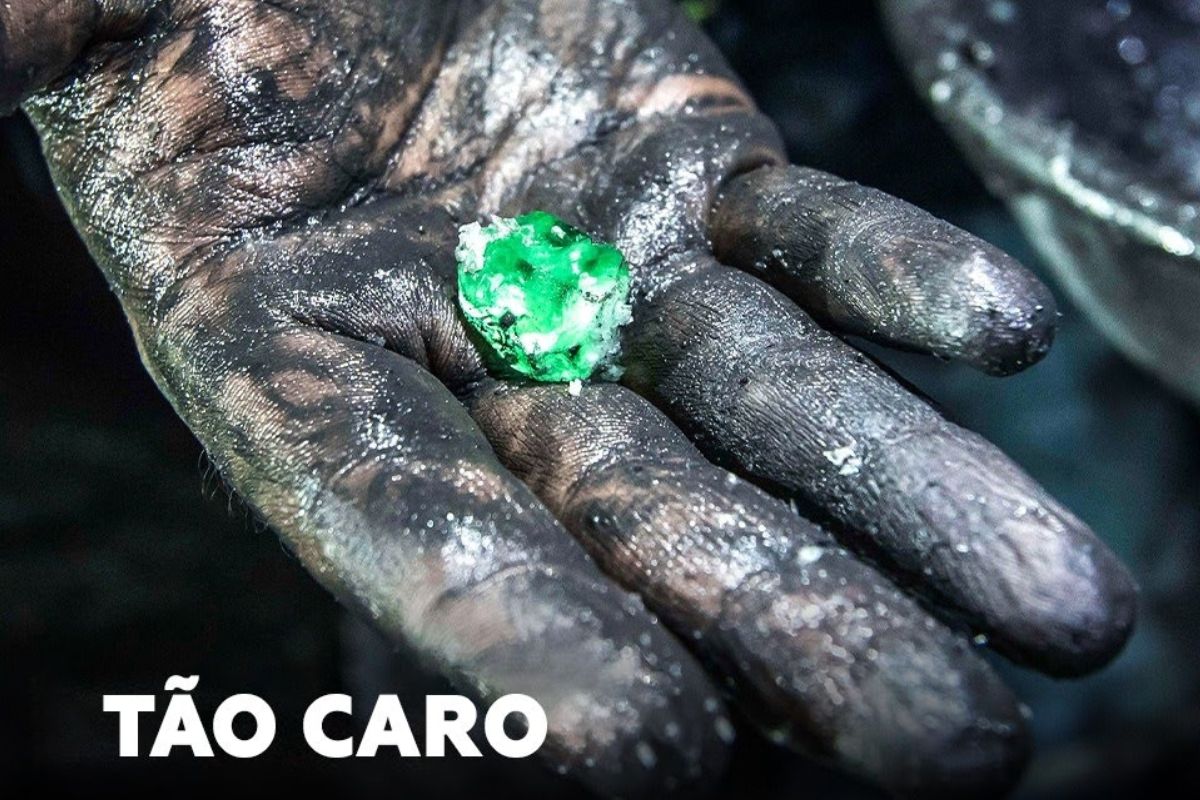


With Emeralds Worth Up To Half A Million Dollars Coming Out Of Ultra-Modern Tunnels While Thousands Of Gold Diggers Compete For Shale Residues On The Slopes, The New Colombian Green Rush Evidences A Brutal Abysm Between International Capital, Formal Jobs, And Precarious Survival In Mining Towns, Where Each Stone Redefines Local Destinies
From the mounds of dust removed from the most valuable mines to the air-conditioned offices of those who export cut gems for red carpets and royal weddings, the Colombian emerald chain is driven by extreme contrasts. On one side, operations with optical scanners, widened tunnels, and investments of 150 million dollars. On the other, men and women who spend hours digging through waste by hand in search of a stone the size of a fingernail.
In this scenario, Colombia is experiencing a fierce competition for mineral wealth, now in a globalized version. Foreign investors modernize mines, increase exports, and extend licenses until 2050, while local miners struggle to maintain access to the only possible source of income in the mountains. At the center of this conflict are the emeralds worth up to half a million dollars per raw stone, turning each fragment of shale into an economic, social, and political battleground.
Why Colombian Emeralds Are So Valuable

The scientific basis for this wealth lies in the specific geology of the region.
-
Nikola Tesla said that intelligent people tend to have fewer friends, and now science partially confirms this: a study with over 15,000 people showed that for the more intelligent, socializing too much can even reduce life satisfaction.

-
A superyacht worth US$ 17 million is delivered in impeccable condition, sets out to sail, and hits a bridge in the Bahamas just two hours later.

-
Residents of Australia woke up to a sky completely red like blood before the arrival of Cyclone Narelle, which hit the coast with winds of 250 km/h, tearing off roofs and lifting iron dust in a scene they described as apocalyptic.

-
New 100% clean fuel produced in Brazil could retire diesel.


Unlike other countries, Colombia is one of the few places where emeralds form in shale, rather than in more common rocks.
Shale contains the essential ingredients of the crystal, but also generates byproducts like sulfur and pyrite.
This detail changes everything.
Sulfur retains part of the iron that would enter the gem’s structure. Less iron means a more saturated, deep, and clean green, exactly what the luxury market desires.
In an environment where color is worth more than size, emeralds worth up to half a million dollars per single raw stone emerge, with prices reaching tens of thousands of dollars per carat for the highest quality pieces.
Gold Diggers On Mounds Of Waste, Physical Risk In Exchange For Minimal Chance

Far from cutting-edge technology, the routine of gold diggers unfolds in the remnants of mining.
Mounds of rubble are produced daily from industrial mines and are dumped on slopes and valleys.
It is there that hundreds of people spend hours sifting through waste, in a dynamic reminiscent of the old gold rushes, but with risks concentrated in a few meters of unstable terrain.
Broken clavicles, fractured ankles, and frequent falls are part of the unofficial statistics of this informal economy.
Still, for characters like Nidan, a veteran gold digger, the risk is worth it when a good stone appears.
A recent find allowed her to pay off debts and buy a house, but she has not found anything truly valuable in over a year.
Most days, the hours spent digging translate only into small emeralds that are worth little, oftentimes less than 25 units of currency per stone.
Everything happens in short windows.
The so-called voladoras, moments when part of the waste is released to the gold diggers, are sporadic.
In some periods, the next opportunity may take weeks, making each uphill scramble a combination of extreme physical effort and mineral lottery.
When money or emeralds are involved, as is reiterated among the gold diggers themselves, there is no secure friendship, and sometimes not even family.
From Green Wars To Foreign Investors With 150 Million On The Table

The current conflict did not arise from nothing.
Since the mid-20th century, the Colombian state has attempted to nationalize emerald mines, but the remote geography and the presence of local elites have made direct control unfeasible.
In the 1970s came a second attempt to reorganize the sector, with concessions given to local leaders known as dons, based on charging royalties rather than operating production.
These dons, many former gold diggers, accumulated economic and military power, ensuring jobs and some income for communities while becoming involved in violent disputes.
Starting in 1965, the region plunged into what were called green wars, a succession of confrontations between local bosses, illegal groups, paramilitaries, and traffickers.
The ceasefire of 1990 stabilized open violence but solidified the idea that the emerald is controlled by a few.
In the 2000s and 2010s, the relatively pacified environment attracted external capital.
Large international companies took over strategic mines, investing in wider tunnels, proper ventilation, support systems, and heavy machinery.
In one case, a foreign company invested 150 million dollars in the modernization and expansion of tunnels, transforming a one-meter corridor into four-by-four-meter galleries where even vehicles can circulate.
Emeralds Worth Up To Half A Million Dollars, Fixed Salaries, And Little Space For The Small Folk
Modernization has brought real changes for part of the workforce.
Approximately 500 workers directly employed by one of these mining companies describe a very different scenario from that of artisanal fronts.
Proper ventilation, structural support, safety routines, and fixed salaries have replaced the logic of earning only if the stone appears.
For families led by women, like Carmenza, this formal job represents stability in regions with few economic alternatives.
The mining process has also become more sophisticated.
The search begins with white calcite, a rock associated with the presence of emerald veins.
Once the promising area is identified, the team advances with excavation, ceiling and wall reinforcement, and, in the next stage, washing and mechanized classification.
Today, optical classifiers with cameras and ultraviolet light detect the gems amidst the shale, automatically redirecting the valuable fragments.
This efficiency has a direct social cost.
The more complete the industrial utilization, the less there is left for the gold diggers.
In some operations, the excess shale is used for the maintenance of internal roads, with no release of waste for voladoras.
Practical result: while the emeralds worth up to half a million dollars continue to make their way to international jewelry stores, entire communities go months without access to the remains that previously guaranteed some income.
Million-Dollar Exports, Concentrated Profits, And Cities Without Refrigerators
At the top of the chain, the logic is global. Each year, Colombia exports between 130 and 150 million dollars in emeralds.
One of the main destinations is the U.S. market, where wholesalers negotiate directly with major jewelers.
It is at this point that the value leap becomes most evident: stones purchased at the source are resold to luxury brands, appearing at red carpet events and in wedding jewelry for royals.
From the intermediaries’ perspective, peace in mining regions and the presence of large companies provide predictability to the flow of gems and final quality.
Some investors claim they only became interested in the sector after the entry of international mining companies in areas like Muso, precisely because modernization reduced operational risk.
At the same time, foreign companies announce new investments of over 100 million dollars and renew mineral extraction licenses until 2050, ensuring a long-term agenda for exploring emeralds worth up to half a million dollars in high-income markets.
In the neighboring towns, the reality is much less spectacular.
Many residents report that not even a refrigerator is guaranteed in their homes, despite living over deposits that supply the global market.
For gold diggers who go an entire year without finding a truly valuable stone, the income obtained from a rare find may equal a lifetime’s earnings in other jobs, but this chance comes with long periods of no return at all.
Between Faith In The Green Stone And The Struggle For Dignity
Amidst so much asymmetry, many workers develop an almost spiritual relationship with the gems.
For Nidan, for example, emeralds are associated with energy, luck, and mindset. For others, green symbolizes health, abundance, and prosperity.
The idea that a single stone can completely change a family’s fate fuels persistence in extreme-risk environments.
At the same time, local leaders are trying to formalize practices such as the voladora, prioritize local labor, and ensure that part of the economic surplus remains in the communities.
The National Mining Agency signals more accessible processes for small titles, and departmental governments seek mediation in recent conflicts, but in practice, the gap between small-scale miners and large international groups remains vast.
Five centuries after the arrival of the conquerors who forced Indigenous peoples and enslaved Africans to explore the first extraction fronts, the cycle repeats itself with new tools and old results.
Mining companies’ technology has changed, capital scale has multiplied, and emeralds worth up to half a million dollars have gained global showcases, but profit remains concentrated at the top while the communities at the base continue to compete for each fragment of shale.
And you, looking at this dispute over emeralds worth up to half a million dollars, think that the priority should be to increase global profit or ensure dignified income for those who live and work in these Colombian mountains?








O ESTADO na Colômbia assim como no Brasil, é DONO de tudo e de todos. Políticos e Funcionários Públicos que controlam o país, as leis, o governo, vendem o que querem a quem quiser pagar mais. Lá, como aqui É PROIBIDO aos mineiros trabalharem nas terras do ESTADO e mesmo nas suas próprias terras, caso tenham alguma.
Aqui no Brasil o subsolo é do ESTADO e se os pobres mineiros forem trabalhar artesanalmente em Rios são impedidos de todas as formas.
Um grande exemplo é a região de OURO PRETO onde em seu entorno existe o topázio imperial que o ESTADO proibe explorar. Areas remotas, que não tem nada, ainda assim não pidem ser exploradas.