





 Portuguese
  English
  Spanish
  5 min of reading
  0 comments


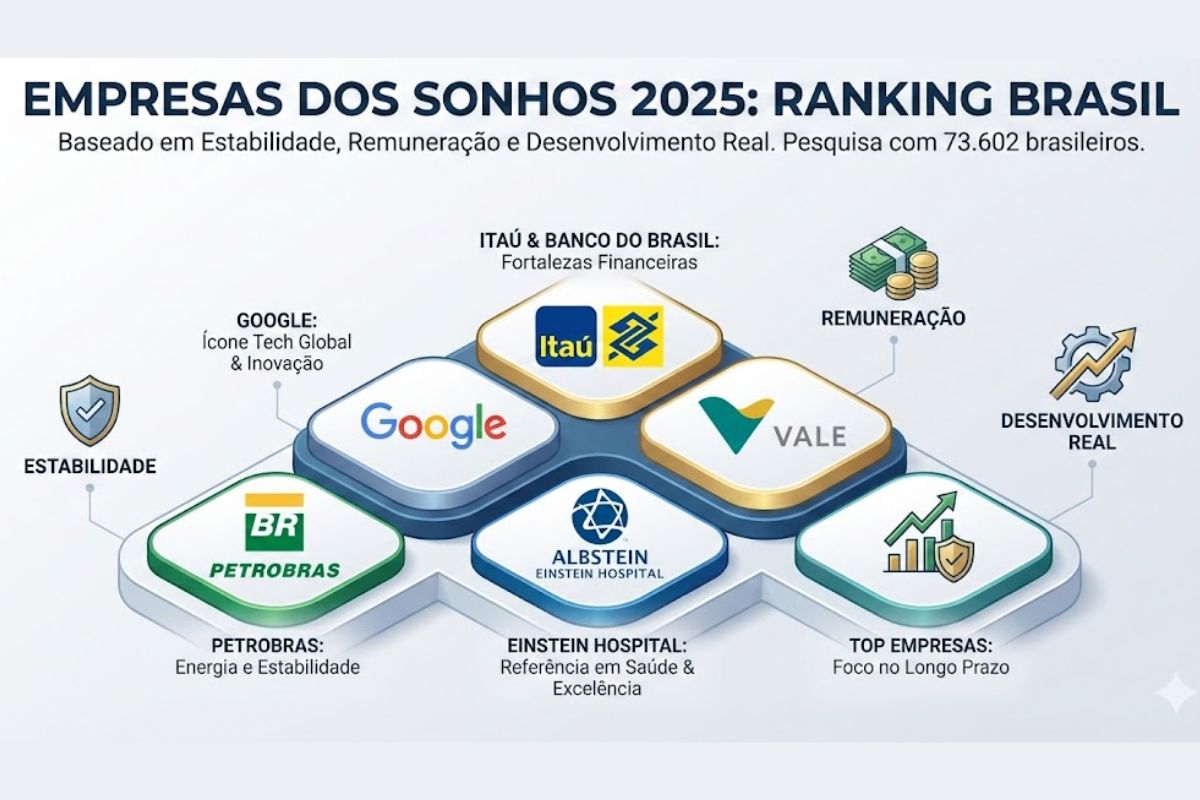
Dream Job Survey Heard From 73,602 Brazilians and Shows That Dream Companies in 2025 Combine Stability, Competitive Salaries, Continuous Development, Well-Being, Real Flexibility, and Coherent Culture, Placing Google, Itaú, Vale, Petrobras, Banco do Brasil, and Einstein Among the Most Desired in the Country by Profiles and Generations Today.
The Dream Job Survey 2025, conducted by Cia de Talentos, interviewed 73,602 people between May 13 and August 22 and reveals that the dream companies in 2025 are no longer the same as those of the past. For youth, middle management, and senior leaders, the combination of financial stability, competitive salaries, and real professional development increasingly matters, not just a strong brand or inspiring purpose statements.
According to content director Danilca Galdini, the study indicates a structural change in the relationship Brazilians have with work. Employment is no longer the center of identity and personal fulfillment; it is now a means to ensure security, well-being, and time for life outside the office. In this new scenario, the dream companies in 2025 are those that offer sustainable working conditions, income growth and concrete opportunities for continuous learning.
Stability Takes on New Meaning in Dream Companies in 2025
One of the strongest findings of the survey is the weight of the word stability. It appears as a common desire among youth, managers, and executives but no longer means a lifetime position or an entire career in one place.
-
Future profession with immediate earnings: Specialist reveals how a solar energy technician earns R$ 8,000 per month by taking advantage of the explosion in demand across the entire country.

-
Work from 8:30 AM to 5:30 PM with a 1-hour break at Sicredi as a Customer Service Assistant and receive a salary + benefits such as life insurance, dental plan, partnerships, Gympass, and much more in job openings across various states.

-
Subsea7 has job openings: the company has offshore and onshore positions available in 2026 for operators, pilots, supervisors, engineers, and much more.
-
Unimed is hiring candidates with and without experience! More than 10 job openings for Assistants, Analysts, Kitchen Assistants, and much more!


In the dream companies of 2025, stability means predictable income, minimum security, and, above all, the opportunity to continue learning to remain employable.
Galdini summarizes that professional stagnation is seen as a form of instability. In other words, staying still is risky.
Therefore, talent seeks environments where they can update their skills, test roles, change fields, and build a resume that protects them in times of crisis.
In practice, the companies that appear as dream companies in 2025 are those that combine solidity with open doors for internal mobility and continuous improvement.
Continuous Development Has Led the Wish List for 15 Years
Among youth, middle management, and senior leadership, development is the number one reason to choose any company, and this is not new. For 15 years, this topic has topped the list among the youngest, and in 2025 it also ranks first for other audiences.
In the reality of the dream companies in 2025, development is no longer a generic statement; it is an objective criterion in the decision-making process.
Internship programs, trainee positions, structured career paths, certifications, and tailored training are considered concrete tools for social mobility and income growth. One data point cited by the director reinforces this: 90 percent of professionals would not have studied in the last year without support from their company, according to research by Único Skill.
Thus, educational benefits cease to be a perk and become a retention strategy in the dream companies of 2025, eliminating financial barriers and transforming the desire to improve into a sustained practice.
Compensation Rises to the Top Focused on Security and Survival
The survey also shows that compensation and benefits return to the center of career decisions, ranking among the top three reasons for choosing most of the analyzed companies.
For Galdini, this is a direct reflection of what young people experienced during the pandemic: high unemployment, pressured family income, and closure of nearby businesses.
In this context, the feeling of vulnerability and risk aversion grows. Work again becomes, first and foremost, a source of security and survival, which makes salary and benefits weigh more in the equation.
At the same time, the executive emphasizes that compensation alone does not retain anyone, especially in the dream companies in 2025.
What retains talent is the combination of competitive salary, consistent development, and healthy working conditions, with boundaries respected and real support for well-being.
Flexibility Enters Even Traditional Sectors of the Ranking
The survey also records a movement of flexibilization in historically rigid sectors. Banco do Brasil, for example, was the only one in the Top 10 where flexible policies appear among the most cited reasons by respondents, which is symbolic for the traditional financial system.
Hybrid models, flexible hours, and benefits linked to well-being are beginning to become competitive advantages for attracting and retaining people, especially among younger individuals. For Galdini, dream companies in 2025 are those that can combine formal stability with operational autonomy, allowing professionals to better organize their routines and place life at the center without abandoning the delivery of results.
How Small and Medium Enterprises Compete With Giants for Dream Companies in 2025
Although the top of the ranking is dominated by giants in technology, finance, mining, consumer goods, media, and healthcare, the 2025 edition of the Dream Job Survey brings unprecedented diversity.
The new generation increasingly values Brazilian companies from different sectors, with authentic value propositions that align with what they deliver daily.
In Galdini’s view, there is no longer a single dream company; there is a set of companies for different dreams.
This movement opens space for smaller businesses to stand out by understanding and clearly communicating their real strengths, such as approachable culture, visible impact, rapid growth, autonomy, involvement in decisions, and fast learning environments.
Thus, even without the same brand as Google or Itaú, an organization can position itself among the dream companies in 2025 for a specific group of professionals.
Ranking of the Top 10 Dream Companies in 2025
The overall ranking of the Top 10 Dream Companies is made up of major names in technology, finance, mining, energy, consumer goods, media, and healthcare, reflecting the diversity of sectors that now attract Brazilian professionals.
The dream companies in 2025 are as follows:
- Itaú Unibanco
- Vale
- Ambev
- Petrobras
- Nestlé
- Grupo Globo
- Microsoft
- Banco do Brasil
- Hospital Israelita Albert Einstein
Beyond the list, what stands out is the package of attributes that these names represent in the minds of respondents: brand credibility, opportunities for growth, the possibility to learn from high-performing individuals, and some level of protection in adverse economic scenarios.
What Defines the Dream Companies in 2025
In 2025, the dream company is one that can combine tangible development, financial and emotional stability, tangible recognition, and a culture consistent with what it promises, according to the director of Cia de Talentos.
The brand remains important but loses strength when not accompanied by real practices of care and learning.
Experts cited in the study discuss a movement of “life before login”, in which well-being takes the place that work used to have as the main axis of identity.
The dream companies in 2025 are those that respect this reversal of priorities, offering space for employees to take care of their health, family, and personal projects while building careers with development, income, and predictability.
Ultimately, the survey reveals that the desire is no longer to work for passion at any cost but rather to work sustainably to live well.
Given this scenario, the question remains for those reading and for those hiring: for you, what characteristics should be essential in the dream companies in 2025 for it to be worth investing time, energy, and talent in an employer brand?







-

Uma pessoa reagiu a isso.