





 Portuguese
  English
  Spanish
  5 min of reading
  6 comments


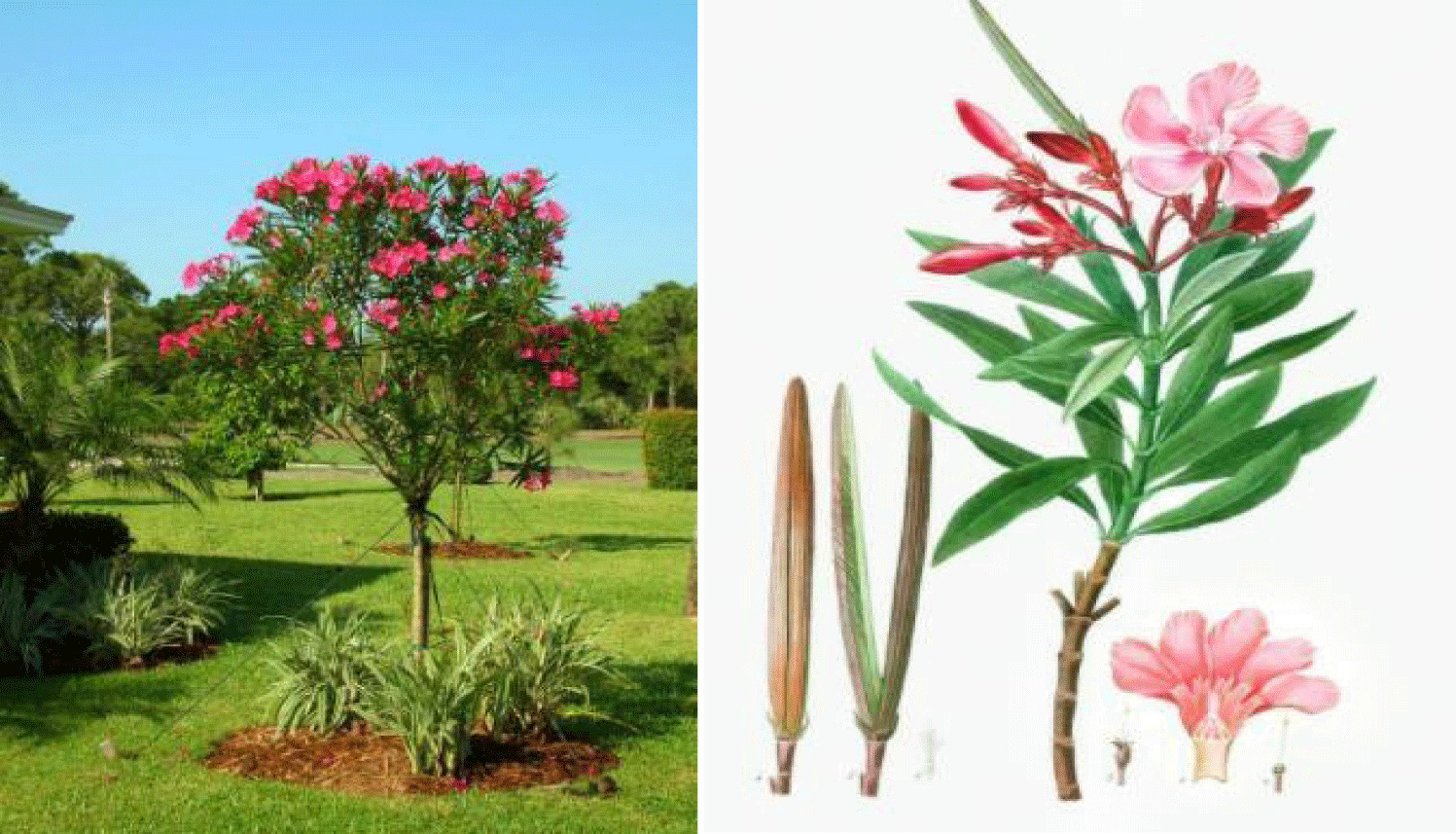


Tree Produces Cardiac Glycosides in Leaves for Defense Against Herbivores and Shows How Plant Chemistry Evolved to Be Lethal and Precise.
Few people imagine that an apparently ordinary tree, with shiny leaves and ornamental flowers, could carry a biochemical arsenal capable of interfering with the heart function of animals. This is the case of oleander (Nerium oleander), an ornamental plant widespread in hot and semi-arid climates that has become the subject of study in botany, chemistry, and pharmacology due to its cardiac glycosides, molecules that can alter the heart rate even when present in very small quantities — often in the microgram range.
Although this toxicity is dangerous for animals trying to chew its leaves, the evolutionary objective is not aggression, but defense against herbivory, a mechanism that enhances species survival in challenging environments. Understanding how this works reveals a little-known facet of plants: they are not passive but specialists in fine chemistry, capable of synthesizing highly complex compounds for precise purposes.
The Chemistry Behind the Poison: How Cardiac Glycosides Work
To understand the impact of this tree, one must look at the compounds it produces. The main ones are cardiac glycosides, a group of molecules also found in species such as digitalis, adonis, and strophanthus.
-
With a cost per shot close to zero, the DragonFire laser could change naval warfare in 2027 and provide British ships with nearly unlimited defense against drones.

-
A British startup creates tires that generate electricity in electric vehicles when passing over potholes, speed bumps, and cracks.

-
Scientists have created robots made with living cells that have their own nervous system, swim on their own, explore the environment, and self-organize without any genetic engineering, and now they want to do the same with human cells.

-
Students create a solar-powered ambulance that operates without a plug, without fuel, and still keeps medical equipment running in remote areas.



The oleander, in particular, contains substances like oleandrin, which can alter the sodium and potassium pump (Na⁺/K⁺-ATPase) in heart cells. This is an essential system for maintaining proper heart rhythm and electrical transmission between cells.
At low and strictly controlled levels, molecules from this group have historically been used by medicine to treat congestive heart failure, as they increase the strength of contraction. However, outside of a medical context, these compounds can make the heart rhythm irregular and dangerous in many animals, which explains their defensive role in ecology.
It is important to highlight to the reader that, despite its reputation, the oleander is not a “killer plant” nor something that presents a mandatory risk just by existing in the environment. The danger lies in ingestion and internal contact, not in coexistence. This is why it is widely used as an ornamental plant in cities, gardens, and highways.
Plant Defense: Why Does a Tree Invest in Such Sophisticated Poison?
One of the most intriguing questions about oleander is: why spend energy producing such a complex molecule?
The answer lies in the dynamics of herbivory. In ecosystems where goats, wild herbivores, and insects compete for food, a highly palatable plant has less chance of surviving. By developing a defensive compound:
- it deters large herbivores, which learn to avoid its leaves,
- prevents excessive consumption, ensuring reproduction,
- reduces attacks by insects, which can perceive the bitter taste,
- avoids leaf loss, which is essential for photosynthesis.
This mechanism is not unique in the plant kingdom. Various plants use alkaloids, terpenes, and phenolics as defense, but oleander stands out for its potency of the compound and the precision of the physiological target.
Ecology and Distribution: A Specialist in Hostile Environments
The oleander is not just chemical; it is also resilient. The species thrives in:
- dry soils,
- high temperatures,
- low water availability,
- high salinity, in some Mediterranean regions.
This resilience explains why it is so common in urban pavements and highways, places where more sensitive native trees would hardly survive.
Records indicate that Nerium oleander is naturally present in areas of the Mediterranean, North Africa, the Middle East, and parts of Asia, but has been introduced ornamentally in several countries, including Brazil.
In dry ecosystems, producing a potent defensive compound helps reduce leaf loss. The less a tree loses leaves, the less water it wastes, as leaves are responsible for a large part of transpiration.
When Chemistry Becomes Scientific and Pharmacological Interest
The presence of cardiac glycosides in plants has not gone unnoticed by medicine. The most well-known example is digoxin, originally extracted from digitalis (Foxglove), used since the 18th century to treat heart failure. In the case of oleander, the pharmacological interest is focused on oleandrin, whose mechanism of action has been investigated in:
- cardiology,
- molecular pharmacology,
- cell biology,
- animal toxicology.
It is worth noting that the medical use of such substances requires extremely precise dosages, supervised by professionals, and cannot be compared to the plant in its natural state.
In the scientific context, oleander serves as a biological model to study how certain molecules interact with cell membranes and vital proteins.
Toxicity and Safety: Urban Coexistence Without Panic
Despite its toxic potential, oleander is a common tree in squares, avenues, and condominiums. This happens because:
- its toxicity is not through contact,
- it does not release toxins into the air,
- it does not affect humans merely by proximity,
- it does not create spontaneous environmental risk.
The danger lies in the direct ingestion of leaves, flowers, or sap, primarily by domestic animals or small children, which can be avoided with simple urban management measures (education, pruning, signage in schools, etc.).
Science does not treat oleander as a villain, but as a fascinating chemical organism that requires respect and proper management, just like poisonous fungi, toads with skin toxins, and other biological defenses.
Botany as Invisible Chemical Engineering
The case of oleander shows how plants are discreet chemical engineers. Without muscles, without eyes, and without active behavior, they create molecules with specific cellular targets, modulate electrochemical gradients, and influence the physiology of animals much larger than themselves.
The most intriguing question is that this mechanism is not an exception — it is part of a silent biochemical universe that includes:
- defensive alkaloids,
- nerve toxins,
- anti-inflammatory compounds,
- antibiotic molecules,
- hormonal regulators.
If a tree can independently synthesize compounds capable of interrupting such a sensitive bioelectrical cycle as that of the heart, an inevitable question arises: how many biotechnological, pharmacological, and ecological solutions are still hidden in plants we consider merely ornamental?
It is this mix of danger, precision, and simplicity that makes oleander a powerful reminder that evolution does not waste energy; it invests with purpose, and sometimes that means turning a green leaf into a living laboratory.








Aqui em Moçambique é comum usar-se medicinalmente, para trato dos dentes (usar para, em caso de dores nos dentes, escova-los) e cura quase que instantaneamente!
Essa árvore fez parte de minha infância, havia uma na casa de minha vizinha, eu amava o perfume das flores. Recentemente consegui uma muda, fiquei muito feliz, porém comecei a ter informações de sua toxidade e por temer por meus netinhos, desfiz -me dela.
Aqui na minha região Montes Claros MG é muito comum essa planta em praças e calçadas. Curioso é que na chácara do meu vizinho, as formigas “cabeçudas” quase não atacam as outras plantas, mas essa elas pelam,carrega todas as folhas. Então não é tóxica para formiga cortadeira?