





 Portuguese
  English
  Spanish
  7 min of reading
  3 comments


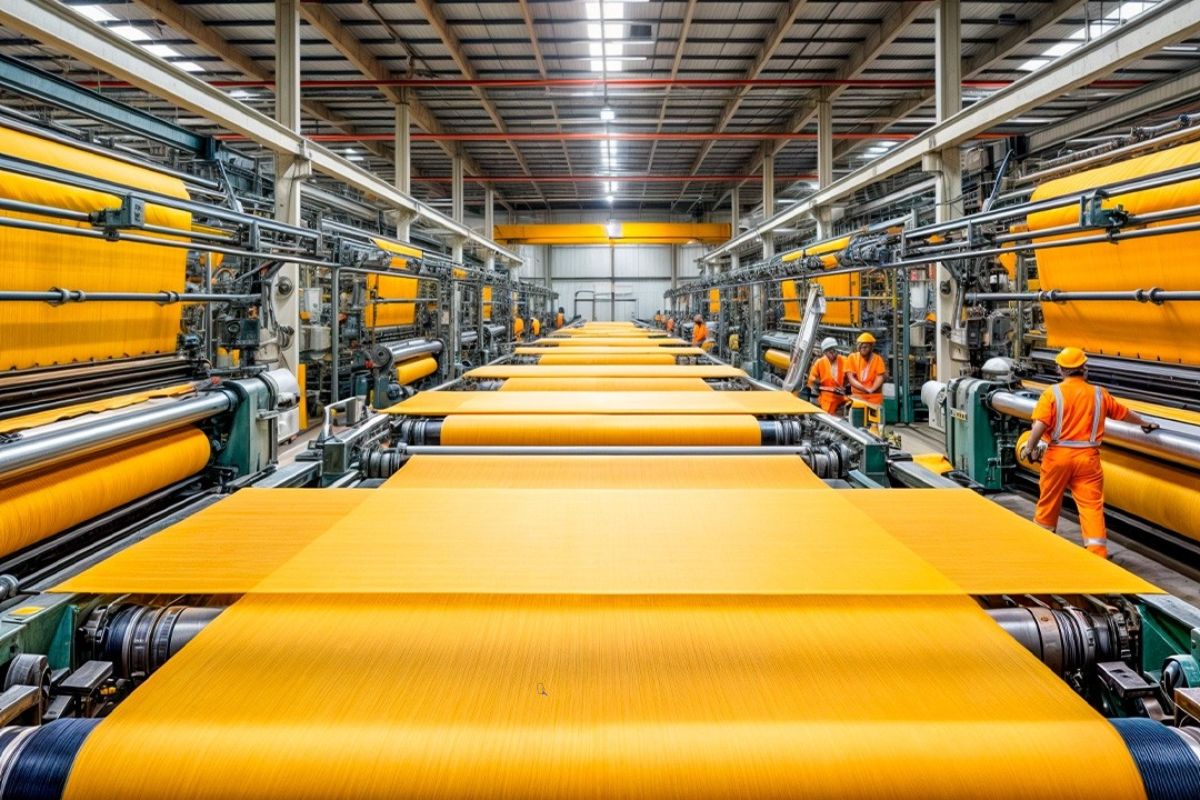


With Strength Five Times Greater Than Steel and Bullet-Stopping Capability, Kevlar Fiber Comes from Chemical Reactors Filled with Acid, Goes Through a Liquid Crystal Phase, and Ends as Ultrafine Filament Lines to Become Practically Indestructible
The Kevlar fiber is one of those materials that seem to come from a secret science fiction laboratory, but is already part of the routine of armies, police forces, industries, and even space exploration. At first glance, it is just a soft, golden-yellow filament that can be wrapped around a finger. However, at the microscopic level, each fiber concentrates a perfectly aligned army of rigid molecules, which makes this fiber up to five times stronger than steel at the same weight and capable of stopping a bullet.
Behind this extreme performance is precise chemical engineering that starts with two seemingly common powders, goes through a highly corrosive reaction, a liquid crystal state, and a spinning process that stretches the molecular chains to the limit. The result is a Kevlar fiber with high mechanical resistance, thermal stability, and a rare balance between lightness and protection, now competed for in a billion-dollar aramid fiber market.
From Discrete Powder to Aggressive Polymer

Before becoming Kevlar fiber, the material is born in a setting very different from traditional textile spinning.
-
With 1,066 acrylic panels, the building known as the friendly alien is supported by a steel skeleton, has a façade that functions as a giant screen, and impresses the world without any internal columns.
-
Scientists warn that a comet about 1 km in size that has started to release gases may actually change direction in space. It was spotted by NASA and surprises with potential impacts near Earth.
-
These living root bridges and ladders are over 700 years old and help indigenous people survive in one of the rainiest regions in the world.

-
From sertanejo star to international investor: Ana Castela invests millions in a mansion in the USA, creates a themed accommodation in Orlando, and shows that the “boiadeira” also wants to grow away from the stage.


It all starts in stainless steel reactors, where two solid components are combined: an organic powder rich in amine groups and a needle-like crystalline compound, such as terephthalic chloride, which acts as a “building block” for the chain.
In solution with a special solvent, these molecules are set to react in a process of polymerization.
It’s as if each monomer had “two hands,” and each unit of chloride had “two hooks.”
The reaction makes the hands and hooks connect one by one, building long, linear macromolecules that will be the backbone of Kevlar.
As a byproduct, hydrochloric acid arises, making the mixture highly corrosive and requiring strict material control, temperature, and safety in the plant.
At the end of this stage, the reactor no longer contains a simple liquid but a thick, viscous yellowish mass with long chains of polyparaphenylene terephthalamide.
Chemically, the polymer is ready. Industrially, it is not yet: it is so rigid and so strongly attracted to itself that it tends to form solid crystals suspended in a liquid medium, as if it were a hard particle gel.
Sulfuric Acid and the Secret of the Liquid Crystal

The next challenge is crucial: turning this almost insoluble gel into a uniform solution that can be extruded into filaments.
To do this, the industry resorts to one of the most aggressive means available, cold concentrated sulfuric acid.
The thick polymer mass is carefully added to the acid, under strict safety protocols. The acid breaks weaker intermolecular interactions, “loosening” the chains and allowing them to disperse.
However, instead of behaving like common polymers, the Kevlar macromolecules form a liquid crystal solution.
In this state, the rigid rod-shaped chains do not orient randomly.
They tend to align in parallel domains, like logs floating organized in a river.
This spontaneous alignment is critical for the final performance: the fiber is born with a prior orientation that will be exploited later in the spinning process.
It is this viscous, golden, and anisotropic solution that proceeds to the next phase.
Wet Spinning: from Liquid Crystal to Continuous Fiber

The transformation of the solution into Kevlar fiber begins in a set of spinning machines that look little like a traditional textile industry.
The process is known as wet jet spinning.
The Kevlar solution in sulfuric acid is pressurized and pushed against a metal plate with hundreds of micro-holes, each thinner than a hair.
As it passes through these holes, the polymer exits as extremely fine jets.
Before coming into contact with water, each jet crosses a small column of air, which already guarantees a first stretching and increases the orientation of the chains along the axis of the fiber.
Shortly thereafter, these micro-jets fall into a coagulation bath containing cold water or a specific solution.
The extreme difference between the hot acidic medium and the cold bath causes an immediate solidification: the acid is displaced, the chains “freeze” in the highly ordered position, and what was once liquid becomes solid fiber.
From the bath emerges a bundle of hundreds of golden, flexible filaments that are already extremely resistant.
They undergo several stages of washing to remove traces of acid and controlled drying systems until the residual water is practically eliminated.
At this stage, it is already possible to speak of a functional fiber, though still far from the maximum performance limit that Kevlar can offer.
Thermal Stretching: Aligning Molecules to the Limit
For the Kevlar fiber to achieve its characteristic strength, an additional step is necessary: controlled thermal stretching.
The bundle of fibers passes through ovens where the temperature can reach 300 to 400 degrees Celsius, enough to make the chains slightly more mobile without degrading the polymer.
Then, the set goes through rollers that spin at progressively higher speeds.
Each group of rollers pulls the fiber slightly faster than the previous one, forcing the fiber to stretch.
It is a “physical training” on a molecular scale: the stretching eliminates residual disorders, removes micro-curvatures, and forces all rigid chains to align almost perfectly along the axis of the fiber.
This fine adjustment transforms the partial alignment of the liquid crystal into a practically maximum orientation.
The intermolecular bonds begin to work all in the same direction, multiplying resistance to tension without requiring more mass.
The result is a Kevlar fiber with an exceptional strength-to-weight ratio, capable of withstanding extreme loads and dissipating impact energy in milliseconds.
After cooling, this fiber is wound into industrial spools, with hundreds or thousands of continuous meters, ready to be sent to the units that will weave, braid, or incorporate the fibers into larger structures.
From Laboratory to Vest, to Cable and Aircraft
Once produced, the Kevlar fiber becomes a versatile raw material for different industrial chains.
In ballistic vests, the fibers are woven into multiple layers of fabric, with grammages and orientations calculated to dissipate the energy of the bullet, spreading the force over a larger area and preventing penetration.
In cables and wire ropes, Kevlar fiber serves as a structural reinforcement, offering high resistance with low weight in applications ranging from ultra-resistant cables to components for high mechanical demand platforms and structures.
In the automotive and aerospace industries, the fibers are combined with resins to form high-performance composites, used in parts of competition cars, aircraft, and even spacecraft components.
The global market for aramid fibers, in which Kevlar is a leading player, moves billions of dollars a year, driven by sectors that demand protection, lightness, and extreme reliability at the same time.
The combination of these characteristics allows for the replacement of metals in various applications, reducing weight and energy consumption without compromising safety.
Quality Control and Operating Limits
The production of Kevlar fiber requires quality control as strict as the material itself.
With each batch, the industry needs to monitor everything from the chemical composition of the monomers to the viscosity of the liquid crystal solution, passing through temperature parameters, residence time, spinning pressure, and stretching profile.
Tensile strength, elongation, and elastic modulus tests are routinely performed, as well as thermal resistance, chemical stability, and impact behavior tests.
In critical applications, such as shielding or transport components, traceability can identify the polymer batch and the production conditions of each spool, reducing the margin of failure.
Even with such robustness, Kevlar has limits: prolonged exposure to intense ultraviolet radiation, specific chemical agents, or temperatures far above the design range can gradually degrade the fibers.
For this reason, proper specification, maintenance, and inspection are fundamental parts of the material’s life cycle.
A Discreet Fiber That Supports Extreme Engineering
At the end of the chain, what the user sees is just a vest, a cable, a structural panel, or a high-performance component.
Behind this, however, there is a Kevlar fiber that started as two discrete powders, went through concentrated sulfuric acid, formed a liquid crystal solution, and was stretched to the limit in carefully controlled spinning lines.
It is this combination of molecular architecture, extreme chemical process, and spinning engineering that makes Kevlar five times stronger than steel in terms of weight-to-strength ratio and capable of withstanding scenarios where error is not an option.
In other words, a seemingly simple material, but built to operate where common materials simply fail.
And you, if you could choose, in which application do you think it is most important to invest in technologies based on Kevlar fiber: personal safety, transport, critical infrastructure, or space exploration?








Doideira
Já trabalhei com kevlar. Produzindo compósitos. É um material impressionante mas muito difícil de trabalhar, pois destrói as ferramentas rápido. Em conjunto com fibras de carbono para garantir dureza e formato da estrutura, resina com boas características de resistência a compressão e um bom projeto para calcular os esforços é possível produzir quase qualquer tipo de peça com quase nada de peso.
Automóveis Blindados, cofres bancários etc.