





 Portuguese
  English
  Spanish
  6 min of reading
  10 comments


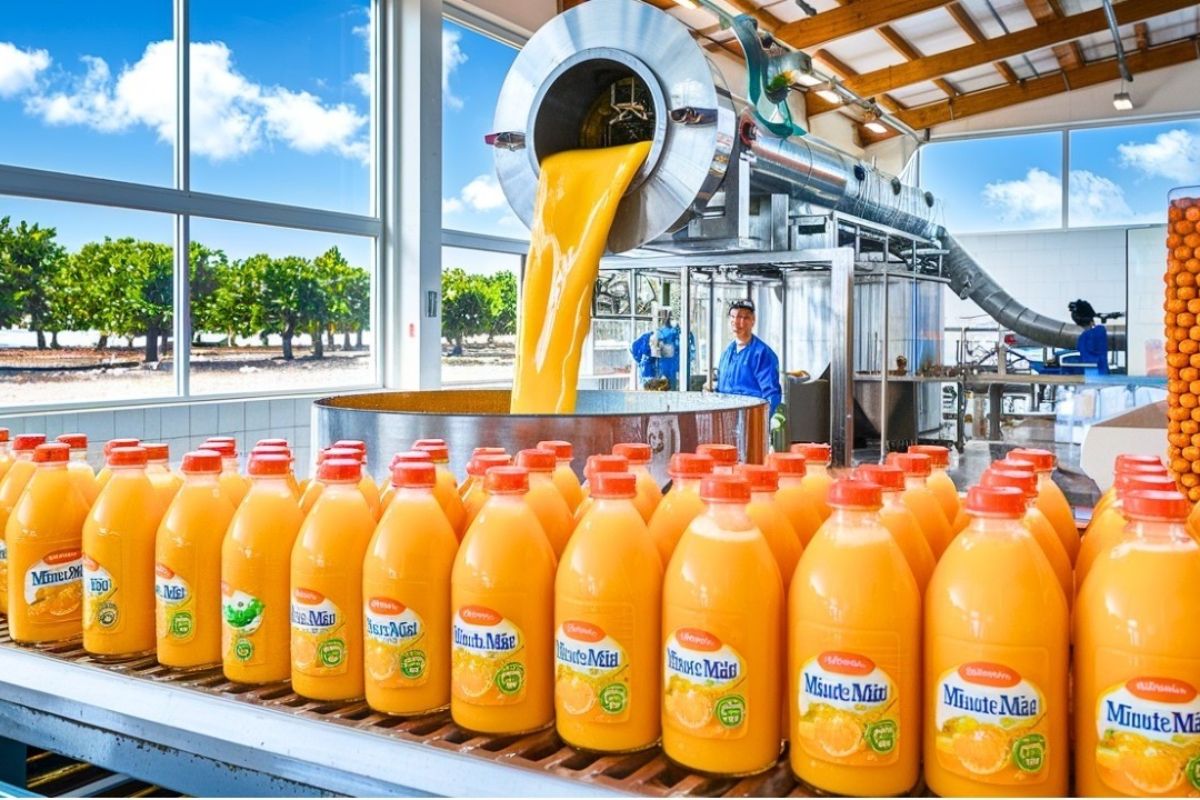


Brazilian Orange Juice: How Selected Fruits and Cutting-Edge Technology Put More Than 2 Billion Liters a Year on the World’s Table
With strict fruit selection and a highly controlled industrial process, Brazilian orange juice comes from orchards in São Paulo and Minas Gerais to supply a billion-dollar global market that consumes more than 2 billion liters each year.
From soil care to the final bottling stage, each liter of Brazilian orange juice goes through a chain of technical decisions involving harvesting, extraction, concentration, and large-scale transportation before reaching consumers on the shelves in Brazil, the United States, and Europe.
From Orchard to Harvest: Where Brazilian Orange Juice Is Born

Everything starts with the selection of the raw material. The industries that produce Brazilian orange juice do not work with just any fruit.
-
While restoring a historic mansion from 1910, a brick structure with an old turbine that generated energy from the Rio do Testo emerged, along with a hidden door and a rare floor concealed under layers of wax.
-
Italian researchers have detected what appears to be a second Sphinx buried under the sands of Egypt, and satellite scans reveal a gigantic underground megastructure hidden beneath the Giza Plateau for over 3,000 years.

-
There are 4,223 drums and 1,343 metal boxes concreted with 50-centimeter walls that store the radioactive waste from Cesium-137 in the worst radiological accident in Brazil, just 23 kilometers from Goiânia, with environmental monitoring every three months.

-
Giant Roman treasure found at the bottom of Lake Neuchâtel in Switzerland reveals an advanced trade system, circulation of goods, and armed escort in the Roman Empire about two thousand years ago.


Varieties such as Pera, Valência, and Natal are cultivated precisely because they offer the ideal balance of sweetness, acidity, and juice yield, along with a vibrant color that the international market demands.
In the field, producers monitor the condition of the trees year-round, controlling irrigation, soil nutrition, and pests.
The goal is simple yet sophisticated: to ensure that, at the exact point of ripeness, the orange is at its peak juiciness and flavor, ready to enter the production line of Brazilian orange juice.
When this point is reached, harvesting comes into play.
It can be manual, with workers selecting fruit by fruit, or mechanical, with machines shaking the trees and dropping the oranges for quick collection.
In large properties focused on industry, the mechanical model usually prevails, due to the scale and speed needed to supply a market that consumes juice every minute.
Selection and Cleaning: Only the Best Fruit Becomes Export Juice

After being harvested, the oranges are sent to sorting and loading platforms, where a basic industry rule applies: spoiled, green, or damaged fruit does not enter the line for Brazilian orange juice destined for the global market.
Upon arrival at the factory, the selection process is repeated.
The fruits move along conveyor belts, are visually inspected, and pass through equipment that helps remove off-spec oranges.
Only then comes the washing stage, done in water tanks or high-pressure showers, to remove dust, leaves, and any surface residue.
After being washed and dried, the oranges undergo a final check.
The logic is simple: the more rigorous the selection, the greater the standardization of the final juice, something fundamental for Brazilian orange juice to maintain the same flavor and appearance, batch after batch, regardless of the harvest.
High-Precision Extraction: Maximum Juice, Minimum Bitterness
With the fruit approved, the most emblematic stage begins: extraction.
The factories use extractors designed to extract the maximum liquid from the pulp, minimizing the juice’s contact with the peel, which concentrates oils and compounds that can leave the drink bitter.
In one of the most widely used systems, the orange is cut in half by blades, and each half is squeezed by metallic cups that close precisely.
The juice flows into a reservoir, while peel and pulp are diverted to another line. Everything happens at high speed, with thousands of fruits being processed per hour.
The result is fresh juice, still raw, with pulp, small fibers, and occasional seeds.
It is this freshly extracted Brazilian orange juice that follows to the purification and standardization stages, until it becomes the product that consumers find in packages.
Filtration, Clarification, and Total Fruit Utilization
Next, the juice goes through straining or filtration.
Fine meshes retain seeds and larger pieces of pulp, adjusting the texture according to the desired profile: from smoother juices to versions with more pulp, reminiscent of homemade consumption.
What remains from this process is not discarded.
The pulp can become animal feed, fertilizer, or even be used in energy generation, while the essential oils from the peel enter various chains, ranging from cosmetics and cleaning products to enhancing the aroma of the juice itself in later phases.
If necessary, the juice still goes through centrifugation and clarification, stages that help reduce suspended particles and sediments.
This visual and physical refinement improves the product’s stability and contributes to a longer shelf life, something decisive in a supply chain that depends on long-distance transportation.
Pasteurization and Concentration: The Secret of Global Scale
With the filtered and standardized juice, the phase of safety and logistics begins.
First, pasteurization occurs: Brazilian orange juice is heated for a short period and quickly cooled, eliminating microorganisms that could compromise quality or spoil the product prematurely.
Next comes one of the most strategic stages for the international market: concentration.
During this stage, part of the juice’s water is removed by evaporation under vacuum conditions, which allows for working at lower temperatures and reducing the sensory impact.
The result is a thick liquid with a high concentration of solids, taking up less space in tanks and ships.
This logic directly impacts the competitiveness of Brazilian orange juice.
By transporting concentrated juice instead of ready-to-drink juice, the industry reduces freight and storage costs, keeping large volumes refrigerated until the moment of reconstitution in the destination countries or in the packaging line itself.
Reconstitution, Flavor Standardization, and Final Bottling
When the time comes to transform the concentrate back into ready-to-drink juice, reconstitution takes place.
Potable water is added in the exact proportion to restore the original concentration of solids and viscosity similar to that of freshly extracted juice.
At this stage, sweetness and acidity are adjusted based on very precise parameters, to ensure that Brazilian orange juice has the same sensory profile in each package, regardless of the natural variation between harvests and producing regions.
Natural orange aroma, recovered from the peel, and vitamins like vitamin C may also be added, always following what the legislation allows and the standards set by the industry.
With the standardized product, the juice moves to high-speed bottling lines.
The machines fill the packages, minimize contact with air, and create airtight seals, protecting the content from oxygen and external microorganisms.
Next come labeling, grouping into boxes or bundles, and palletizing, preparing everything for distribution.
Why Does Brazilian Orange Juice Dominate the Global Market?
The dominance of Brazilian orange juice in the global scenario is a direct result of this combination of specialized agriculture, industrial technology, and logistics designed for large volumes.
From orchard to bottle, there is an integrated chain that reduces waste, makes use of by-products, and maintains a high quality standard.
While the consumer sees only a glass of beverage, behind the scenes are synchronized harvests, meticulous fruit selection, high-performance extractors, vacuum concentration systems, and refrigerated tanks crossing borders.
It is this complete engineering that makes it possible to supply demanding markets on different continents with a product recognized for its consistency in flavor and appearance.
In the end, Brazilian orange juice is more than an agricultural commodity: it is a case of advanced industrialization of the fruit, supported by science, food engineering, and international logistics.
And you, when looking at a simple glass of juice, did you imagine that Brazilian orange juice went through so many stages until it reached your table?









State of ART…suco de laranja brasileiro, impossível melhor… brasileiros alto nível… somente no mundo NUMBER OBR
Excelente reportagem, o suco Prat’s é o melhor que conheço tem qualidade e preço acessível.
Esse processo deve acontecer só pra exportação pq nunca vi um suco de laranja q não tem gosto de laranja podre e assim o pior pra nós e o melhor pra eles ao contrário q acontece no primeiro mundo
Pra nós o resto. Parabéns pelo comentário