





 Portuguese
  English
  Spanish
  8 min of reading
  12 comments


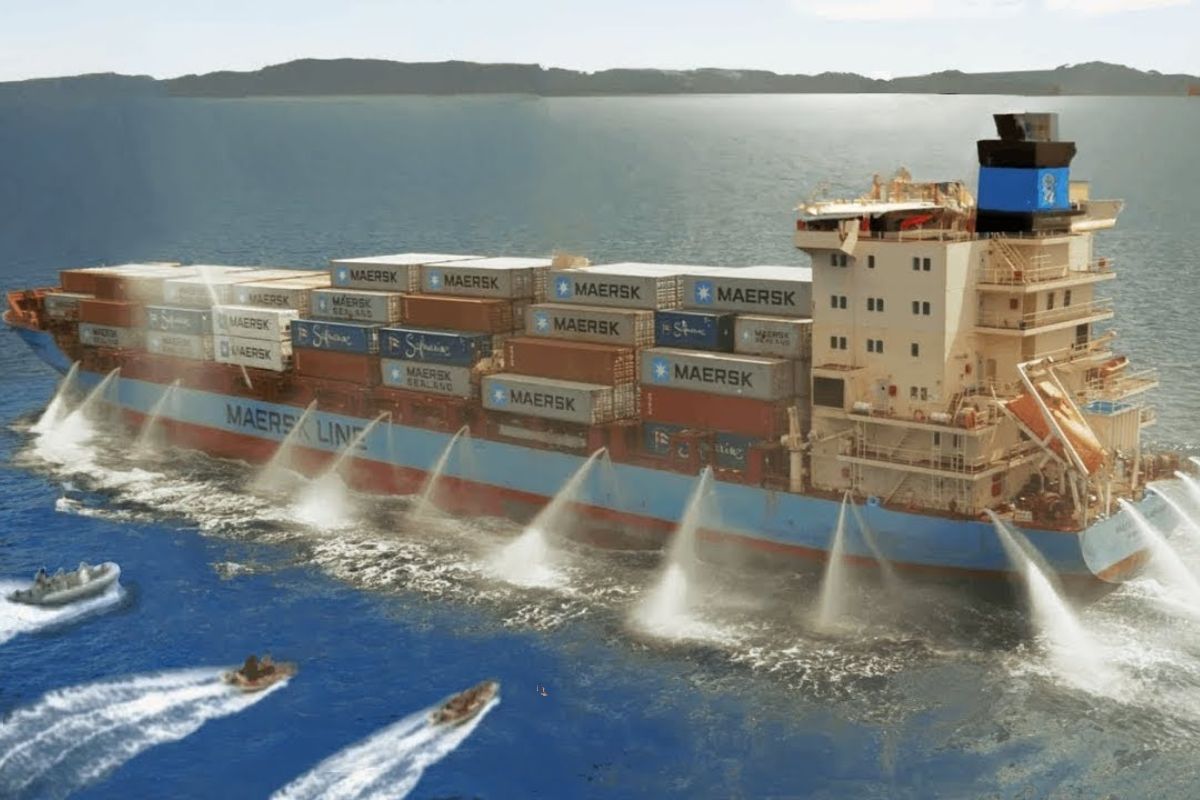


With High-Pressure Water Jets, Barbed Wire Barriers, Blinding Lasers, and LRAD Systems Capable of Deafening at a Distance, Cargo Ships Transform Weaponless Defense into a Front Line Against Somali Pirates and Houthi Rebels, Balancing Crew Safety, International Law, and Operational Costs on Vital Global Trade Routes
Imagine crossing one of the most dangerous maritime corridors in the world on giant cargo ships, carrying thousands of containers, knowing that fast small boats armed with rifles and RPGs can suddenly appear on the radar at any moment. Instead of heavy machine guns on the deck, the first response is not gunfire but water at extremely high pressure, concentrated sound waves, and lights that temporarily blind. It seems little against AK-47s, but that’s exactly how modern defense works for much of the commercial fleet.
In recent years, Somali pirates, armed groups in the Gulf of Guinea, and Houthi rebels in the Red Sea have pressured the most used maritime routes for cargo ships. The response combined non-lethal technology with strict operational protocols: dissuasion layers, physical barriers, and contingency plans ranging from changing the route to locking the entire crew in a safe room while waiting for naval forces.
The New Battlefield Surrounding Cargo Ships

The protection of cargo ships today is structured in two complementary layers.
-
A Japanese mason transforms raw granite into small cups and handcrafted utensils, collects giant stones, cuts with precision, and impresses with detailed manufacturing and finishing.

-
With 1,066 acrylic panels, the building known as the friendly alien is supported by a steel skeleton, has a façade that functions as a giant screen, and impresses the world without any internal columns.

-
Scientists warn that a comet about 1 km in size that has started to release gases may actually change direction in space. It was spotted by NASA and surprises with potential impacts near Earth.

-
These living root bridges and ladders are over 700 years old and help indigenous people survive in one of the rainiest regions in the world.


The first is deterrence, which seeks to convince pirates to choose another target even before attempting to approach.
The second is anti-boarding, focused on making it physically difficult or dangerous to board.
In practice, this starts with simple yet effective measures. Some vessels scatter mannequins on deck to simulate more lookouts than the crew actually has.
Others employ lasers that disrupt the pirates’ vision at the critical moment when they attempt to get closer.
At the same time, the captain can increase the speed of the cargo ships, making the approach maneuver with ladders or hooks much riskier for those in lightweight boats.
This logic is clear: the harder, more uncertain, and uncomfortable it is to attack a ship, the greater the probability that the armed group will seek a less protected target.
LRAD: The Loudspeaker That Becomes a Directed Sound Weapon

Among the most striking resources is the LRAD, a high-powered directional sound system.
Initially, the LRAD serves as a communication channel: the crew can alert the suspicious vessel, declare it as a threat, and order a course change.
If the warning fails, the LRAD escalates to another level.
The equipment concentrates sound at an intensity comparable to a jet engine, specifically directed at the pirates’ boat.
The discomfort is so great that remaining in the impact zone becomes almost unbearable.
And, according to manufacturers, even with ear protection, the effects continue, because part of the sound energy reaches the inner ear through bone conduction via the skull bones.
In many cases, this initial shock is enough for the armed group to abandon the idea of engaging with cargo ships equipped with this type of defense and seek a less resistant target.
Still, more determined pirates may insist, which necessitates activating the next layer of protection.
Tracking Wires, Barbed Wire, and Physical Barriers

The transition from deterrence to anti-boarding begins in the water. Systems inspired by anti-boarding tracking wires fire floating lines that wrap around the propellers of boats that get too close, forcing them to stop and disrupting the attack.
In parallel, high-pressure water cannons come into play.
Unlike a regular hose, these systems can destabilize those attempting to climb stairs, flood, and even sink nearby small boats.
Some are operated remotely, protecting the crew; others operate with rotating heads, creating continuous water curtains along the sides.
A specific accessory transforms the hose into an even more unpredictable weapon: a special weight keeps the nozzle close to the water, while a restrictive orifice increases the pressure.
The result is a hose that whips violently and randomly, making it extremely risky to approach the impact point.
When all this is not enough, the physical barrier comes into play. Barbed wire or laminated wire is quickly installed on the edges of the deck, making it difficult to attach ladders.
On some vessels, safety panels create a “negative step” on the side of the hull, preventing ladders from resting properly and making climbing much harder, even for those attempting with ropes.
When the Threat Comes from Above: The Galaxy Leader Case
The defenses described above were designed for a classic scenario: cargo ships surrounded by small boats, not by helicopters.
This limitation became evident in November 2023 when the vehicle carrier Galaxy Leader was boarded in the Red Sea by Houthi rebels who descended from a helicopter, already armed and accompanied by a videographer.
The crew, composed of 25 people, was taken by surprise and held hostage.
Since the ship was empty and the objective was political, not economic, the hijacking did not follow the traditional logic of Somali piracy.
In early 2024, the ship was anchored near the coast of Yemen and was ultimately displayed as a sort of trophy, almost in a tourist attraction mode.
In this context, standard defenses of cargo ships show their limits.
The recommended strategy in cases of “classic” maritime piracy dictates that if all barriers fail, the crew issues a Mayday, shuts down the ship, and seeks refuge in a safe room.
The logic is simple: without hostages and without the ability to operate the cargo ship, the pirates lose leverage and are likely to abandon the ship when facing approaching naval or coast guard forces.
In the air attack on the Galaxy Leader, the element of surprise and the political origin of the hijacking make the application of this protocol much more difficult.
Somali Pirates vs. Gulf of Guinea: Motivation Dictates Risk
The way cargo ships are attacked varies according to the region and the objectives of the armed groups.
Off the coast of Somalia, the dominant model is ransom kidnapping.
The case of the Ukrainian cargo ship Faina, in 2008, is emblematic: 20 crew members held hostage for about four months until a payment of US$ 3.2 million was dropped from a plane near the vessel.
The pirates left the vessel and the hostages came out alive.
In the Gulf of Guinea, the focus tends to be on the cargo.
The groups intercept the ship, hold the crew and the vessel until transferring oil or other products to another vessel, in ship-to-ship operations that can last up to ten days.
After the transfer, the ship and crew are released.
This difference in motivation influences the design of defenses and the level of risk accepted by companies operating cargo ships on each route, in addition to directly affecting insurance prices, travel planning, and the decision to hire or not private armed escorts.
Why Cargo Ships Are Not Armed
At first glance, it seems obvious to arm cargo ships with rifles, machine guns, or light cannons. In practice, the equation is much more complex.
In open waters, ships follow the rules of the country whose flag they fly: if the flag state authorizes weapons, it is possible. The problem begins in ports.
Many countries have strict legislation against firearms on commercial vessels.
Arriving armed at a port that prohibits weaponry on board can lead to seizures, heavy fines, and detention of crew members, as well as disrupting logistics operations.
There’s also the operational issue. The main function of the crew is to operate cargo ships, not to act as a combat force.
Training sailors to respond with weapons, make shooting decisions, and deal with legal and diplomatic consequences is something many companies do not accept.
The analogy often made is straightforward: it’s like asking teachers to assume the role of armed security in school shootings, taking on risks for which they were neither hired nor prepared.
Therefore, in higher-risk areas, the most common solution is to hire specialized private security companies, with teams embarked only in critical segments.
These teams are pre-declared and checked when entering sovereign waters, within the legal limits of each country.
Diverted Routes, More Expensive Insurance, and the Return of Naval Forces
When piracy grows too much or when politically motivated attacks, such as those by Houthi rebels, multiply, cargo ships do not only alter the deck but the entire route strategy.
After the escalation of attacks in the Red Sea, a large part of the container fleet began to circumvent Africa, avoiding the Suez Canal. The trip can take up to a week longer, costs increase, and global logistics suffer cascading delays.
Those who maintain the traditional route pay higher insurance premiums and reinforce onboard measures.
Still, there comes a point where non-lethal defenses and diversion protocols are no longer sufficient. Historically, whenever piracy becomes a systemic problem, national navies and coalition forces come into play.
This occurred at the height of Somali piracy in 2011, when attacks surpassed two hundred annual records, with an estimated impact in billions of dollars on the global economy.
During that period, destroyers, cruisers, and patrol ships from the U.S. and multinational coalitions actively began to pursue pirate vessels, reaching direct confrontations, such as the incident in 2006 when a pirate boat was destroyed after a shootout with the USS Gonzalez destroyer and the USS Cape St. George cruiser.
More recently, Houthi attacks in the Red Sea prompted air operations by the U.S. and the UK against targets in Yemen, in an attempt to rebalance the cost of attacking trade routes.
At these times, the protection of cargo ships ceases to be just a matter of equipment on board and starts to depend on strategic state decisions.
A Tense Balance Between Trade, Security, and War
The struggle of cargo ships against pirates and armed groups shows a scenario in which water jets, barbed wire, lasers, and sound waves share space with frigates, destroyers, and geopolitical decisions.
The choice of non-lethal defenses seeks to preserve crews, avoid unnecessary military escalations, and keep routes open, but coexists with increasingly diversified threats, which now include airstrikes, missiles, and political motivations.
Ultimately, each crossing in risk areas is an exercise in calculation: how far is it possible to rely on layers of deterrence and physical barriers before resorting to state armed force.
And you, if you were in command of cargo ships on high-risk routes, would you trust more in these weaponless defenses or advocate for the embarkation of heavily armed teams on board?







Eles poderiam usar inicialmente cloriquina ou invermectina no Brasil esta mistura matou 700.000 pessoas.
Mesmo assim se falhar era só usar um cabo e um soldador.
O que matou foi a ineficiência dos governos e principalmente o Vírus Chinês do seu parceiro Comunista: a China.
Primeiro, se der tiro, eles param, se o país não permite armamento, problemas deles, ninguém leva **** nenhuma! Simples assim!!!
…esconder o armamento em lugar seguro e difícil de se achar dentro do navio!!!…contratar uma segurança seria o mais adequado então!!!!…🤷