





 Portuguese
  English
  Spanish
  8 min of reading
  0 comments


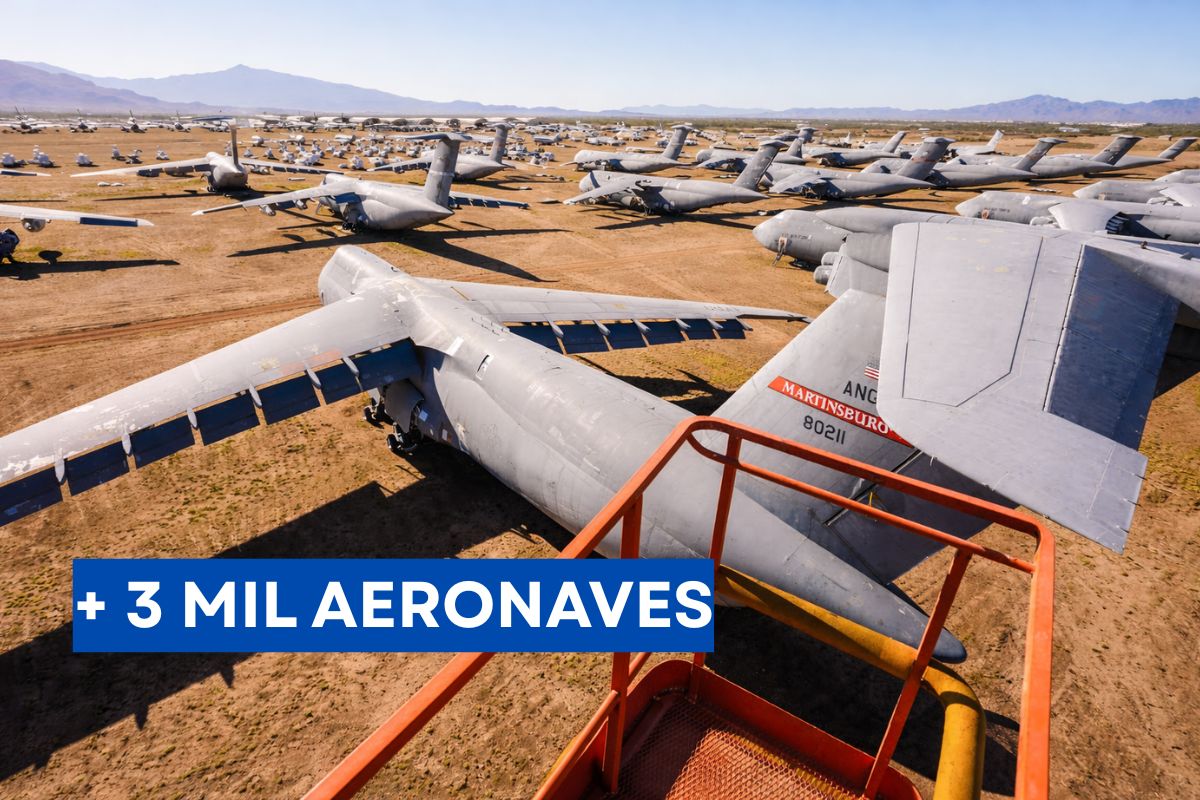
In 2,6 Thousand Acres And More Than 3 Thousand Aircraft Stored, The Davis-Monthan Aircraft Boneyard Reuses Parts Worth US$ 454 Million Per Year And Keeps The US Military Aviation Operational.
What looks like a large junkyard in the middle of the Arizona desert is actually one of the nerve centers of US military aviation. In Tucson, at Davis-Monthan Air Force Base, more than three thousand retired aircraft form the largest collection of military planes in the world, spread over 2.6 thousand acres of dry sand, strong sunlight, and a deceiving silence. There, nothing is truly still.
Behind the cut fuselages, aligned wings, and windows covered in white paint, a high-precision system operates. A team of about 800 technicians and mechanics from the 309th Aerospace Maintenance and Regeneration Group spends the entire year storing, preserving, dismantling, and sometimes resurrecting entire aircraft. From there, parts valued at US$ 454 million per year emerge, fueling the logistics of US military aviation and ensuring that combat and strategic cargo aircraft continue to fly around the world.
What Is The Arizona Aircraft Boneyard
Officially called the 309th AMARG, the aircraft boneyard is located within the Davis-Monthan Air Force Base in Tucson, Arizona.
-
With a cost per shot close to zero, the DragonFire laser could change naval warfare in 2027 and provide British ships with nearly unlimited defense against drones.

-
A British startup creates tires that generate electricity in electric vehicles when passing over potholes, speed bumps, and cracks.

-
Scientists have created robots made with living cells that have their own nervous system, swim on their own, explore the environment, and self-organize without any genetic engineering, and now they want to do the same with human cells.

-
Students create a solar-powered ambulance that operates without a plug, without fuel, and still keeps medical equipment running in remote areas.


It houses over 3 thousand military aircraft of various models, ages, and functions, accumulating nearly 80 years of aviation history.
To the general public, the place appears to be just the end of the line for Air Force, Navy, and other branches of the armed forces’ aircraft. In practice, its real function is strategic.
The site stores aircraft in controlled conditions, serves as a giant stockpile of parts for still-active fleets, allows regeneration of aircraft that can return to service, and helps fulfill international arms control treaties by visibly documenting the elimination of strategic bombers.
Each fuselage parked there is a chapter in the history of US military aviation, and almost none of them are completely “dead.”
Why The Desert Is Perfect For Storing Aircraft

Davis-Monthan is in Arizona for technical reasons. The extremely dry climate reduces corrosion of metals and internal systems. The firm and stable soil allows heavy aircraft to be parked directly on the sand without requiring large paved areas.
And the large number of clear-sky days facilitates inspections, landings, takeoffs, and the daily logistics routine.
Thanks to this environment, an aircraft can remain stationary for decades and still provide parts in good condition. There are aircraft over 40 years of storage that continue to serve as a reliable source of components for other models of US military aviation.
Iconic Aircraft And Nuclear Arms Treaties
Walking through the rows of metal is like traversing an open-air museum of US military aviation. Among the most notable pieces is the EB 57 Canberra, authorized in 1952 and completed in 1953, which now rests in Tucson and continues to be useful as a parts source for the WB 57 still operated by NASA on scientific missions.
Another highlight is the LC 130 equipped with skis, designed to land on snow and ice in Antarctica. This plane once crashed on the ice in the early 1970s, was abandoned for years, was rescued, received a new engine, flew again for about a decade, and only then was retired under the Arizona sun.
Perhaps the strongest symbol of the strategic role of the boneyard is the more than 90 B 52 bombers, including G and H models.
They are directly linked to strategic arms reduction treaties signed between the United States, the former Soviet Union, and later, Russia.
Many of these B 52s were physically eliminated to comply with these rules, with noses removed, tails cut off, wings displaced, and fuselages positioned at a specific angle.
This way, reconnaissance satellites can confirm from a distance that the bomber will never take off again.
Even so, these carcasses remain valuable. Parts from G models are still reused in operational B 52 Hs, showing how the boneyard functions as a large logistical lung of US military aviation.
How An Aircraft “Dies” And Is Reborn As Parts
When an aircraft arrives at the Boneyard, it goes through a detailed receiving and preservation process.
First, the crew brings the plane to the initial processing area, where documentation, general condition, and category of storage or regeneration are defined.
Next, the operational fuel is drained and replaced with preservative oil, which protects lines, engines, and internal systems during years of inactivity.
After that, the engines are run for a few minutes each, with the preservative oil circulating. This step helps lubricate internal components and ensures everything is prepared for long-term storage.
Only then does the aircraft proceed to the washing area. At this stage, it receives a complete cleaning, similar to a giant car wash, which removes dirt, salt residue, dust, and other contaminants.
Aircraft that served on aircraft carriers or in tropical regions, more exposed to sea air and salty air, particularly benefit from this stage to avoid accelerated corrosion.
Only after going through all these stages is the aircraft ready for sealing and, finally, to be parked in the desert.
From Wash To Seal, The Shield Against Dust And Heat
After cleaning, the stage begins that gives the boneyard its most striking appearance. Windows, panels, air intakes, and sensitive surfaces receive layers of sealant and paint that protect the aircraft’s interior from dust, heat, and solar radiation.
First, a black spray layer is applied, sealing crevices, glass, and access areas. Then, a white layer is sprayed over it, acting as a thermal shield that reflects sunlight and helps keep the internal temperature under control.
Instead of turning into a metal oven, the aircraft typically remains only a few degrees above the external ambient temperature, even under the intense Arizona sun.
Critical parts are treated with even more attention. The GAU 8 Avenger cannon of the A 10, for example, is usually covered with cardboard and protective material to prevent the entry of insects and birds, which could cause corrosion or pose a risk to recovery teams.
The result is aircraft with “darkened” windows and sensitive areas wrapped in white, as if frozen in time, awaiting a future decision from US military aviation.
Regeneration, When The Aircraft Returns To Flying
Not every aircraft sent to Davis-Monthan is doomed to become parts. At various times, the US military aviation calls upon the boneyard to reactivate stored aircraft and compensate for fleet shortages or extend the lifespan of specific models.
In 2016, the Marine Corps decided to refurbish F 18 Hornet fighters taken from the boneyard to bolster aircraft availability.
In 2020, a 55-year-old B 52 Stratofortress was completely regenerated, returning to flight condition after nearly a year of work.
In 2023, a B 1 bomber had its recovery process completed in approximately 64 days, a very short time for a large aircraft.
Behind these cases is the concept of depot-level maintenance, which involves hangars dedicated to modernization. In them, older aircraft receive upgrades to hardware, software, avionics, and mission systems.
After the interventions, a test pilot performs a functional check flight, taking the aircraft to different altitudes, testing pressurization, fuel, and engines in various regimes, alternating from full power to idle and back to requiring maximum power from the engines.
Only after passing this complete examination is the aircraft cleared to return to operational routines or integrate into specific programs, such as QF target drones.
The Recovery Line That Generates US$ 454 Million Per Year
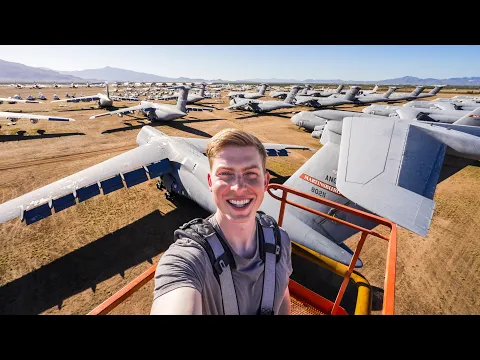

If the rows of parked aircraft are the most recognized image of the boneyard, the decisive part for US military aviation is in the recovery line of parts.
It is there that idle metallurgy transforms into fleet availability and real resource savings.
The process begins with the removal of the part directly from the aircraft, following requests from active units, maintenance depots, or logistics centers.
Technicians dismantle everything from small components to large fuel lines in aircraft like the F 15. Bulky parts return to the washing area, are cleaned, and then proceed to the woodworking shop, where they receive custom-built crates for safe transport.
In the next stage, on the recovery line, the parts are inspected, cataloged, and separated according to priority. Packagers prepare each component according to its final destination, whether an operational squadron or a central maintenance depot.
The shipping area functions as an outbound hub. Smaller items are sent via courier services, with a high same-day processing rate.
Larger parts are transported by truck and, in some cases, are shipped on cargo aircraft such as C 17 and C 5 to fulfill urgent missions.
In a recent fiscal year, over 9 thousand parts were recovered and sent to the supply chain, totaling about US$ 454 million in estimated value.
The projection is that this volume will reach 10 thousand parts per year, reinforcing the economic weight of this vast open-air stockpile.
For an aircraft parked in a hangar on the other side of the world, a single rare part that only exists in Davis-Monthan can make the difference between remaining on the ground or returning to mission.
The Hidden Role Of The Boneyard In US Military Aviation
From a strategic standpoint, the Arizona Aircraft Boneyard functions as an essential infrastructure, far beyond visual curiosity.
It reduces operational costs by allowing the reuse of parts instead of relying solely on the production of new components.
It extends the lifespan of entire fleets, keeping older models relevant with targeted updates. It ensures transparency in the compliance with international treaties, making the dismantling of nuclear platforms like the B 52 visible.
At the same time, it creates a unique technical reserve, difficult to reproduce elsewhere and crucial for US military aviation.
In a world where the availability of transport aircraft, fighters, and bombers directly weighs on power projection capability, the Arizona desert serves as a kind of long-term, silent, and decisive insurance.
The carcasses aligned under the sun tell stories of wars, missions, and secret operations, but they also reveal a behind-the-scenes mechanism that keeps the machine running.
When an operational aircraft needs a critical part, it is likely that someone, at some point in the rows of Davis-Monthan, has already set aside a component ready to return to the sky in another cockpit.
And you, if you could visit the Arizona Aircraft Boneyard, would you prefer to walk among the historical aircraft or follow the technical backstage of the recovery that keeps US military aviation operational day after day?






Seja o primeiro a reagir!