





 Portuguese
  English
  Spanish
  5 min of reading
  0 comments


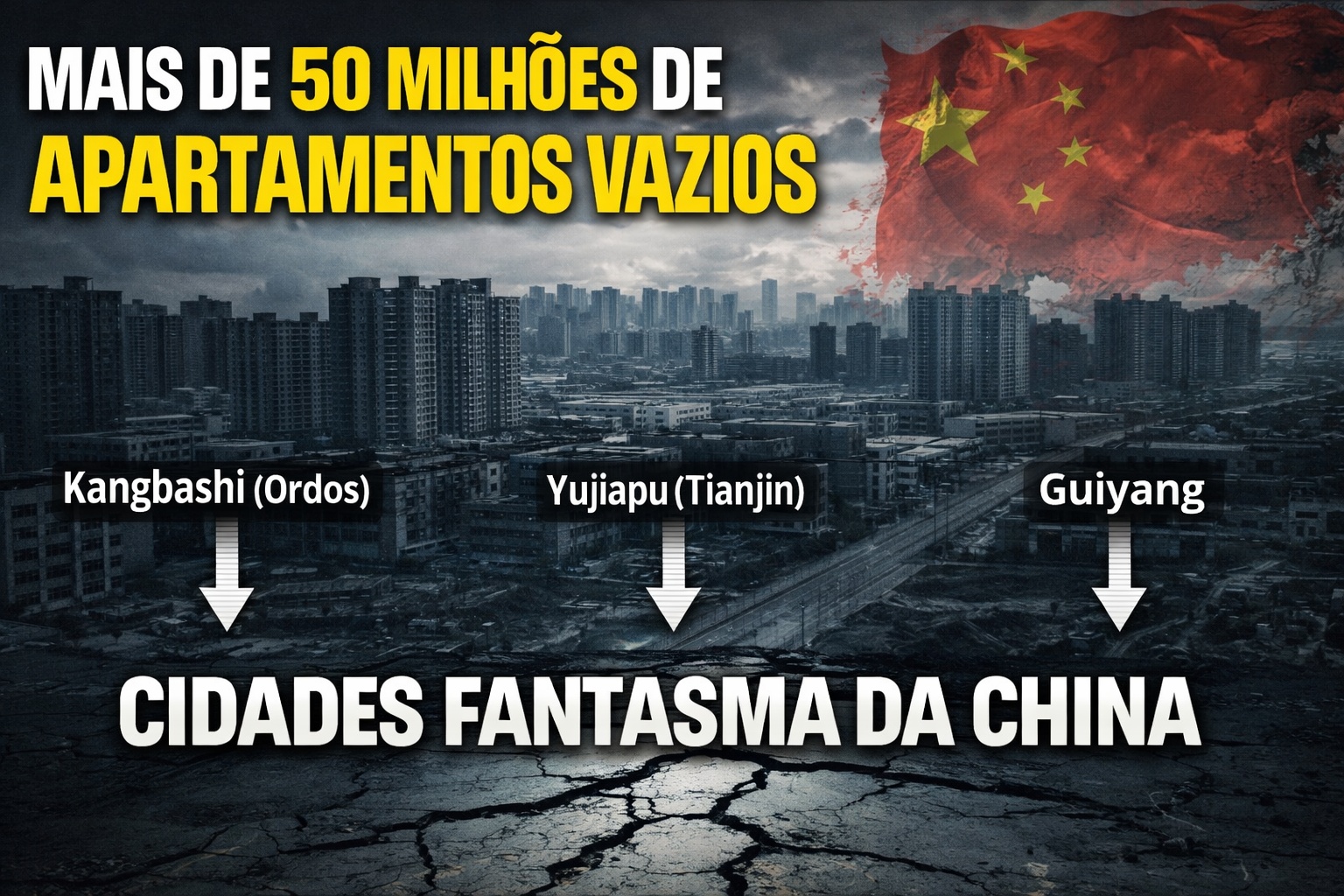
With Over 50 Million Vacant Apartments, Cities Like Ordos and Tianjin Reveal How Overbuilding Created Entire Neighborhoods Almost Without Residents in China.
The estimate of more than 50 million vacant apartments in China is not based on speculation or informal assumption. It frequently appears in analyses by outlets such as Bloomberg, The Economist, Reuters and studies based on the China Household Finance Survey (CHFS), one of the largest independent household surveys in the country. These numbers are also corroborated by assessments from international banks like Nomura and Goldman Sachs, which analyze real estate inventories, urban occupancy rates, and Chinese census data.
In practice, this means that China currently has a volume of completed housing, connected to power, water, transport, and public service networks, sufficient to house entire populations of medium-sized countries, but that remains partially or fully unoccupied. This phenomenon is not restricted to a single city or isolated region: it repeats itself in dozens of new urban districts built over the last two decades.
What Really Defines a “Ghost City” in China
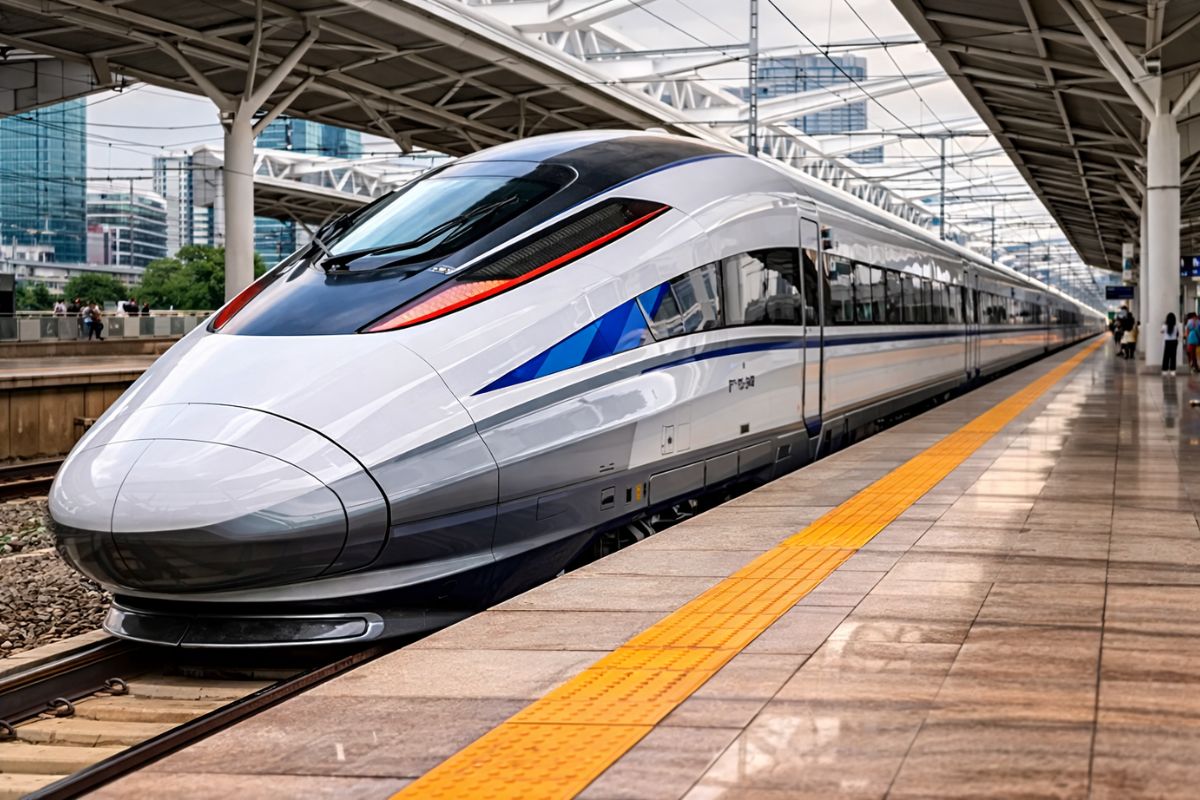
Contrary to popular belief, Chinese ghost cities are not abandoned ruins or deserted villages. They are modern urban areas, often featuring futuristic architecture, wide avenues, parks, hospitals, schools, and high-speed rail stations. What sets them apart is the discrepancy between planned capacity and the actual resident population.
-
Brazilian city neighboring Paraguay becomes a ‘magnet’ for people seeking quality of life and high standards with exceptional growth and commutes of up to 15 minutes.
-
A rare storm transformed part of the Gulf into an unlikely scene of hail, extreme rain, and tornado risk in the middle of the desert, with volumes that exceeded the annual average in a single day.

-
Brazil catches the world’s attention with ships powered by ethanol and biodiesel that have lower emissions, an unprecedented certification with advantages in chartering, and a revolution in cabotage.

-
A couple who only has Sundays free has built a hand-dug pool, a hamburger joint, a dance hall, and a playground in their own home without hiring a mason, and even with breaks due to accidents and the pandemic, the work has never truly stopped.




In many of these districts, the initial occupancy rate was below 20% to 30% of planned capacity, according to reports from BBC, Reuters and Financial Times. This creates visually striking urban landscapes: nearly empty residential buildings, underutilized commerce, and public transport operating far below expected volume.
Kangbashi, in Ordos: The City Symbolizing Excess
Kangbashi, a district of Ordos in Inner Mongolia, has become the most cited example of this phenomenon. Designed at the height of the coal and commodities boom, the city was planned to accommodate up to 1 million people, with monumental theaters, museums, administrative buildings, and vast residential complexes.

By the early 2010s, when the city began to be portrayed by the international media, estimates indicated a real population of less than 100,000 inhabitants, occupying only a minimal fraction of the existing infrastructure. Photographs of empty avenues and residential buildings with few lights on circulated worldwide.
Although Kangbashi has grown in the following years — it currently houses several hundred thousands of residents — the pace of occupancy has never matched the original planning, keeping the district as a symbol of the disconnect between urban investment and real population demand.
Yujiapu, in Tianjin: The “Manhattan That Didn’t Happen”
Another emblematic case is Yujiapu, a financial district built in Tianjin with the explicit goal of becoming a global financial services hub. Inspired by Manhattan, the project envisioned corporate skyscrapers, bank headquarters, and upscale residential neighborhoods.

Infrastructure was delivered quickly, but demand for offices and residences did not keep pace with supply. Reports from Reuters and the Wall Street Journal showed corporate buildings practically empty for years, even in one of the most economically dynamic regions of the country.
Yujiapu became a classic example of urban planning based on financial expectations, rather than on actual population and employment flows.
Guiyang and the New Interior Districts
Similar phenomena have occurred in interior cities like Guiyang, the capital of Guizhou province. Over the last 15 years, the city has aggressively expanded its urban boundaries, creating new districts with tens of thousands of apartments, modern avenues, and monumental public buildings.
Although Guiyang has grown demographically, the pace of construction has exceeded the capacity for population absorption. As a result, entire neighborhoods have remained under-occupied for long periods, reinforcing the national statistic of millions of vacant residential units.
Where Did Such Investment Come From
The phenomenon of ghost cities is directly linked to three central pillars of the Chinese economic model in recent decades.
The first is accelerated urbanization. Between 2000 and 2020, over 400 million Chinese migrated from rural areas to urban centers, an unprecedented historical movement. To absorb this migration, local governments bet on large-scale construction.
The second pillar was the role of the real estate sector as a growth engine. For years, real estate accounted for between 25% and 30% of China’s GDP, directly or indirectly. Building entire cities became a way to generate employment, revenue, and economic growth.
The third factor was debt-based financing and land sales. Local governments depended heavily on land sales to developers as a source of revenue, encouraging increasingly larger projects, even when real demand was not guaranteed.
The Real Meaning of “50 Million Vacant Apartments”
The often-cited number of over 50 million empty units does not mean that all of them are abandoned or completely unused. It represents the excess supply relative to effective demand, according to analyses by CHFS, Bloomberg, and international banks.
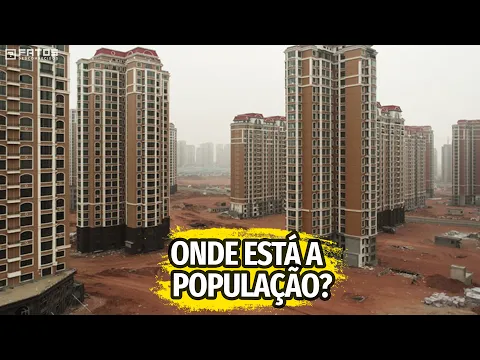
Some of these units are in regions where occupancy occurs slowly, others are maintained as investment assets, and some belong to families that already own more than one property. Nevertheless, the volume is sufficiently large to indicate a structural imbalance in the real estate market.
Keeping cities under-occupied incurs real costs. Urban infrastructure requires constant maintenance, regardless of the number of residents. Water, sewage, lighting, transport, and security systems need to function, putting pressure on municipal budgets.
Additionally, the excess of properties contributed to the Chinese real estate crisis, which became evident from 2021 onward, with financial difficulties for large developers and a market downturn.
A Phenomenon in Transformation, Not Static
It is important to note that many of these cities have not remained empty forever. In some cases, occupancy has increased over time, driven by new public policies, relocation of industries, and expansion of railway lines.
Even so, the legacy of ghost cities remains one of the largest urban experiments in human history, both in scale and economic impact.
What the Chinese Experience Teaches the World
The case of China’s ghost cities serves as a global warning. It shows that:
- large-scale urban planning needs to align with actual demographics,
- economic growth based solely on construction has clear limits,
- infrastructure without people incurs high costs and uncertain returns.
More than a curiosity, it is a concrete lesson about the risks of over-planning disconnected from social and economic reality.
The question that remains is straightforward: how many of these cities will be fully occupied, and how many will remain as concrete monuments to an era of growth too rapid for its own population?









-

Uma pessoa reagiu a isso.