





 Portuguese
  English
  Spanish
  5 min of reading
  1 comment


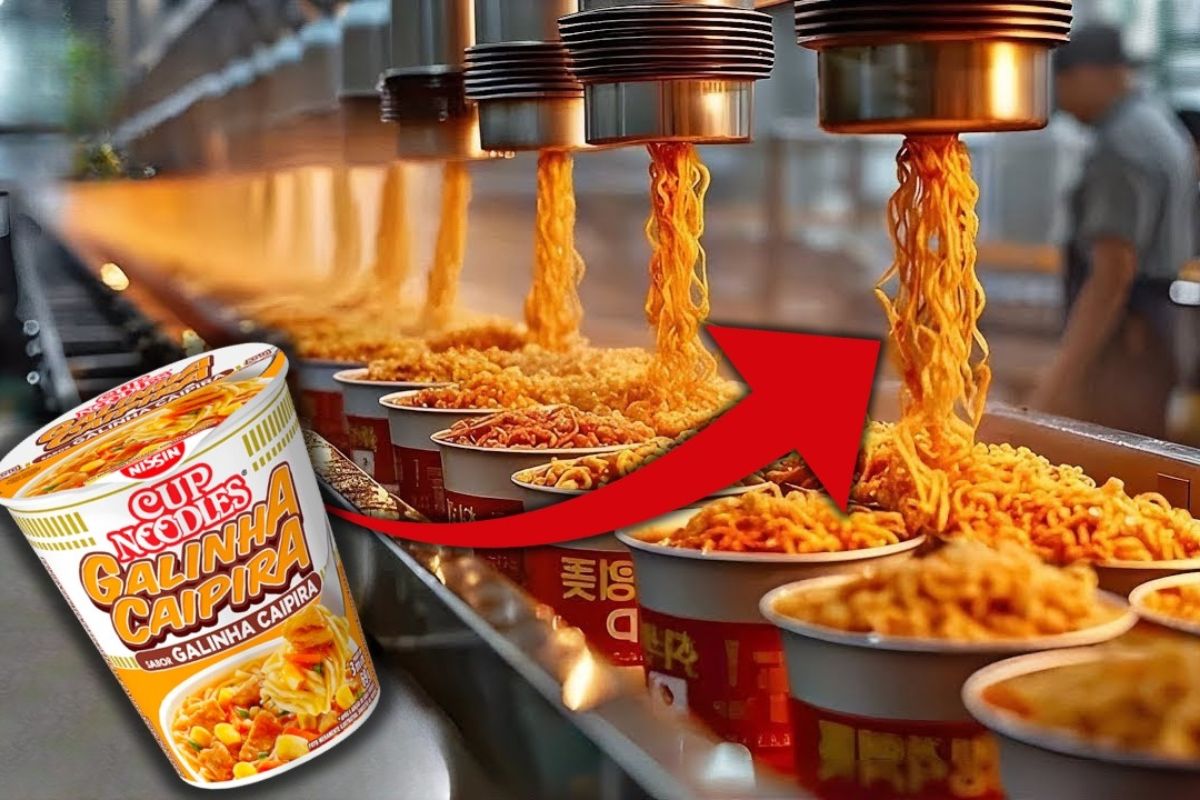


With Fried Noodles in Palm Oil, Wheat Flour, and Dehydrated Seasonings, Cup Noodles Result from an Industrial Process That Ensures Convenience, Standardization, and Instant Flavor.
Created to simplify the preparation of noodles as much as possible, Cup Noodles has become a symbol of quick, cheap, and easy-to-consume meals almost anywhere. With large-scale production and global consumption exceeding 50 billion units, the product is now one of the icons of instant food.
Behind this image of “just add hot water and wait a few minutes,” there is a complex industrial chain that starts with the selection of wheat flour and ends with automated packaging lines. Each Cup Noodles cup goes through rigorous stages of mixing, steaming, frying in palm oil, dehydrating, assembling, and quality control before reaching the shelves.
The Origin of Cup Noodles and the Concept of Cup Noodles

Cup Noodles was born in Japan in 1971, created by Momofuku Ando, founder of Nissin.
-
Inside an active volcano in Africa, residents use volcanic rocks to build houses in an impressive setting.

-
After 14 years of waiting, a rammed earth mansion built in 1702 in the North Zone of São Paulo will become a park with leisure facilities and green areas, with a million-dollar investment.

-
With 2 unfinished nuclear reactors, up to 25 billion in costs, and proven fraud, the Nukegate case has left 800,000 consumers still paying today for energy that will never be produced.

-
The household appliance that consumes the most energy in Brazilian homes is not the air conditioner; it is located in the smallest room of the house, is used daily, and can account for up to 25% of the electricity bill, while an alternative in the same outlet can reduce this cost by up to 75%.


He had already developed instant noodles years earlier but was looking for an even more convenient solution that eliminated pots, plates, and the need for dishes.
During a trip to the United States, Ando observed an American consumer eating instant noodles from a paper cup, with the product cut into smaller strands and consumed with a fork.
The simple scene became a direct inspiration for the concept of Cup Noodles in disposable cups, designed to make preparation and consumption even faster and more convenient.
Since then, the cup format has solidified as one of the most popular forms of instant noodles, especially in settings where traditional cooking is not feasible, such as offices, student dorms, and travel.
From Wheat Flour to Dough: Mixing and Formation of Strands

The base of Cup Noodles is wheat flour, received from specialized suppliers and analyzed before entering the production line.
The type of flour used must ensure elasticity, consistency, and good texture after cooking, preventing the noodles from becoming brittle or too mushy.
In mixing tanks, the wheat flour is combined with water and other components, such as vegetable oil, salt, starch, and flavor enhancers at defined levels.
The goal is to form a homogeneous dough, free of air bubbles and with the proper elasticity to be rolled and cut.
This dough then passes through industrial rollers that laminate it, creating thin sheets of controlled thickness. Next, cutting machines transform the sheets into uniform strands.
The characteristic waviness of Cup Noodles is not just aesthetic: it helps to separate the strands and improves the adherence of seasonings and hot water during preparation.
Steam, Frying in Palm Oil, and Dehydration of the Dough

After cutting, the strands of dough are still raw and fragile.
The next step is pre-cooking with steam, which coagulates the gluten present in the flour and gives firmness to the noodles.
This cooking is quick and controlled, enough to stabilize the structure of the strands without making them completely ready for consumption.
Then, the pre-cooked noodles are cooled with cold air to prevent further cooking.
Once stabilized, they move on to one of the most critical phases of the process: frying in palm oil or a combination of selected vegetable oils.
In this step, the strands are immersed in hot oil, quickly removing moisture and promoting a type of accelerated dehydration.
The result is a block of dry noodles, light and with small internal porosity, a characteristic that allows Cup Noodles to rehydrate quickly when hot water is added to the cup, recreating the texture of cooked noodles in just a few minutes.
Some lines may adopt alternative drying processes in hot air chambers, without frying, but the classic Cup Noodles model is that of noodles fried in palm oil, associated with faster cooking and the typical flavor of the product.
Shaping in the Cup and Adding Vegetables, Meats, and Seasonings

With the noodles already fried and dehydrated, they are shaped into blocks that fit the diameter of the cup.
Machines compress the strands into discs or blocks that precisely fit inside the packaging, ensuring uniformity in weight and volume.
The positioning of the block in the cup can occur in two ways: either the cup rises along the line to encase the noodles, or the block is deposited directly into the cup as it moves along the conveyor.
In both cases, the process is continuous and high-speed, allowing thousands of Cup Noodles units to be assembled per hour.
On the same production line, dehydrated complements enter.
Vegetables, animal or plant-based proteins, and possible pieces of seafood, depending on the flavor, arrive at the factory already dehydrated and with low moisture, ready to be precisely dosed.
Specific machines control the amount of each ingredient and add the pieces directly into the cup.
The seasoning can come as an individual envelope or be sprinkled as powder over the noodles.
It is at this stage that Cup Noodles gains the flavor profile recognized by consumers in each version, maintaining standardization across different batches.
Sealing, Labeling, and Quality Control
After assembly with noodles, vegetables, and seasonings, the Cup Noodles cup moves on to sealing.
The top receives a layer of aluminum or similar material, which is hermetically sealed to prevent air and moisture from entering.
Then, the assembly may be wrapped in plastic film with mandatory consumer information.
At this stage, labels, barcodes, manufacturing date, expiration date, and preparation instructions are applied.
Samples from the batches undergo laboratory analyses evaluating weight, visual appearance, texture of the noodles after rehydration, and maintenance of flavor standards.
Only after passing this quality control does Cup Noodles proceed to packaging in boxes and subsequent distribution.
Why Cup Noodles Became a Symbol of Convenience?
The success of Cup Noodles is directly linked to the combination of cup format, noodles fried in palm oil, and dehydrated ingredients.
The entire industrial process is designed so that the consumer only needs hot water and a few minutes to have a ready meal, without the use of pots, a stove, or additional dishes.
For students, office workers, travelers, or those in situations with limited infrastructure, the disposable cup model simplifies both preparation and consumption.
At the same time, the industrial process ensures standardization and scale, allowing billions of units to circulate worldwide while maintaining similar characteristics of flavor and texture.
In the end, Cup Noodles translates a simple idea into a product: transforming wheat flour, steam, palm oil, and dehydrated seasonings into an instant meal, easy to transport and store, capable of serving different consumer profiles.
And you, in what situation has Cup Noodles saved your hunger and become the most practical solution of the day?







Consumimos Muito