





 Portuguese
  English
  Spanish
  7 min of reading
  2 comments


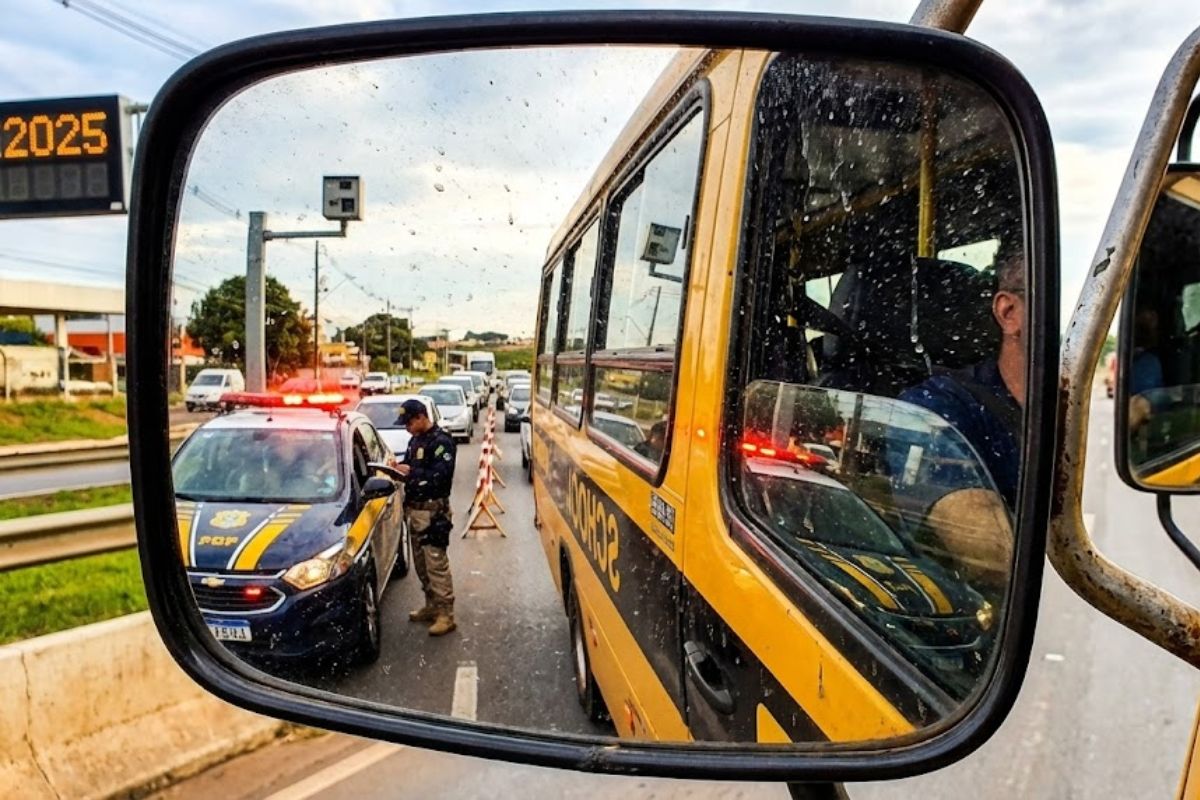


With New Contran Regulations Already in Effect, the Rearview Mirror Law Redefines What Is Mandatory Equipment, Tightens Inspections, Requires Extra Mirrors in School Transportation, Maintains Adaptation Deadlines, and Turns Any Broken or Irregular Rearview Mirror into a High-Cost Fine for Distracted Drivers Nationwide
The rearview mirror law is not a single isolated article, but a package of rules from the Brazilian Traffic Code combined with resolutions from Contran that directly address driver visibility. In practice, these regulations define which mirrors are mandatory, how they must be installed, and which vehicles need additional devices to reduce blind spots, especially in school transportation.
With the new requirements consolidating deadlines starting in 2025, the rearview mirror law enters a period of stricter enforcement. Those who do not take mirrors seriously will drive with a target on their backs, particularly drivers who insist on driving with broken, flipped, removed, or out-of-spec mirrors. In some cases, in addition to the fine, the vehicle may be impounded until it is regularized.
What the Rearview Mirror Law Really Covers for Cars and Motorcycles
In the passenger fleet, the rearview mirror law follows a logic that combines manufacturing date and vehicle configuration.
-
The Senate approves a bill that criminalizes misogyny, hatred, or aversion towards women, and includes the crime in the Racism Law with a penalty of up to 5 years.

-
Chamber Approves Bill That Allows Pepper Spray for Women Over 16 and Imposes Strict Rules for Purchase, Possession, and Use as Self-Defense

-
Chamber Approves Law to Combat Leucaena, Fast-Growing Plant That Dominates Land and Threatens Native Species in Various Regions of the Country

-
Asset Division: Know What Cannot Be Divided in Case of Divorce

For most cars, it is mandatory to have an internal rearview mirror and an external rearview mirror on the left side.
The external mirror on the right side became a requirement for all vehicles manufactured from January 1, 1999, which, in practice, includes almost everything currently on the streets.
This means that older cars may have some flexibility, provided the internal mirror ensures adequate visibility.
But for newer vehicles, driving without a right mirror already puts the driver directly in the sights of the rearview mirror law, opening the door to severe infringement, points on the driver’s license, and vehicle retention.
For motorcycles, motor scooters, and mopeds, the rule is even clearer. It is mandatory to use rearview mirrors on both sides, left and right, without exception.
Riding a motorcycle with only one mirror or with both removed is tempting fate, both in terms of safety and financially, because inspections view this as an immediate risk to the driver’s integrity and that of other road users.
How Trucks, Buses, and Passenger Transport Are Affected
In cargo transport and collective transport, the rearview mirror law is also firm.
Trucks and buses must have external mirrors on both sides, ensuring the driver sees laterally and rearward with maximum possible visibility.
This is crucial during overtaking maneuvers, lane changes, and turns in urban areas.
The difference is that, in this segment, any visibility failure usually has a greater impact, as these are large and heavy vehicles.
A poorly adjusted mirror on a truck means tons moving with an enlarged blind spot, a typical scenario for collisions in bus lanes, smaller vehicles crushed during turns, and pedestrian accidents at intersection corners.
Therefore, transport companies that neglect the maintenance of mirrors, mounts, and adjustments end up accumulating legal and financial risks.
The rearview mirror law acts here as a minimum safety line. Those who fall below this level assume the risk of accidents and costly lawsuits.
Fines for Broken Mirrors and the Financial Burden on Drivers
When it comes to punishment, the Brazilian Traffic Code treats the rearview mirror as an essential safety item.
Driving with a non-existent, broken, or visibly damaged mirror is classified as a serious infraction under Article 230.
The rearview mirror law considers that without adequate lateral visibility, the driver is driving almost in the dark, unable to see vehicles, motorcyclists, and cyclists beside them.
The penalty is clear: a fine of R$ 195.23, five points on the National Driver’s License, and the possibility of vehicle retention until regularization.
This applies to those who have removed the mirror, those who left the rearview mirror dangling after a collision, and those who insist on driving with a mirror that does not meet the minimum visibility area.
In practice, a driver who delays “fixing it later” ends up paying twice.
The rearview mirror law does not treat the mirror as an aesthetic detail, and inspections in blitz or operations have legal backing to classify the vehicle at the time.
Replacing the rearview mirror before being pulled over almost always ends up being cheaper than paying the combination of a fine and points.
What Changes for School Transportation with the New Rearview Mirror Law
The most sensitive point of the recent updates to the rearview mirror law is in school transportation.
Resolutions such as Contran 993/2023 consolidated specific technical requirements for vans, minibuses, and buses carrying children, focusing directly on reducing accidents caused by blind spots around the vehicle.
According to these regulations, these vehicles must have indirect vision devices, which can be additional mirrors, especially long-range convex mirrors, or camera and monitor systems.
The goal is for the driver to see areas that were previously completely hidden, especially alongside and in front of the vehicle, where small children can become invisible at the height of the hood or bumper.
In other words, it is no longer enough to just have the conventional pair of rearview mirrors.
The rearview mirror law for school transportation now requires an expanded vision package, which reduces the risk of accidents during boarding, disembarking, and reversing in front of schools.
Adaptation Deadlines and Timeline for the School Fleet
To avoid rendering the service unviable, Contran established a staggered timeline.
The rearview mirror law applied to school transportation began with new vehicle designs, those launched from January 1, 2024. They leave the factory with the indirect vision solutions incorporated.
Next, comes the more delicate phase: adapting the entire circulating fleet.
According to the timeline, from January 1, 2026, the requirement will apply to all school vehicles, including older vans and minibuses, which will need to be equipped with extra mirrors or compatible camera-monitor systems.
Those who ignore the deadline face risks on two fronts.
On one side, traffic penalties: fines, retention, and prohibition of circulation.
On the other, civil legal risk, as in the event of a serious accident, non-compliance with the rearview mirror law may be considered a factor of liability, complicating the situation for fleet owners and companies contracted by municipalities and private schools.
Motorcycle Customization, Small Mirrors, and What the Law Allows
In the two-wheeled world, it is common to see motorcyclists replacing original mirrors with more discreet or stylized models.
However, the rearview mirror law does not concern itself with style but with the area of visibility. The replacement is allowed as long as the new equipment meets the technical requirements for size and reflection quality.
In practice, the mirror must provide a minimum reflection area of around 69 cm² and allow for a circle with a diameter of 7.8 cm to be inscribed on its surface.
Those tiny mirrors that barely show the rider’s arm do not meet the required standard, even if they are freely sold in the parallel market or accessory stores.
Moreover, riding with mirrors folded or turned inwards, a common practice during “stunt” maneuvers or in tight corridors, also contradicts the spirit of the rearview mirror law.
If the mirror does not provide adequate visibility of the road, the inspection can fine the driver as if they were without the equipment.
How the Average Driver Should Prepare for Inspections
For the driver who uses the car every day, the first step is simple: to look at their own rearview mirror with the same seriousness they give to the brakes and tires.
The rearview mirror law transforms the mirror into a frontline safety measure, so driving with a loose, cracked, or improvised piece becomes an invitation for fines and bigger problems in case of an accident.
It is worth checking whether the vehicle meets the minimum required mirrors according to the year of manufacture, whether all are secure, free of cracks that distort the image, and properly adjusted for the ideal field of view.
In taller vehicles, such as SUVs and trucks, a poorly adjusted mirror can widen blind spots to dangerous levels.
In school transportation, van and minibus owners need to pay attention to the adaptation timeline.
The installation of additional mirrors or camera systems is not only compliance with the rearview mirror law.
It is a direct investment in the protection of children circulating around the vehicle, precisely in the area most vulnerable to blind spots.
In the end, the message is clear: the rearview mirror law has moved from theory to the routine of those driving in Brazil.
A driver who takes mirrors seriously gains safety, reduces legal risk, and avoids unnecessary expenses with fines and retention.
Those who insist on treating the rearview mirror as an aesthetic detail will discover the cost of that in the next inspection.
If you were an inspector today, looking at the rearview mirror of your own vehicle, would you give it a pass or issue a fine right away for how it is adjusted and maintained?










Está chegando o dia em que dirigir, ter veículo, tirar CNH, não vai mais valer a pena chamar um Uber ou procurar um transporte,tipo que não precisa de CNH e nem emplacamento será mais viável, o Estado todos os dias inventa uma coisa ou manobra pra tomar o que é seu, pior que um ladr@0 comum.
São uns ****, porque prejudicar as pessoas assim, essa nova lei é muito injusta. Fazer que o cônjuge da vida inteira fique desamparado nesse momento é uma crueldade enorme. Pior que a maioria das pessoas estão contra e eles não levam nada em consideração. NÃO CONCORDO, É UMA TREMENDA INJUSTIÇA 😡