





 Portuguese
  English
  Spanish
  6 min of reading
  0 comments



Built in the Interior of Myanmar, Naypyidaw Emerged as a Billion-Dollar Planned Capital, with 20-Lane Highways, Empty Hotels, and Deserted Temples, Forming a Mega Ghost City that Reinforces Military Control in Southeast Asia and Raises Questions About Strategy, Fear, and Democratic Future for Residents, Analysts, and Regional Governments.
The history of Naypyidaw, described as the strangest capital in the world, mixes urban engineering on a continental scale, opaque political decisions, and a use of territory that resembles an enlarged bunker more than a functional city. Officially, it was presented as a response to the overcrowding of the old capital and as a symbol of modernization, but the practical result was a mega ghost city, with low population density and disproportionate infrastructure.
While Yangon continues to concentrate the majority of the population, the economy, and today the most intense conflicts, Naypyidaw operates as an isolated planned capital, with empty 20-lane highways, surrounded government zones, rumors of underground tunnels, and a daily life that does not resemble that of any other seat of power in Southeast Asia. The central question remains: city for whom and for what?
Naypyidaw, The Planned Capital That Was Born Almost Empty

Naypyidaw was built in the interior of Myanmar starting in the early 2000s, in a process led by the military regime with secrecy and absolute control of information.
-
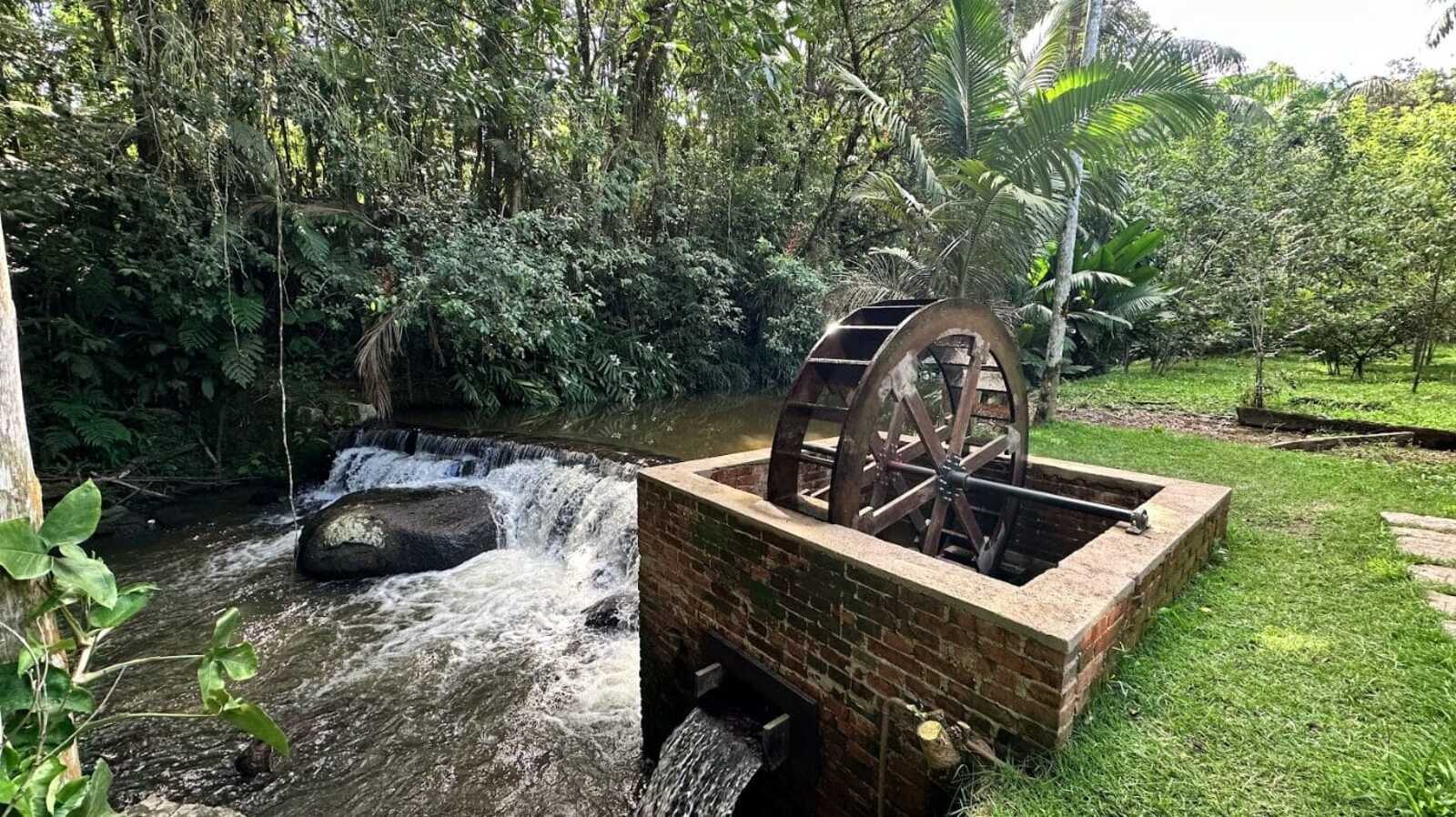
While restoring a historic mansion from 1910, a brick structure with an old turbine that generated energy from the Rio do Testo emerged, along with a hidden door and a rare floor concealed under layers of wax.
-
Italian researchers have detected what appears to be a second Sphinx buried under the sands of Egypt, and satellite scans reveal a gigantic underground megastructure hidden beneath the Giza Plateau for over 3,000 years.

-
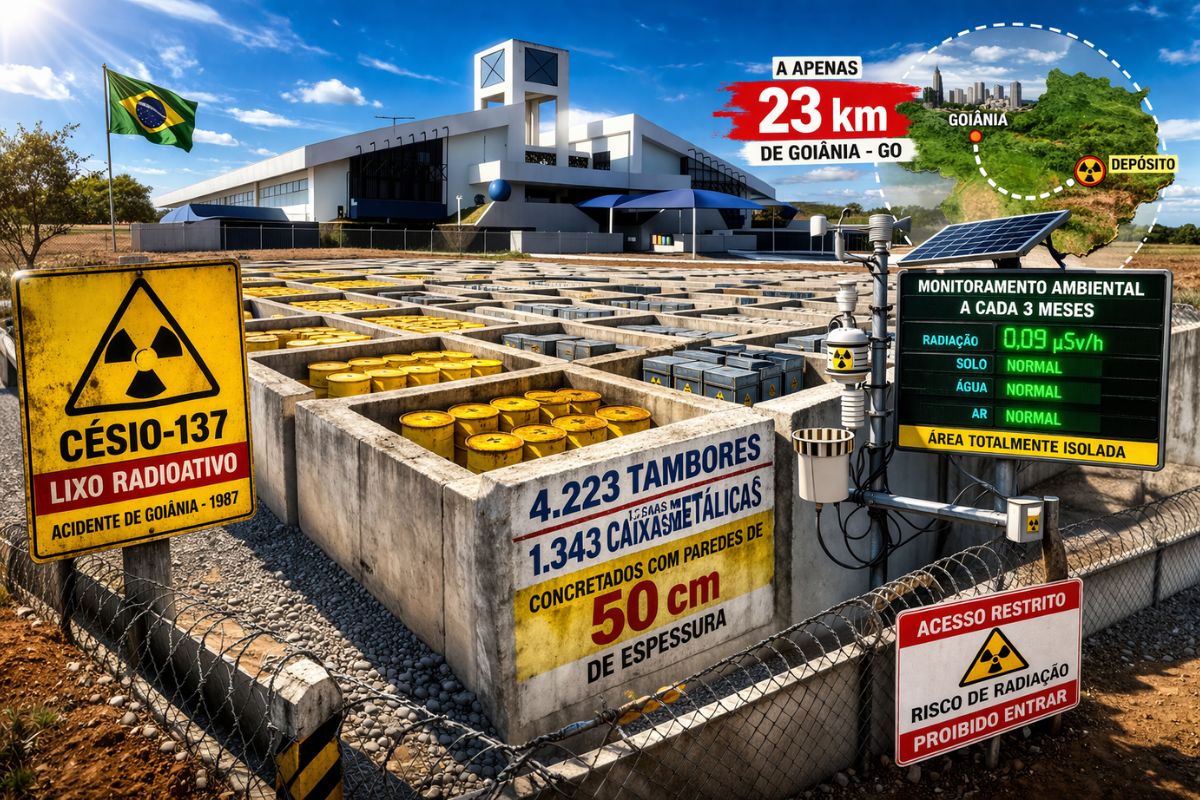
There are 4,223 drums and 1,343 metal boxes concreted with 50-centimeter walls that store the radioactive waste from Cesium-137 in the worst radiological accident in Brazil, just 23 kilometers from Goiânia, with environmental monitoring every three months.
-
Giant Roman treasure found at the bottom of Lake Neuchâtel in Switzerland reveals an advanced trade system, circulation of goods, and armed escort in the Roman Empire about two thousand years ago.


The planned urban area occupies about 7,000 square kilometers, four times larger than London and six times larger than New York, but with less than 1 million inhabitants.
This combination of gigantic scale with low occupancy helps to consolidate the image of a mega ghost city.
Entire neighborhoods, monumental avenues, and official buildings always seem to be in test mode, as if the population were still to arrive one day.
For the military, however, moving the capital to the interior offered something Yangon did not have: distance from large urban concentrations, lower risk of mass popular uprisings, and a geographically more protected position within Southeast Asia.
20-Lane Highways and the Void That Became a Global Symbol

One of the most famous elements is the 20-lane highways, which cross the ministerial zone and other areas of Naypyidaw.
In practice, these monumental roads are almost always empty. An isolated truck or a lost car appear from time to time, but for most of the day, the city seems like a post-apocalyptic movie set, without the apocalyptic event.
These 20-lane highways connect to other equally oversized avenues, with enormous roundabouts and unintuitive layouts.
In some stretches, there are still 16-lane highways that stretch for miles in almost a straight line, which fuels theories that, in an emergency, they could function as improvised landing strips.
Even if this hypothesis has never been confirmed, the fact is that the oversized road network reinforces the perception that Naypyidaw was designed more for military mobility than for civilian traffic.
On the outskirts of the city, one of these highways gained fame as the “highway of death,” due to the high number of fatal collisions since its inauguration in 2010.
For drivers not accustomed to 20-lane highways or almost empty 16-lane highways, the illusion of safety and wide speed can quickly turn into real risk.
Sectorized Zones and the Fortress Logic


The organization of Naypyidaw as a planned capital follows a highly sectorized model: ministerial zone, military zone, hotel zone, residential zones, and specific areas for leisure, a zoo, a golf course, and large temples.
There is no defined urban center; instead, the city spreads out in blocks separated by large distances, reinforcing the sense of an empty maze.
In the residential area, the roofs of houses are color-coded according to the ministry where the residents work, such as Health or Agriculture, for example.
The parliamentary zone forms a huge complex, surrounded by moats and barriers, with restricted access and a constant presence of soldiers.
There are also persistent rumors of underground tunnels that would connect strategic buildings, supposedly constructed with foreign technical support.
None of this is officially confirmed, but it fits the image of a surrounded fortress, typical of a nervous regime with its own population and the geopolitical environment of Southeast Asia.
This configuration reinforces the character of a mega ghost city: a large part of the urban surface appears to exist to protect and sustain a relatively small power core.
Civil life is dispersed, silent, and difficult to perceive at scale, unlike other dense, chaotic Asian capitals packed with street commerce.
Why Naypyidaw Was Created and How Much It Cost
Officially, the justification was administrative: Yangon, the former capital, was overcrowded, with chaotic traffic and little room for orderly expansion.
In practice, analysts point out that the decision to build Naypyidaw as a planned capital was linked to the fear of large urban uprisings and concerns about military vulnerability.
The construction of the city consumed around 4 billion dollars, a heavy amount for a country that, at the time, had an annual GDP of just over 10 billion dollars.
In a scenario of widespread poverty, deficiencies in education and health, and outdated infrastructure in various regions, allocating this volume to an almost empty capital fueled internal and external criticism.
Still, from a strategic standpoint, the new capital offers advantages for the regime.
Located between mountain ranges, far from the coast and major urban concentrations, Naypyidaw is less vulnerable to mass protests, external attacks, or maritime blockades.
In the broader context of Southeast Asia, this choice reinforces the military leadership profile that prioritizes control and self-protection.
Mega Ghost City, but Politically Alive
Despite being labeled as a mega ghost city, Naypyidaw concentrates the main state organs, including Parliament, the government headquarters, and sensitive military structures.
Daily life is discreet, with hotels often empty, malls nearly without customers, and even monumental temples with few visitors, but the decision-making axis of the country is there.
In recent years, the country made headlines again with a new military coup in 2021 and the beginning of a civil war of variable intensity.
Visible protests, fighting, and repression concentrate in Yangon and populous regions, while Naypyidaw remains relatively isolated, preserving the regime’s core.
In this sense, the city fulfills the role that many analysts believe it was designed for: to be a political-military fortress distant from social turmoil.
This duality is central to understanding the character of a planned capital: architecturally oversized, socially emptied, and politically loaded.
On a map of Southeast Asia, Naypyidaw is both an almost silent point and a power center with a direct impact on regional stability.
The Urban Enigma of Naypyidaw and the Future of the City
Two decades after the start of construction, Naypyidaw continues to be treated as an urban enigma by urban planners, diplomats, and journalists.
The combination of 20-lane highways, sparsely populated neighborhoods, wide green areas, and a heavily protected state apparatus creates a landscape that challenges traditional capital models.
While other planned capitals in the world, like Brasília or cities in Central Asia, gradually filled with people, businesses, and services, Naypyidaw remains marked as a mega ghost city, albeit with a slightly larger population than in the early years.
The long-term question is whether the city will one day become a dynamic urban center or if it will continue to be primarily a physical and symbolic shield for the military regime in Myanmar, in the heart of Southeast Asia.
In the end, Naypyidaw extremely synthesizes the tension between urbanism, security, and democracy.
The city shows what happens when the primary function of a capital is not to integrate the population, but to protect the power that governs that population.
And you, after learning about this mega ghost city called Naypyidaw, do you believe that a planned capital of this kind can one day become a truly vibrant city, or is it doomed to be just a permanent military fortress?









Seja o primeiro a reagir!