





 Portuguese
  English
  Spanish
 7 min of reading
  0 comments


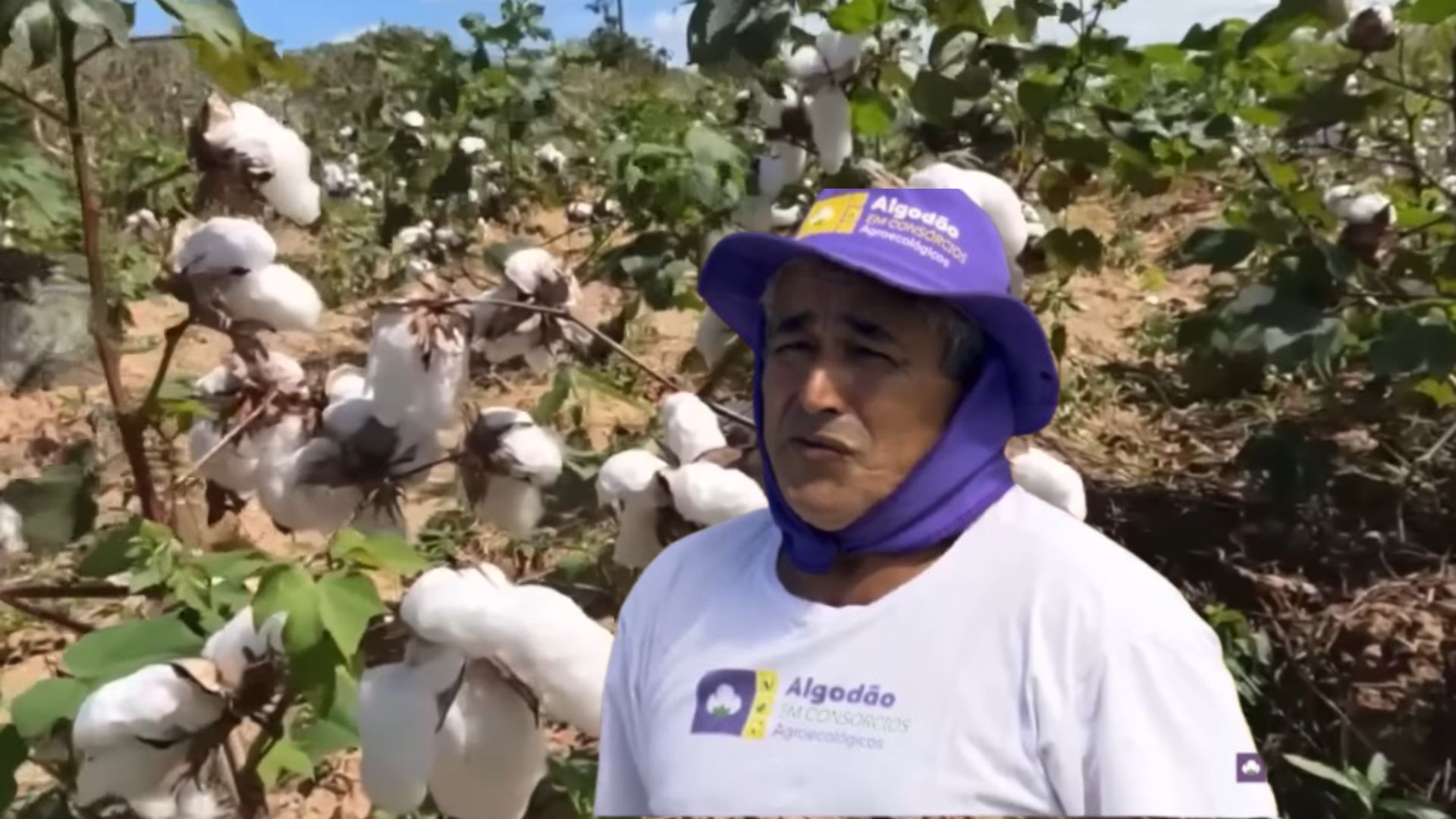
A Farming Model That Combines Survival, Tradition, and New Techniques Is Redesigning the Future of Hundreds of Families in the Semi-Arid, Showing That Even with Fragile Soil, Little Rain, and Long Years of Abandonment, It Is Still Possible to Recover the Crop and Increase Income Without Poison
The northeastern semi-arid has always been marked by resistance, long periods of drought, and stories of families needing to migrate to survive. This was the case for much of Pedro’s life, a farmer from the Sertão do Araripe in Pernambuco. For ten years, he left his wife and children to cut sugarcane in other states, spending up to seven months a year away from home in search of sustenance.
His wife, Risonete, remembers well the weight of that period. While he planted and traveled, she took care of everything: the children, the house, the animals, and the crop. Many days, the children took a while to recognize their father upon his return from long seasons away. It was a hard routine, marked by uncertainty and little return.

But the life of this family changed after they managed to buy a piece of land. There, in the 5-hectare plot in Ipubi, Pedro abandoned cutting sugarcane and returned to planting what once symbolized wealth in the Northeast: cotton. But this time, in a totally new way — organic, diversified, and sustainable.
-
The sea water temperature rose from 28 to 34 degrees in Santa Catarina and killed up to 90% of the oysters: producers who planted over 1 million seeds lost practically everything and say that if it happens again, production is doomed to end.

-
An Indian tree that grows in the Brazilian Northeast produces an oil capable of acting against more than 200 species of pests and interrupting the insect cycle, gaining ground as a natural alternative in soybean, cotton, and vegetable crops.
-
The rise in oil prices in the Middle East is already affecting Brazilian sugar: mills in the Central-South are seeing their margins shrink just as ethanol gains strength.
-
Rain gains strength in April, potentially exceeding 150 mm, placing the North, Northeast, and the coasts of the South and Southeast at the center of the heaviest forecast of the week.


The Comeback of a Crop Destroyed by the Cotton Weevil
In the 1980s, the Northeast experienced one of the greatest agricultural disasters in its history. The cotton weevil, a small beetle capable of piercing flower buds and green fruits, destroyed entire plantations and forced thousands of farmers to abandon the crop. The pest attacked precisely at the most sensitive stage of cotton, knocking off buds, reducing productivity, and making traditional planting unfeasible.
This information was disclosed by the content aired by TV Globo, which showed how the weevil transformed the rural landscape of the region. The impact was so great that cotton virtually disappeared from the semi-arid for decades.
Today, however, history is being rewritten — and in a surprising way — thanks to a model called agroecological consortium, developed by the NGO Diaconia. This system combines cotton with food crops and repellent plants that confuse the weevil, reduce pest pressure, and increase farmers’ income.
How the Organic Consortium Works
In Pedro’s plot, half of the area is for cotton, and the other half consists of organic food. The species are planted together, side by side, creating diversity that strengthens the soil, attracts beneficial insects, and protects the cotton plants.
The model works like this:
- 10 rows of planting
- 5 rows for cotton
- 5 rows for foods such as sesame, peanuts, corn, string beans, pork beans, and pigeon peas
This distribution changes every year, in a process called crop rotation, essential for breaking the pest cycle and improving the soil. Additionally, the cotton is now herbaceous, an annually cultivated variety that allows for the sanitary void: a period of 90 days with no plants, essential for reducing weevil infestation.

Pedro laughs when asked if this rotation confuses the weevil:
— “It really does!” — he replies, recalling that sesame functions as one of the best natural barriers against the pest.
The method has brought about a silent and powerful transformation. Many farmers who had given up on growing cotton in the past now see organic farming as a real opportunity for income and autonomy. The change, however, is not always easy.
Pedro recounts that, at first, the biggest resistance was to abandon the pesticides. When a pest appeared, the impulse was to reach for the sprayer immediately. But over time, he and his children noticed something surprising: even without pesticides, the pests declined — and the vigor of the crops increased.
The Strength of Technical Assistance and Shared Knowledge


The Diaconia project offers technical assistance, courses, machinery, seeds, and ongoing guidance. Agronomist Fábio Santiago explains that in 2022 alone, 990 hectares of cotton were cultivated, covering half of the areas included in the consortium. The program is present in Pernambuco, Alagoas, Sergipe, Paraíba, Rio Grande do Norte, and Piauí, serving 1,400 farmers, of which 380 families are from the Sertão do Araripe.
The logic is simple and powerful:
those who learn share the knowledge.
This is how groups like Eco Araripe emerge, a regional reference formed by farmers who replicate techniques, supervise organic practices, and help certify properties. Certification requires a series of protocols: fencing, animal control, distance from areas with pesticides, and strict organization of the field notebook.
One of the leaders is Maria do Socorro, a knowledge multiplier and guardian of heirloom seeds — traditional varieties adapted to the semi-arid and nearly extinct. In her plot, sunflowers, mucuna, pork beans, cunhã, and crotalária create an impressive colorful display.

She explains that these seeds are not only for planting: when they bloom, they are cut and turned into straw, enriching the soil with organic matter.
When asked if she truly believed in the consortium without pesticides, she replies firmly:
— “I believed and still believe. The poison comes back to us in the food. This way is better for us and for the soil.”
Water as a Limit — and as Hope
Despite the advances, water remains the great challenge of the semi-arid. At the end of 2020, the implementation of an irrigation system in an area of 1 hectare ensured production throughout the year. However, like almost everything there, this change also encountered resistance.
Francisco, Socorro’s husband, recounts that he doubted the efficiency of the drip irrigation system:
— “At first, I thought it wouldn’t water anything. Then I would move the hose this way, then that way… Until they explained to me that the drip was to make it easier, not to make it harder.”
After the technical guidance, he learned to trust the continuous droplets that keep the soil moist without wastage.
But not everyone is as fortunate. Dona Terezinha, another farmer in the region, lives only with the water from the cistern. Three years ago, the family saved R$ 15 thousand, an amount equivalent to almost a year’s savings, to drill a well. When they finally tested the water, they discovered it was salty and bitter, unfit for irrigation — the plants would grow a little and then die shortly after.
Even so, in just three years of the consortium, she has already managed to increase her income through the sale of sesame, which she transforms into candy, paçoca, and rapadura. Each small jar sells for R$ 4 and helps complement the budget.
— “Before, we couldn’t pay the bills. Today there’s no extra money, but it’s enough to live.” — she says.
From Field to Market: How Cotton Becomes Real Income

What makes the model even more attractive is that the production has a guaranteed market. In Orocó, in the Sertão do Araripe, a processing unit transforms sesame into tahini and natural flour. Meanwhile, the cotton is separated into lint and seeds by specific machines. The lint goes to a footwear industry that works exclusively with organic raw materials.
The producers receive R$ 19.95 per kilo of lint, plus a bonus of R$ 3.80 per kilo for those who keep their field notebooks organized and follow the best practices of organic farming.
At the end of the harvest, Pedro harvested 1,500 kg of cotton in total — which, after processing, resulted in 600 kg of lint. With the bonus, he should receive about R$ 16 thousand just from this year’s cotton. An amount that guarantees security to reach the next harvest without repeating the past of migration and instability.
— “Now we can make it to the next harvest,” he says proudly.
A Future Born from the Land — and Started with a Dream
The storage shed built with the project’s funding is the physical proof of transformation. The family, who once lived in a mud house without doors, now sees real improvements: structure, more predictable income, and autonomy.
When asked about her greatest dream, Risonete replies:
— “To fix my house. To make it very comfortable. It’s better than it was, but there’s still room for improvement.”
Pedro adds:
— “Our dream is to have water to work better. The biggest problem here in the Northeast is water. But we have to dream. If we don’t dream, it doesn’t happen.”
The project will continue to provide support until 2027. The goal is that by then, farmers achieve economic and organizational autonomy — and that organic cotton spreads even further across the semi-arid, strengthening family farming and rescuing a tradition that nearly disappeared.
What starts in a simple piece of land, among sesame, beans, and cotton, today represents something greater: hope, dignity, and proof that even where water is scarce, a future can still bloom.
In light of all this, do you believe that simple, sustainable, and low-cost agricultural models like the organic consortium can be the key to transforming other regions of Brazil that still struggle against drought, lack of income, and abandonment of the countryside?







-

-

-

-

-

-

67 pessoas reagiram a isso.