





 Portuguese
  English
  Spanish
  3 min of reading
  0 comments


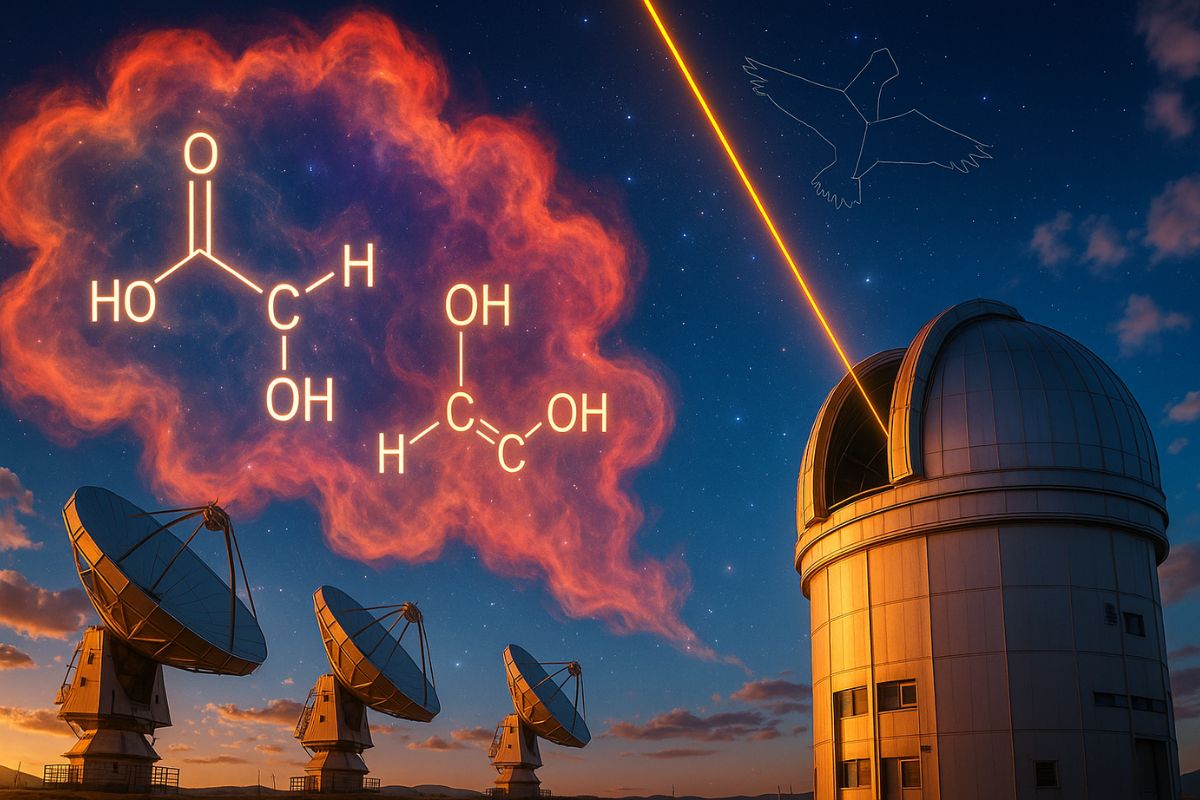
With High-Precision Telescopes, the Giant Alcohol Cloud in the Eagle Constellation Exposes Clear Signatures of Ethyl Alcohol and Methyl Alcohol, Offering a Natural Laboratory for Astrochemistry and New Clues About Star Formation and Complex Organic Molecules
The detection of the Giant Alcohol Cloud approximately 10,000 light-years away in the Eagle Constellation expands the chemical map of the Milky Way. The object, estimated to be about a thousand times the diameter of the Solar System, exhibits intense spectral lines of ethyl alcohol and methyl alcohol, key compounds for astrochemistry and for models of molecular synthesis in the interstellar medium. The simultaneous presence of methyl alcohol and ethyl alcohol in large quantities makes this region a rare and valuable case study.
The team utilized radio frequency and infrared observations, combining spectral mapping and molecular column estimates to characterize the Giant Alcohol Cloud. The cross-referencing of radio frequency bands with infrared reduces identification ambiguities and supports the analysis of relative abundances, especially in low-temperature environments where methyl alcohol, ethyl alcohol, and other organic species freeze and sublimate from dust grains.
What It Is and Where It Is
The Giant Alcohol Cloud is located in the Eagle Constellation, about 10,000 light-years away.
-
A gigantic dam project in the Himalayas could solve one crisis but silently create another for millions of people.

-
Nikola Tesla said that intelligent people tend to have fewer friends, and now science partially confirms this: a study with over 15,000 people showed that for the more intelligent, socializing too much can even reduce life satisfaction.

-
A superyacht worth US$ 17 million is delivered in impeccable condition, sets out to sail, and hits a bridge in the Bahamas just two hours later.

-
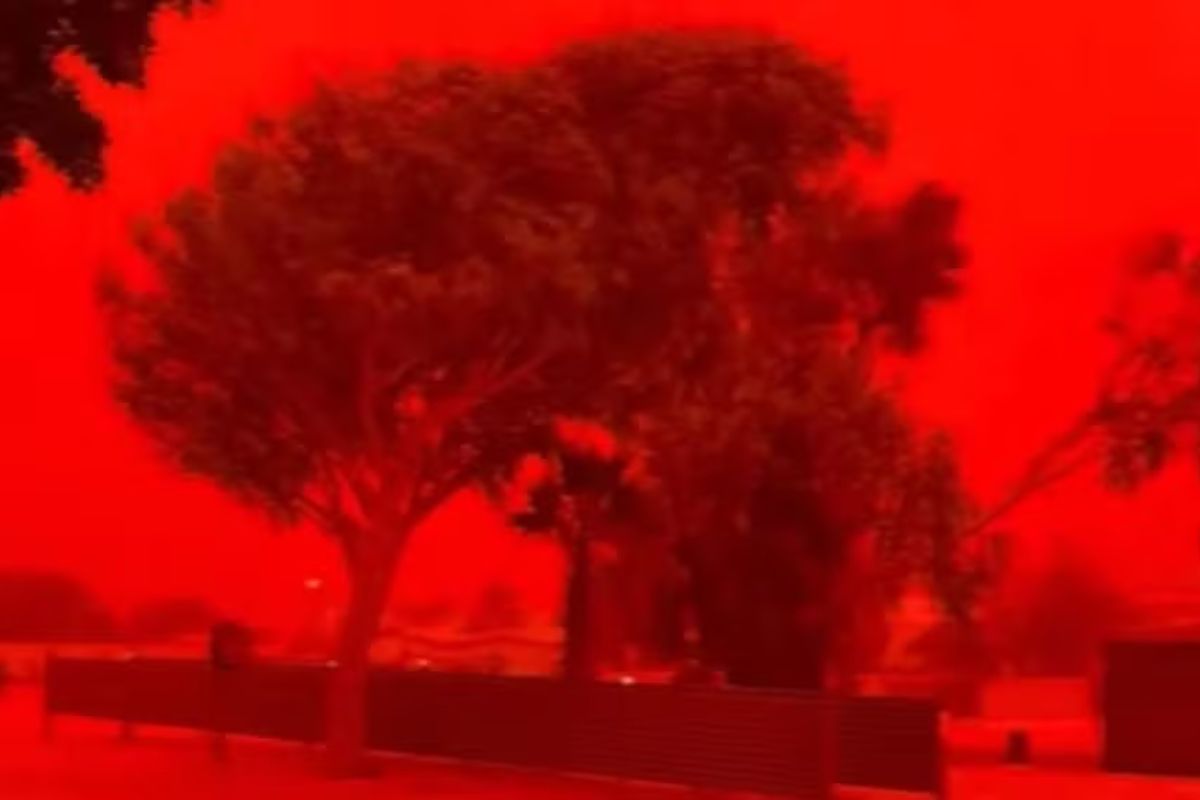
Residents of Australia woke up to a sky completely red like blood before the arrival of Cyclone Narelle, which hit the coast with winds of 250 km/h, tearing off roofs and lifting iron dust in a scene they described as apocalyptic.
It is a cold and dense mass, with an extent comparable to a thousand diameters of the Solar System, whose dusty opacity favors detection by radio frequency.
The location in the Eagle Constellation facilitates comparing the local chemistry with other star formation regions and refining the role of the environment in astrochemistry.
How It Was Detected
The spectral signature in radio frequency revealed rotational transitions typical of methyl alcohol and ethyl alcohol, while the infrared traced ice and local heating.
The combination of weak and strong lines, spread across different wavelengths, is crucial to confirm that this is a giant alcohol cloud and not confused with point sources.
The result reinforces the effectiveness of multi-band surveys applied to astrochemistry.
What It Is Made Of
The composition includes large amounts of ethyl alcohol, abundant methyl alcohol, and other organic molecules associated with star-forming regions.
The coexistence of ethyl alcohol and methyl alcohol suggests chemical pathways on dust grains and successive gaseous phases, compatible with freezing and sublimation cycles.
In the Eagle Constellation, the density and history of shocks may explain the efficiency of these pathways, making the Giant Alcohol Cloud a benchmark target for observational experimental astrochemistry.
Why It Matters for Astrochemistry
The Giant Alcohol Cloud provides a laboratory to test how methyl alcohol and ethyl alcohol form and evolve in cold environments before radiation and shocks heat the gas.
This window allows relating molecular inventories to stages of star formation and, by extension, to prebiotic chemistry.
For astrochemistry, comparing the Eagle Constellation with other organic-rich regions helps separate environmental effects from universal processes.
Next Observation Steps
The upcoming campaigns prioritize high-resolution spectroscopy in radio frequency and infrared to map chemical gradients within the Giant Alcohol Cloud.
The goal is to quantify abundance ratios between ethyl and methyl alcohol, identify precursors, and correlate chemistry with young sources in the Eagle Constellation.
With this, astrochemistry will be able to link molecular signatures to physical conditions and to the dynamic history of the gas.
What aspect do you want to see first in the new observations of the Giant Alcohol Cloud in the Eagle Constellation: the detailed map of methyl alcohol and ethyl alcohol in radio frequency or the astrochemical comparison with other organic-rich clouds?









-

-

-

-

-

-

25 pessoas reagiram a isso.