





 Portuguese
  English
  Spanish
  7 min of reading
  2 comments


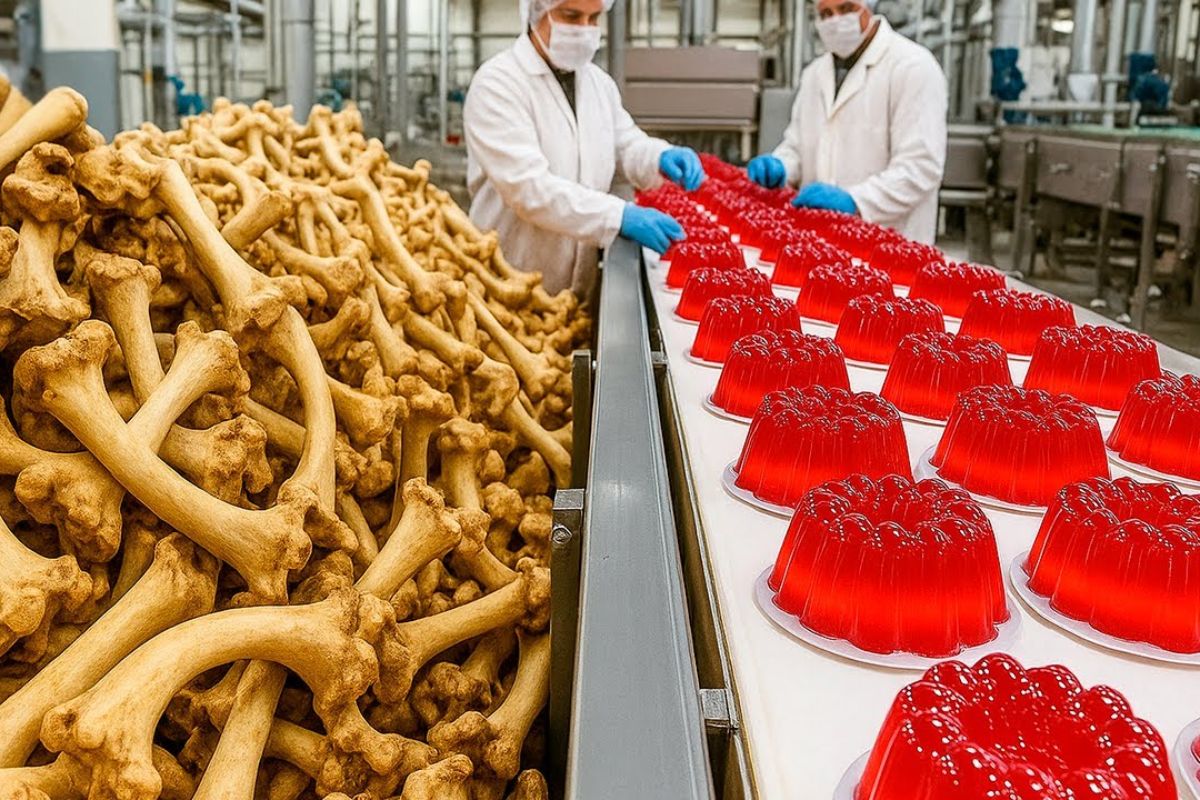


Behind The Jiggly Gelatin On The Plate, There Is A Heavy Industry That Grinds Skins And Bones, Controls Acids And Temperatures With Microscopic Precision, And In Just 48 Hours Transforms Bloody Waste Into A Crystalline Ingredient Used By Food, Medicine, And Beauty Factories In Total Silence, Repeated Millions Of Times.
Have you ever stopped to think that that gelatin that is transparent and wobbly in dessert is, in practice, the direct result of crushed skins and bones, immersed in acids and heat controlled with laboratory precision? Behind the innocent sweet lies a gigantic industrial system that transforms slaughterhouse scraps into a crystalline, stable, and standardized ingredient in about 48 hours.
This story didn’t start in a modern lab. Long before stainless steel factories, humans were boiling bones and skins in ancient Egypt to extract a thick and nutritious broth. Centuries later, in the 19th century, Peter Cooper created powdered gelatin and opened the door to the processed food era. During the wars of the 20th century, the same material became lightweight and protein-rich ammunition for entire armies, eventually infiltrating everything: desserts, medicine capsules, supplements, cosmetics, and mass meat processing lines.
From Egyptian Broth To Industrial Powder

Today, gelatin is practically everywhere, even when it doesn’t seem like it. It is in the pharmaceutical capsules that you swallow without a thought, in the supplements that promise to take care of your joints, in cosmetics, in meat products, and, of course, in the colorful jars of dessert.
-
How 5,000 Indian dabbawalas manage to deliver around 200,000 lunchboxes a day in Mumbai for over 130 years using bicycles, crowded trains, and a manual system that continues to operate with impressive accuracy.
-
While restoring a historic mansion from 1910, a brick structure with an old turbine that generated energy from the Rio do Testo emerged, along with a hidden door and a rare floor concealed under layers of wax.

-
Italian researchers have detected what appears to be a second Sphinx buried under the sands of Egypt, and satellite scans reveal a gigantic underground megastructure hidden beneath the Giza Plateau for over 3,000 years.

-
There are 4,223 drums and 1,343 metal boxes concreted with 50-centimeter walls that store the radioactive waste from Cesium-137 in the worst radiological accident in Brazil, just 23 kilometers from Goiânia, with environmental monitoring every three months.

The difference is that, instead of a steaming pot on the stove, the modern process takes place in colossal factories, with tanks, sensors, filters, and vacuum systems operating in sequence.
The logic remains the same as it was thousands of years ago, but now everything is pushed to the limits of engineering: extracting as much collagen as possible from what would be waste – skins and bones left behind at the end of the slaughter line.
The Journey Of Gelatin Begins At The End Of The Slaughterhouse
The route of gelatin begins right where most people don’t want to look: the end of the meat processing line.
When the prime cuts of cattle or pigs have already been separated, what remains is what no one wants to see on their plate, but is worth its weight in gold for the industry – skins, tendons, bones.
Among all this, pork skin rules the game, accounting for more than half of global gelatin production. It may seem like worthless waste, but this skin has such a high concentration of collagen that it sustains a multibillion-dollar industry.
As soon as they are separated, the skins are quickly cooled and loaded onto specialized trucks, with temperature monitored second by second. It’s not an exaggeration: a mistake at this stage ruins tons of raw material in one go.
When the trucks arrive at the factory, the load undergoes heavy inspection. What does not meet the standard is discarded, while the rest is stored in warehouses controlled by sensors and technicians until it is released for the stage where biology meets industrial chemistry.
Heavy Cleaning And Chemical Attack On Collagen
From here on out, skins and bones follow parallel lines, each undergoing a type of highly planned torture.
For the hides, the process begins in gigantic tanks filled with a diluted lime solution. This alkaline environment attacks the tissue, softens the structure, loosens the hairs, and dissolves natural residues.
When the skin is flexible enough, it goes into high-pressure washing systems. Jets of water remove impurities and reveal a clean surface, ready to release the collagen.
The bones don’t have this luxury. They face a much more violent process. First, they are washed under high pressure. Then, they are ruthlessly crushed into pieces about 2.5 to 5 centimeters – a size calculated to increase the surface area in contact with the chemistry that follows.
These fragments go through circulating hot water to remove surface fats and minerals and then tumble into mild acidic or alkaline solutions that soften the hard mineral matrix, as if they were unlocking a biological safe.
When the skins and bones are clean and stable, it’s time for hydrolysis, the key stage that unlocks the collagen. Hides, being softer, are treated in tanks with diluted acids, such as citric acid, with concentrations controlled to the millimeter to break bonds without destroying the protein.
Bones require a more aggressive alkaline environment to penetrate their mineral armor. This chemical cooking can last hours or days until the tissue structure is open and ready to release the collagen.
Extraction, Filtration, And Birth Of The Gelatinous Block
With the internal structure precisely destroyed, the critical moment begins: the extraction of collagen that will become gelatin. The prepared raw materials are taken to enormous stainless steel extraction kettles, with capacities of thousands of liters. The lids are locked, and the mixture is carefully heated to be between about 54 and 82 ºC.
The point is simple: sufficient heat to dissolve the collagen in water, but not so much as to cook and ruin sensitive proteins. Slow agitators keep everything in motion for hours until the solid becomes a viscous yellowish liquid. The result is a thick broth, not photogenic, full of fat and particles.
This is where membrane filters come in. The hot solution is pumped through steel tubes to filters with pores so small that they only let collagen molecules pass, trapping dirt and fat. What comes out on the other side is a clear, almost transparent stream of dissolved collagen.
This liquid is still too watery. It proceeds to vacuum concentration tanks, where low pressure accelerates water evaporation.
Minute by minute, the broth thickens until it turns into a dense syrup. When it reaches the perfect concentration, it is slowly cooled in steel trays until it transforms into a semisolid gel block – the “mother” of all gelatin, whether in powder form or sheets.
When The Block Turns Into Transparent Pasta Rain
On the route to powdered gelatin, the gelatinous block is fed into a powerful extrusion machine. Inside a sealed steel chamber, a hydraulic piston brutally pushes the gel against a metal plate full of micro-holes, each about 2.5 millimeters in diameter.
The result is a rain of long, transparent strands that cascade onto a conveyor belt like glass noodles.
The physical reason is simple and brilliant: thin strands have much more surface area, so moisture evaporates faster, and the product dries without yellowing.
These strands fall onto a cooling belt at about 20 ºC. The cold air sets the shape and prevents them from sticking. Afterward, they enter a long drying tunnel, where hot air circulates between about 49 and 71 ºC. Inside, humidity drops from over 90% to around 10%, transforming the moist gel into a light and brittle solid, almost like fine glass.
Next, a high-speed cutting system slices the dried strands into smaller pieces, which fall into hammer or roller mills.
These machines hit the gelatin hard until it turns into fine granules. Vibrating screens, with openings measured in thousandths of an inch, separate the ideal powder from what is still coarse. The coarse returns for regrinding, the fine continues on.
In the end, the gelatin powder is automatically packaged. Machines fill hundreds of bags per minute, seal them with heat, and print traceability codes that tell exactly which batch, factory, and line that bag came from.
The Slow And Precise Line Of Sheet Gelatin
While the powder dominates the mass market, another part of the factory works at a more delicate pace: the production of sheet gelatin, widely used in professional pastry. Here, the concentrated block is not crushed, it is rolled out.
The thick gel is placed on a stainless steel rolling table, where heavy cylinders press it until it turns into a very thin, almost invisible film.
This sheet then travels along a cooling conveyor belt, with cold air between about 7 and 12 ºC stabilizing the surface until it turns into a smooth, firm film, similar to transparent plastic.
Tension mechanisms keep the sheet stretched while rotary knives cut perfect rectangles, about 10 by 7 centimeters, the classic shape of gelatin sheets.
These still damp sheets are separated by blasts of air so they don’t stick together, arranged in trays with millimeter spacing, and taken to drying chambers, where the air slowly removes moisture to maintain crystal clarity.
Bloom Test, Packaging, And The Invisible Role Of Gelatin
Before hitting the kitchen, each batch of sheet gelatin undergoes a physical strength test known as Bloom. A sample is dissolved, the gel is formed, and a mechanical plunger measures how much force is needed to sink into the surface. If the resistance is below standard, the batch is rejected.
Only the perfect sheets are packaged in moisture-resistant bags and then in boxes that go to supermarkets, pastry shops, and industries across the country. The powder follows a similar path, in versions for food, pharmaceutical, or cosmetic industries.
At the end of the line, what began as a mountain of skins and bones destined for disposal goes through a complete metamorphosis.
From raw carcasses, a light, invisible, and extremely versatile ingredient is born, sustaining entire industries without almost anyone noticing.
The next time you see a dessert shining in the light or swallow a medicine capsule, remember the violent, precise, and micrometer-accurate route this material took to become gelatin.

After learning about this brutal journey of skins and bones to the crystalline gelatin on your plate, will you face the next spoonful the same way or are you already looking at this sweet with different eyes?








Mas q exagero tem nada de brutal nisso so materia prima da gelatina nada de mais, faz bem pra saúde
E o holocausto **** continua