





 Portuguese
  English
  Spanish
  7 min of reading
  0 comments


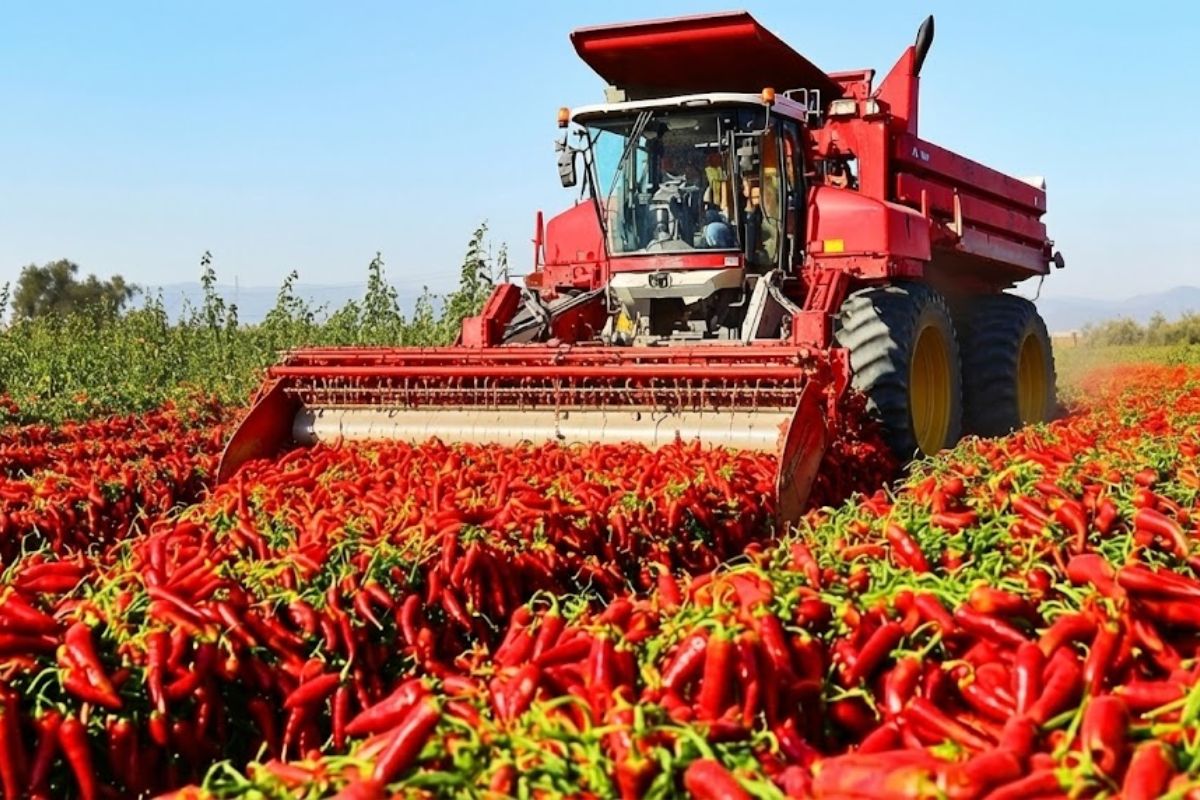
From Seedling in Greenhouses to the Use of Smart Harvesters, China Organizes Its Pepper Fields for Large-Scale Pepper Production, Transforming Malagueta Pepper into Standardized Pepper Sauce and Chili Sauce that Supply Industries, Supermarkets, and Kitchens Worldwide with Control, Safety, and Advanced Technology.
The malagueta pepper is treated as a strategic asset in various agricultural regions of China, where pepper fields are highly mechanized, feeding an industrial chain that goes far beyond small family farms. From the moment the seed enters the tray to the minute the pepper sauce drops into the bottle, everything is measured, monitored, and automated to ensure that pepper production is consistent, predictable, and scalable throughout the year.
At the same time, the chili sauce industry is growing, anchored in this highly organized agricultural base, using sensors, automated belts, and high-capacity industrial kitchens to deliver standardized batches that travel worldwide. Malagueta pepper ceases to be just a spicy seasoning and becomes a technological product, where every step is designed to extract the maximum flavor, color, and food safety from China’s vast irrigated fields.
From Nursery to the First Seedlings of Malagueta Pepper

The journey of malagueta pepper begins well before it appears red in the pepper fields.
-
For years, no one could cross a neighborhood in Tokyo because of the tracks, but an impressive solution changed mobility and completely transformed the local routine.
-
With 15 floors, an unusual building in Curitiba uses concrete, pilasters, and exposed roofs to create the effect of stacked houses.

-
Archaeologists opened a secret chamber that had been sealed by sand for 40,000 years inside a cave in Gibraltar and found what may be the last place where Neanderthals lived before disappearing from Europe forever.
-
The water that may have gone to the Moon with NASA during the Apollo 11 mission and been consumed by the astronauts springs in a Brazilian city at an altitude of 945 meters, famous for its thermal springs, above-average quality of life, and a natural radioactivity so unusual that it attracted Marie Curie.


The seeds are selected and sent to modern nurseries, where greenhouses control temperature, humidity, and light.
There, the pepper production is still microscopic but relies on sensors and constant monitoring to ensure uniform germination.
The trays are organized in rows, with fine irrigation and precise application of nutrients.
In about 7 days, the first seedlings emerge, and after two weeks, the seedlings reach about 5 centimeters in height.
This period is critical for malagueta pepper, as any management failure compromises future performance in the production fields.
Only when the seedlings reach between 10 and 15 centimeters, strong and well-rooted, does the technology enter another phase: transplanting to the pepper fields at scale.
Mechanical Transplanting and Organization of the Pepper Fields

In China’s large pepper fields, transplanting is no longer done plant by plant, by hand.
Specific machines with automatic transplanters position each malagueta pepper seedling in the soil with the root ball intact, reducing root stress and increasing the survival rate.
The spacing between plants, usually between 30 and 50 centimeters, is calibrated in the machine itself, depending on the variety and the target pepper production per hectare.
Everything is designed so that each plant has light, ventilation, and space for efficient photosynthesis.
In crops of this scale, a few centimeters of error replicated over thousands of rows means loss of productivity and uneven harvest, which is why micrometric adjustment is a central part of the strategy.
At the end of this process, what can be seen from above are pepper fields perfectly aligned, with straight lines that facilitate the use of tractors, sprayers, harvesters, and high-precision irrigation systems, essential to sustain a pepper production of tens of thousands of tons per year.
Precision Irrigation, Fertilization, and Plant Protection

With the malagueta pepper seedlings established, the combination of irrigation and nutrition comes into play.
In many agricultural hubs, high-efficiency drip or sprinkler irrigation systems are used to deliver water in the right amount, avoiding waterlogging or water stress.
Throughout the cycle, pepper production depends on a delicate balance between water, nutrients, and plant protection.
Fertilizers are applied in stages, often through fertigation, reducing waste and ensuring that the roots absorb as much as possible.
At the same time, pesticides such as fungicides and insecticides are applied using boom sprayers or autonomous equipment, controlled by application maps.
This intensive treatment ensures that the pepper fields maintain high health even across large areas, reducing losses from pests, diseases, and climate stress.
The goal is simple and direct: to bring high-quality malagueta pepper to the harvesting stage, with minimal defects and high concentration of color and spiciness.
Mechanized Harvesting and First Selection of Malagueta Pepper
Between two to three months after the final planting, depending on the variety and climate, the fruits reach a deep red color, signaling that the malagueta pepper has reached the ideal point.
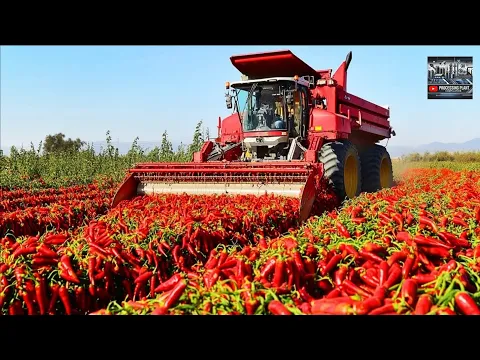
In small properties, harvesting can still be manual, but in large projects, specific harvesters tailored to handle delicate plants come into action.
These machines traverse the pepper fields, removing ripe fruits while trying to preserve the plants and minimize damage.
Afterward, conveyor belts transport the peppers to temporary storage compartments.
Mechanization speeds up the pepper production harvested per day, reducing reliance on large teams of manual labor.
Still in the field or in nearby units, batches of malagueta pepper undergo a preliminary selection.
Green, damaged, or out-of-standard fruits are separated.
This stage prepares the product for what really drives the chain: the industrial processing that will generate pepper sauce and chili sauce ready for consumption.
From Farm to Factory: Beginning of Industrial Pepper Production
Arriving at the industry, trucks loaded with malagueta pepper enter reception lines with scales, sampling, and quality control.
From this point onward, pepper production ceases to be merely agricultural and becomes industrial, with strict hygiene and traceability protocols.
The fruits go through automated washing systems, where pressurized water removes soil, dust, and impurities.
Next, sorting machines categorize the peppers by size, color, and integrity.
Only malagueta peppers that meet predefined standards proceed to become sauce, while out-of-standard fruits can be redirected for drying, animal feed, or composting, to avoid wasting raw material.
This continuous flow, from truck to the start of processing lines, is what allows the pepper fields of China to connect directly with factories that supply both domestic and international markets, sustaining a stable pepper production even during peak demand periods.
How Malagueta Pepper Becomes Pepper Sauce Inside the Factory
In the next stage, the direct transformation of malagueta pepper into pepper sauce begins.
The peppers are crushed in industrial mills, forming a homogeneous paste.
In this base, ingredients such as garlic, salt, sugar, vinegar, and other spices are added, always in carefully calculated proportions.
The mixing tanks are heated to controlled temperatures, which helps to integrate flavors, develop texture, and eliminate unwanted microorganisms.
This phase is decisive for standardizing the pepper sauce, ensuring that each batch has the same color, viscosity, and level of spiciness.
If the sauce becomes thinner or more concentrated than expected, adjustments are made in real-time based on laboratory measurements.
After cooking, the pepper sauce is filtered to remove seeds and skins, delivering a product with a smooth texture, ready to enter the bottling lines.
In parallel, a fraction of the batches may be specifically formulated to become chili sauce, with variations in acidity, sweetness, and spiciness intensity.
Chili Sauce, Extreme Standardization, and Bottles Ready for Export
The chili sauce follows a similar logic to that of pepper sauce, but with a focus on meeting specific flavor profiles for different markets.
In some cases, the same malagueta pepper from the large pepper fields is combined with other varieties to adjust color and pungency.
Automated bottling lines fill sterilized glass or plastic bottles, seal them with high-sealing caps, and apply labels with batch information, production date, and expiration date.
The standardization is so strict that the chili sauce must maintain the same flavor on any shelf in the world, whether in a European, Asian, or American supermarket.
In the end, both pepper sauce and chili sauce undergo quality tests that evaluate color, consistency, pH, salt content, spiciness level, and microbiological safety.
Only after this battery of checks is the load released for distribution, closing the cycle that began with the small seed of pepper in the greenhouse.
Global Economic Impact of Chinese Pepper Production
The scale of pepper production in China repositions malagueta pepper as an industrial input of global relevance.
Large fast-food chains, snack manufacturers, ready-to-eat food companies, and condiment brands rely on this consistent supply to maintain product lines that use pepper sauce and chili sauce daily.
At the same time, the pepper fields generate jobs, logistics, and services in rural areas, from agricultural input supply to heavy machinery maintenance.
Tractors, harvesters, irrigation systems, and sensors become part of the permanent malagueta pepper ecosystem, consolidating the crop as a vital cog in the Chinese agribusiness.
This model also generates debates about sustainability, water usage, environmental impacts, and external dependence of some countries that import large volumes of pepper sauce and chili sauce.
However, from a productive organization perspective, the Chinese case shows how pepper production can turn into a complex, integrated, and highly technological chain.
In the end, the story of malagueta pepper in China is the story of how pepper fields, pepper production, pepper sauce, and chili sauce have been woven into a single mechanism, going from greenhouse to plate with almost industrial precision.
And you, do you think this heavy technology applied to malagueta pepper is an inevitable path to feed the world, or does it still make sense to preserve a more artisanal and regional pepper production?








-

-

-

-

-

21 pessoas reagiram a isso.