





 Portuguese
  English
  Spanish
  8 min of reading
  0 comments



Made With Memory Alloys That Deform and Return to Normal, NASA’s Airless Tires Withstand Extreme Impacts, Require No Inflation, Promise to Reduce Fuel Consumption, Inspire More Efficient Airplanes, Almost Indestructible Bicycles, and Wheels Capable of Crossing Lunar Craters and Rocks on Mars Without Fear of Failure
NASA engineers are using a metal that seems to defy intuition: it bends, twists, stretches up to dozens of percent beyond normal, and when the load is relieved, it returns exactly to its original shape. It is with this alloy that the agency is testing airless tires designed to survive rocks, craters, extreme temperatures, and even gunfire.
By replacing the air chamber with a type of “spring skeleton” made from a memory alloy, these airless tires no longer rely on internal pressure to function. In practice, this paves the way for wheels that do not puncture, almost do not permanently deform, and can roll both on urban bicycles and on Mars rovers, as well as high-demand applications such as commercial airplane landing gear.
The Metal That “Remembers” Shape and Enables Airless Tires

The central component of this technology is a nickel-titanium alloy known as nitinol, a shape memory metal.
-
While restoring a historic mansion from 1910, a brick structure with an old turbine that generated energy from the Rio do Testo emerged, along with a hidden door and a rare floor concealed under layers of wax.

-
Italian researchers have detected what appears to be a second Sphinx buried under the sands of Egypt, and satellite scans reveal a gigantic underground megastructure hidden beneath the Giza Plateau for over 3,000 years.

-
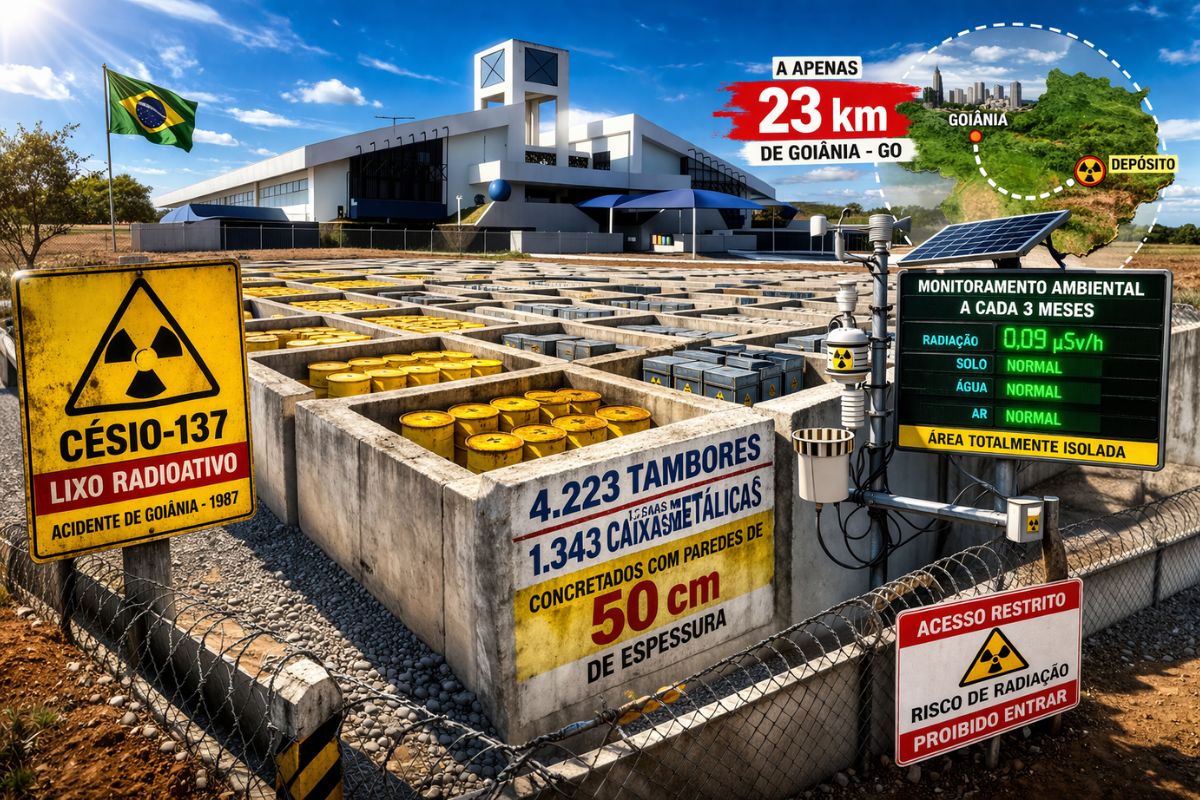
There are 4,223 drums and 1,343 metal boxes concreted with 50-centimeter walls that store the radioactive waste from Cesium-137 in the worst radiological accident in Brazil, just 23 kilometers from Goiânia, with environmental monitoring every three months.
-
Giant Roman treasure found at the bottom of Lake Neuchâtel in Switzerland reveals an advanced trade system, circulation of goods, and armed escort in the Roman Empire about two thousand years ago.


Under the right temperature and stress conditions, nitinol can deform much more than conventional metal and, upon removing the load, returns automatically to its original geometry, as if it has a “factory shape” encoded in its atomic structure.
When cold, the material enters a phase called martensite, in which the crystal lattice is more asymmetric and easily deformable.
When heated, it transitions to a more organized austenite phase, where the atoms return to their reference positions.
This solid-state phase transition is what gives the metal the ability to “remember” the pre-defined shape.
In practical terms, the wires that form the “skeleton” of the airless tires can be twisted, compressed, and loaded repeatedly without losing the original configuration.
In addition to thermal shape memory, nitinol exhibits superelasticity: even above the transition temperature, the simple act of applying mechanical stress forces the phase change between austenite and distorted martensite.
This allows for much greater deformations than those of ordinary steel, without rupture and without permanent deformation.
This combination of memory and superelasticity makes nitinol an ideal candidate for high-durability airless tires.
Why NASA Needed to Reinvent the Wheel

Exploring the Moon and Mars presented an obvious limitation: air tires do not survive in environments with near-zero pressure, extreme temperatures, and aggressive soil.
In past missions, such as those of the Apollo program, the wheels of lunar vehicles were made of steel mesh with an internal stop structure to limit deformation.
They worked, but were designed for short trips, of only a few dozen kilometers.
In the most recent rovers, like Curiosity, the solution became machined aluminum wheels made as a single piece, with structural “claws” for traction.
The aluminum skin, to meet the mass restriction, is thinner than a credit card.
On rocky terrain, concentrated load peaks between the claws opened tears and holes over the years, affecting the route and efficiency of the vehicle.
Every kilo launched into orbit is too expensive to be wasted on wheels that tear before the mission ends.
Thus, the interest in a wheel that is both lightweight, highly deformable, and practically immune to catastrophic fractures.
An airless tire based on shape memory alloy meets this triple requirement: it can withstand large deformations without buckling like a common sheet of metal, better distributes loads around the circumference, and does not rely on a thin pressurized wall to operate.
From Nitinol Wire to the Mesh That Replaces Rubber and Chamber
The basic architecture of airless tires is born from a simple concept: wrap a spring around a wheel and turn that spring into a support structure.
Instead of steel, engineers use nitinol wires woven into a complex mesh, where hundreds of turns cross to form an elastic “metal carcass.”
The process is labor-intensive: each tire requires hundreds of windings and wire passes so that the mesh has adequate density and strength.
The result, however, is a wheel body that operates as an integrated suspension system.
When passing over rocks or irregularities, the mesh deforms locally, absorbs mechanical energy, and then returns to its original shape without accumulating significant structural damage.
In laboratory tests, memory alloy wheels are evaluated on rotating carousels with sand, gravel, and rocks of different sizes.
Simulating the average speed of a Martian rover, the airless tires are forced to repeatedly go up and down obstacles, under load, to measure fatigue and residual deformation.
The goal is clear: ensure that, even after thousands of impact cycles, the wheel maintains geometry, traction, and load capacity within design limits.
Superelasticity, Heat, and Impact Dissipation
From a physical perspective, the behavior of these airless tires is determined by the stress-strain curve of nitinol.
Conventional metals begin to suffer permanent plastic deformation at around 0.3 to 0.8% deformation.
On the other hand, shape memory alloys, in superelastic mode, can achieve several percent of deformation in the practical use of the wheel, returning to original shape after load removal.
This phase transformation induced by stress is accompanied by heat exchange.
When the structure transitions from austenite to distorted martensite under load, the process is exothermic: the material releases heat.
When reverting to austenite as the load is removed, the process becomes endothermic, absorbing heat from the environment.
In practice, the metal mesh itself functions as a combination of spring and damper, dissipating part of the impact energy in the form of controlled heat.
For NASA, this means that part of the traditional suspension’s role can migrate to the airless tire itself, simplifying the mechanical architecture of spacecraft.
Fewer moving components, fewer failure points, and more reliability in environments where any maintenance intervention is impossible.
From Rovers to Almost Bulletproof Bikes
The same physics that allow traversing fields of rocks on Mars is already being demonstrated in more familiar terrestrial applications.
In bicycle prototypes, airless tires based on metal meshes coated with polymers have been subjected to beds of nails and gunfire.
The behavior is consistent with theory: nails and projectiles puncture the coating, but there is no loss of performance because there is no air to escape nor thin carcass to tear.
Peddling with this type of airless tire produces a cushioning sensation similar to that of a traditional tire, with the added advantage of eliminating flats and the need for periodic inflation.
In urban terms, the promise is of “almost indestructible” bicycles for daily use, especially in high-wear contexts like deliveries, shared use, and pothole-ridden bike lanes.
Despite this, the challenges of cost, mass manufacturing, and fine comfort still need to be balanced.
The nitinol mesh is complex, requires careful control of alloy and heat treatment, and must be encapsulated in materials that protect the metal without compromising flexibility.
It is this fine-tuning that will determine the pace of adoption of airless tires outside of the experimental environment.
More Efficient Airplanes and Simpler Maintenance
Research on memory alloys is not limited to wheels.
The same ability to change shape with temperature has been applied to aerodynamic devices, such as vortex generators and adjustable flaps on aircraft wings.
In cruise configurations, small surfaces can retract to reduce drag; during takeoff and landing, they automatically reappear as ambient temperature varies with altitude.
In landing gear, the logic of airless tires is straightforward: a conventional airplane tire operates at extremely high pressures, in the hundreds of pounds per square inch.
This increases the risk of explosion due to thermal or mechanical overload and requires constant pressure monitoring, lest fuel consumption rise or dangerous failures occur.
By migrating part or all of the structural function to airless tires based on metal meshes, this risk package disappears: there is nothing to puncture, and no risk of “running flat.”
For airlines, this translates to fewer unscheduled stops, simplified inspections, and potential efficiency gains, especially in high-turnover fleets.
In an industry where fractions of a percentage point in fuel savings represent millions in annual savings, any reduction in drag and maintenance has a direct impact on the bottom line.
Wheels Prepared for Mars and the Next Generation of Vehicles
In the context of space exploration, airless tires made of nitinol are a direct response to the problems exhibited by aluminum wheels on Mars.
A wheel that withstands repeated deformations, distributes load around the circumference, and does not create holes when encountering sharp rocks significantly extends the range and lifespan of rovers.
Every extra meter traveled safely means more data collected, more science delivered, and better utilization of missions that cost billions of dollars.
At the same time, the transfer of this technology to everyday life promises a new generation of wheels in which the combination of smart metal, absence of air, and optimized design reduces maintenance in cars, bicycles, cargo drones, and off-road vehicles.
The same logic applies to military, agricultural, and mining equipment, where the failure of a tire today can interrupt entire operations.
Ultimately, what NASA is developing with airless tires based on memory metal is a new way of thinking about the contact between machine and ground: wheels that adapt to the terrain, absorb impacts actively, and recover without damage, rather than rigid structures that break or pressurized rubbers that burst.
What Changes When the Wheel Stops Relying on Air
The combination of shape memory alloys and airless tires represents a structural change on three fronts simultaneously: safety, efficiency, and reliability.
By removing air from the equation and replacing it with a metal mesh that bends, adapts, and returns to normal, NASA and its partners create wheels that function as structure, suspension, and damper in a single component.
Whether on a bicycle crossing a bed of nails, an airplane landing without fear of blown tires, or a rover traversing the Martian terrain without creating craters in its wheels, the physical principle is the same: use the intelligent behavior of metal to eliminate the weak point of the traditional tire, which is the dependence on compressed air and fragile carcass.
And you, if you could choose today, would you dare to swap your regular tires for NASA-inspired airless tires, even if the initial cost were higher, in exchange for zero flats and less maintenance?








-

-

2 pessoas reagiram a isso.