





 Portuguese
  English
  Spanish
  7 min of reading
  46 comments


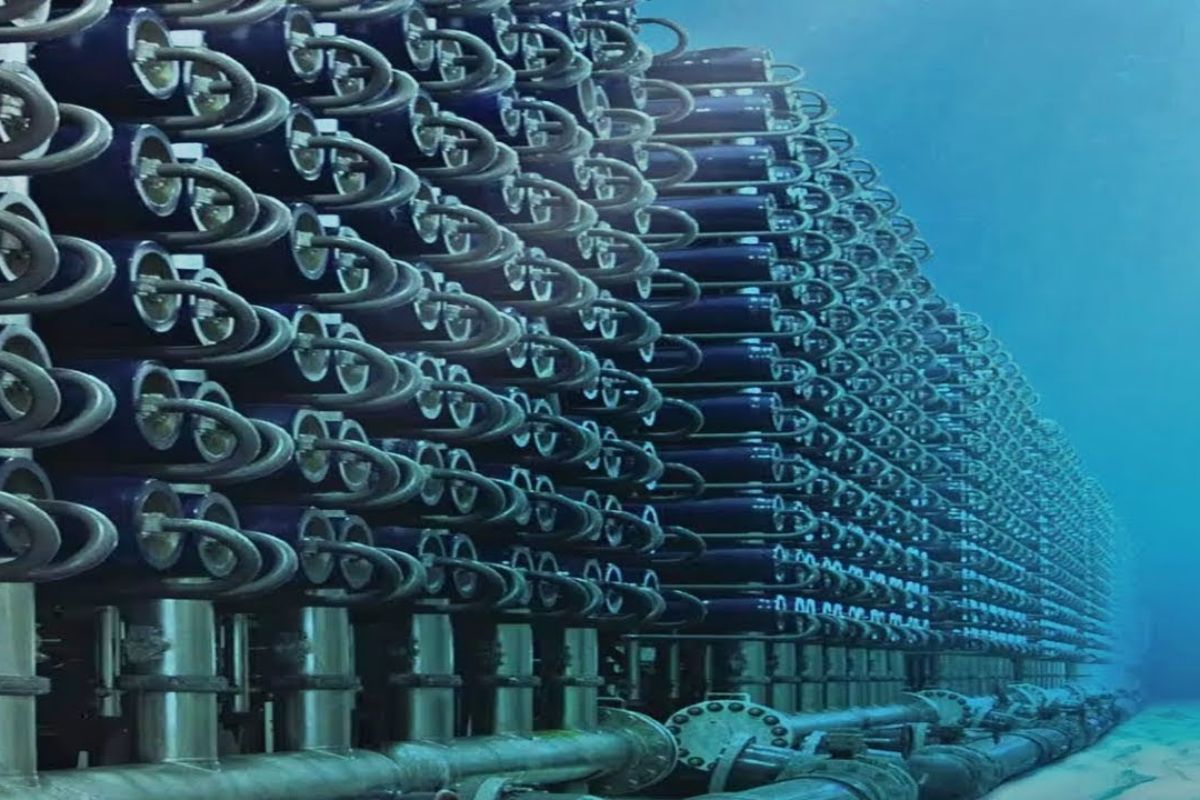


Reverse osmosis technology is behind plants capable of transforming 7 million liters of seawater into potable water in about 90 minutes, in highly automated lines that operate under high pressure, constant monitoring, and rigid chemical parameters to ensure safety and standardization of quality.
The advancement of reverse osmosis technology arises as a direct response to the scarcity of fresh water in arid or densely populated regions. Instead of relying solely on rivers, aquifers, and reservoirs, countries and cities have begun to use the sea as a strategic source of supply, supported by thousands of desalination plants around the world, capable of producing billions of liters of potable water every day.
In this scenario, reverse osmosis technology consolidates a new level of water engineering, combining high-pressure systems, semi-permeable membranes, and fine chemical treatment to break the natural bond between water and salt. It is an energy-intensive process, but it has been refined to increase efficiency, reduce environmental impact, and make the large-scale production of safe water for human consumption economically viable.
Why The Ocean Became An Alternative For Drinking Water

In many regions of the planet, the availability of fresh water no longer keeps up with the growth of population, agriculture, and industry.
-
For decades, a 50-kilometer ring structure in the middle of the Sahara has puzzled scientists: visible from space, it reveals layers of millions of years and turns the desert in Africa into a geological mystery.

-
With an unusual prize, Japan transforms office chairs into a resistance race on the streets, the ISU-1 Grand Prix grows, fills events, and pays 90 kilograms of rice.

-
With a façade that resembles a giant zipper, the building in Milan creates a sense of strangeness, featuring lighting that transforms engineering and attracts the attention of residents and tourists.

-
The Brazilian city has 319 crooked buildings built on sandy soil without proper deep foundations, houses the largest beach garden in the world, with over 5 km, and is still considered the birthplace of surfing — meet Santos, in São Paulo.


Reservoirs are running dry, aquifers are being pressured, and extreme climate events are making supply more unstable.
In this context, using the sea as a source of potable water has ceased to be science fiction and has become a survival strategy.
This is where reverse osmosis technology comes in as the protagonist.
It allows desalination plants to capture seawater, remove contaminants, microorganisms, and salt in successive stages, until reaching a final product that meets drinking water standards.
With tens of thousands of units in operation, reverse osmosis technology already supplies hundreds of millions of people, especially in coastal areas with scarce fresh water available.
From Sea To Plant: The Journey Of Salt Water

The process begins at the intake. Seawater is collected at strategically located points, hundreds of meters from the coast, through submerged intake structures. Grates and filters block large objects and prevent the entry of marine animals, such as mollusks, jellyfish, and small fish.
A single large-diameter pipe can extract around tens of thousands of liters per minute, equivalent to a bathtub full per second. High-capacity pumps push this salty water to the plant, overcoming distance and loss of pressure in the pipes.
At this initial stage, the priority is not yet the reverse osmosis technology, but rather preparing the water so that it can pass through the membranes without damaging them. To achieve this, the plant enters the pre-treatment phase.
Pre-Treatment Before The Reverse Osmosis Technology
Before reaching the core of the system, seawater goes through a sequence of physical and chemical barriers.
The goal is to reduce the load of solids, sediments, and microscopic particles that could clog or degrade the reverse osmosis membranes.
The pre-treatment typically follows three main stages:
Filtration through grates and screens to remove larger debris
Passage through sand beds, where gravity forces the water to cross tiny spaces between the grains
Chemical treatment with coagulants and disinfectants
In the tanks with sand beds, suspended dirt adheres to the grains and is retained. Even so, there are still very small particles left.
To deal with them, the plant adds sodium hypochlorite for disinfection and ferric sulfate as a coagulant, forming larger flakes that sink and are separated.
The water then proceeds to secondary stage filters, where agitated air currents and layers of finer sand promote even more precise filtration.
Only after this “heavy cleaning” is the visually clean water sent to large temporary storage tanks, in volumes on the order of hundreds of thousands of liters, awaiting the central step: reverse osmosis technology.
Heart Of The Plant: How Reverse Osmosis Technology Works
Reverse osmosis technology is based on a well-known physicochemical principle, but applied on an extreme industrial scale.
Under natural conditions, osmosis causes water to move from a less concentrated solution to a more concentrated one, through a semi-permeable membrane. In desalination, the process is reversed.
To achieve this, high-pressure pumps raise the seawater to about 60 bar, about 60 times the atmospheric pressure at sea level.
Under this force, the water is pushed against semi-permeable membranes rolled into cylindrical modules.
These membranes have pores up to 100 times thinner than a human hair.
Water molecules, being smaller, can cross the barrier. Salt ions, excess minerals, and other impurities are retained on the high-pressure side.
In each tube, there are typically several membranes in series, creating an extremely efficient selective barrier.
The result is the separation into two streams:
- Permeate: the purified water that passed through the membrane
- Brine: the concentrated saline reject, with a high concentration of salts and residues
In simplified terms, for every 2 liters of salty water, about 1 liter of fresh water is obtained and a smaller volume of concentrated brine, with salt removal rates close to 99.8 percent in well-adjusted systems.
What Happens To The Brine And Solid Residues
Desalination generates two main types of waste: solids removed in pre-treatment and the concentrated brine from the reverse osmosis technology stage.
The solid residues settle in treatment tanks. Part of them can be reused in the initial filtration stages, and the surplus is dehydrated in presses, which remove residual water before disposal in appropriate landfills.
This care reduces the volume and environmental impact of the solids generated.
The brine, in turn, cannot simply be returned to the sea uncontrolled.
Therefore, it undergoes dilution and mixing with other water flows before returning to the ocean, in order not to significantly alter the local salinity.
In many projects, the discharge point is studied to favor rapid dispersion and minimize any effects on marine fauna and flora.
Remineralization And Final Adjustments Of Desalinated Water
The water produced by reverse osmosis technology is extremely pure, with very low concentrations of salts and minerals.
Paradoxically, this is not ideal for human consumption. Safe drinking water needs to have a balanced mineral profile, both for health and taste reasons.
Therefore, the plant performs a post-treatment in several stages:
pH correction with the addition of acids or bases until reaching the appropriate range
Remineralization with calcium, magnesium, and other minerals in controlled concentrations
Final chlorination to ensure microbiological safety until distribution
This remineralization returns more pleasant sensory characteristics to the water, improves its taste, and rebuilds a chemical profile closer to naturally good quality water.
Then, automated systems monitor parameters such as turbidity, dissolved solids, heavy metals, and disinfectant residues.
Only after passing this battery of tests is the water released into the distribution network, supplying urban reservoirs and supply systems that serve entire populations.
Energy, Limits, And Challenges Of Reverse Osmosis Technology
Despite its efficiency, reverse osmosis technology is not without challenges. The operation at high pressure consumes a lot of energy, which impacts the final cost of water.
The economic balance depends on the combination between energy prices, the scale of the plant, and the efficiency of equipment.
Furthermore, the durability of the membranes, the control of fouling, and the proper management of brine are critical points in desalination engineering.
More recent projects aim to integrate renewable energies, such as solar and wind, to reduce the carbon footprint of producing potable water from the sea.
Still, the fact is that reverse osmosis technology has fundamentally transformed the way the world views the ocean, no longer seeing it merely as a geographical frontier but also treating it as a strategic water reserve.
Reverse Osmosis Technology As Global Critical Infrastructure
Today, desalination plants based on reverse osmosis technology are part of the critical infrastructure of entire countries, especially in arid coastal regions.
By allowing cities and industries to access a virtually inexhaustible source of water, they pave the way for new models of urban, agricultural, and energy development.
In practice, reverse osmosis technology is already one of the backbones of global water security, alongside reservoirs, supply networks, conventional treatment stations, and policies for rational water use.
It does not replace rivers and aquifers but adds a layer of resilience in an increasingly unstable climate scenario.
In a world surrounded by salty water but with limited reserves of fresh water, the ability to transform the ocean into a secure supply source reshapes the map of water geopolitics.
Amid high-pressure pumps, sand filters, microscopic membranes, and digital control systems, reverse osmosis technology demonstrates how engineering, physics, and chemistry are already combining so that humanity can literally drink the sea.
And you, in your opinion, should reverse osmosis technology be a priority for investment in coastal regions facing water crises, or should the focus still be primarily on reuse and reduction of consumption?








O intuito do ser humano é só usar, usar, usar…sem preservar. Vão destruir o planeta. Estão acabando com a água potável no planeta e agora estão querendo acabar com a vida marinha, destruindo o oceano, justificando com a possibilidade de purificação da água do mar. É muita ignorância. Muito egoísmo com desculpas “altruísta”.
Deixa de ser ****
As plataformas marítimas de perfuração, captação e armazenamento de Petróleo, utilizam essa tecnologia para o seu próprio abastecimento e consumo de água.
o reuso para indústria é fundamental e a dessanilização para o litoral com problemas de captação e escassez.