





 Portuguese
  English
  Spanish
  5 min of reading
  0 comments


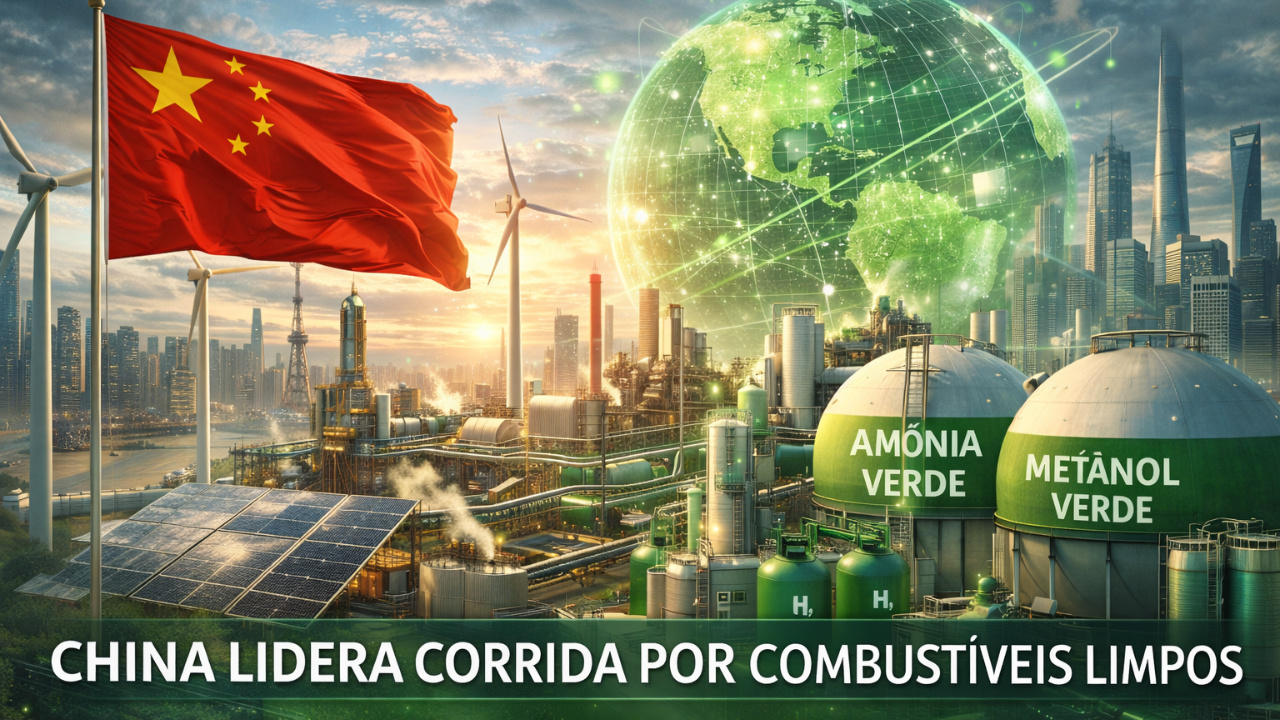
China Accelerates Investment In Clean Fuels Like Green Ammonia And Methanol, Using Large-Scale Renewable Energy And Consolidating Leadership In Global Clean Technology Supply Chains.
The China’s energy transition has entered a new phase. In addition to its established leadership in solar and wind energy, the country is rapidly advancing in the production of clean fuels for heavy industry, shipping, and the chemical sector. Chinese companies are using abundant and low-cost renewable electricity to produce green ammonia and methanol, laying the groundwork for a new global supply chain.
Although these technologies still face scaling and cost challenges, experts point out that the current movement resembles the early years of the solar industry, when high investments preceded a rapid decline in prices and quick global expansion.
Green Ammonia Emerges As Strategic Bet
In an industrial park in Chifeng, located in the Inner Mongolia region, one of the most emblematic projects of this transformation is already in operation. Entrepreneur Zhang Lei, founder of Envision, has expanded his focus beyond manufacturing wind turbines and has started producing green ammonia using wind energy as the main source.
-
A Canadian retiree creates a hydroelectric system on a real river, generating energy continuously throughout the day and demonstrating how the power of water can supply a house with stability even in a simple structure.

-
Petrobras reaffirms its commitment to the market and ensures that it will carry out the energy transition safely to maintain national sovereignty.

-
Researchers discover a possible hydrogen deposit of up to 46 million tons beneath an ancient coal basin, and the volume could exceed half of the entire global production.

-
China bets on the Fishery-PV model and transforms fish farms into giant solar plants, covering ponds with panels that generate energy while utilizing the same space for large-scale aquaculture production.


The product is intended for fertilizers, chemicals, and potentially for use as fuel for shipping. “This is more than a technological milestone,” Zhang said earlier this year. “Green and scalable alternatives are now real and operational.”
Ammonia is one of the most produced industrial chemicals in the world. Currently, most production relies on natural gas or coal. In the green version, renewable electricity replaces fossil fuels, drastically reducing carbon emissions.
Scale Production Strengthens Global Ambition
Envision invested around 8 billion yuan, equivalent to US$ 1.1 billion, in the Chifeng plant. The initial capacity is 320,000 tons per year. According to the company, contracts have already been signed with customers in Japan, Singapore, South Korea, and Europe.
The long-term plan is even more ambitious. The company aims to increase production to up to 5 million tons per year in the next decade, strengthening China’s presence in the global clean fuels market.
Despite the progress, costs remain high. The price of electrolyzers and the lack of robust storage and distribution networks still limit broader adoption.
Scale As A Key Factor For Cost Reduction
Analysts believe that the Chinese strategy is based on rapidly gaining scale. “There is an expectation that scale will make it cheaper — just like what happened with solar panels from 2010 until now,” said David Fishman, an energy analyst based in Shanghai at The Lantau Group.
The logic is similar to what has been adopted in other clean technology sectors. First, large investments and state support. Then, efficiency gains, cost reductions, and domination of global supply chains.
Green Methanol Broadens The Range Of Clean Fuels
Another example of China’s advancement is in the methanol sector. In Inner Mongolia, near Jungar Banner, a factory operated by Towngas is undergoing a gradual transformation. The site, spanning 500,000 square meters, initially relied on cheap coal to produce methanol.
Since 2021, the company has begun replacing coal with discarded tires. The next step involves using biomass. According to Tony Lin, an executive responsible for green fuels and chemicals at Towngas, by 2026 half of the annual production of 300,000 tons will be made with small desert willow pellets.
Biofuels Connect Climate And Environmental Recovery
The desert willow used as raw material is harvested in the regions of Kubuqi and Ulan Buh. These areas have been planted to combat desertification, but the trees need to be cut periodically to prevent excessive groundwater consumption.
Thus, the project combines environmental recovery, biofuel production, and emissions reduction. By 2028, the remaining 150,000 tons of production should fully transition to renewable raw materials.
Shipping Observes, But Still Hesitates
Methanol is seen as an alternative to traditional marine fuels, such as heavy fuel oil and diesel. However, the pace of adoption in international shipping remains uncertain.
In October, the United States and Saudi Arabia blocked the adoption of the International Maritime Organization’s “net zero framework,” which included mandatory emissions reduction targets. The decision delayed firmer regulatory signals for the sector.
Still, Lin believes that the transition is inevitable. “We need to make it green; otherwise, we won’t survive,” he stated.
China Leads Clean Industrial Projects At Scale
Data from the Mission Possible Partnership indicates that China hosts 54 clean industrial projects in operation or financed, three times more than the United States. This year, 12 of the 19 global projects that reached final investment decisions are in the country.
Manufacturers like Longi, Goldwind, and Mingyang, already established in renewable energy, are now advancing into green fuels and chemicals, including ammonia, methanol, and sustainable aviation fuels.
State Support And Long-Term Vision Sustain Advancement
Experts highlight that Chinese projects benefit from a broad range of public policies. These include low-interest loans, easy access to industrial land, and research and development subsidies.
Faustine Delasalle, executive director of the Industrial Transition Accelerator, states that Chinese developers see clean fuels as the “new oil.” According to her, China leads not only in the volume of projects but also in the ability to bring them to final investment phase.
External Uncertainties Challenge International Expansion
Despite internal progress, Chinese companies are considering producing clean fuels outside the country, including in Latin America, Africa, and the Middle East. Envision, for example, is already investing in the manufacturing of green hydrogen equipment in Spain.
For Frank Yu, responsible for the company’s zero-carbon gas and hydrogen efforts, the biggest obstacle is not technological but political. “Without strong emission reduction policies, how can green fuel compete with fossil fuels?” he questions.
In this scenario, China continues to advance, betting that the combination of scale, technology, and long-term planning will consolidate its global leadership in clean fuels.








Seja o primeiro a reagir!