





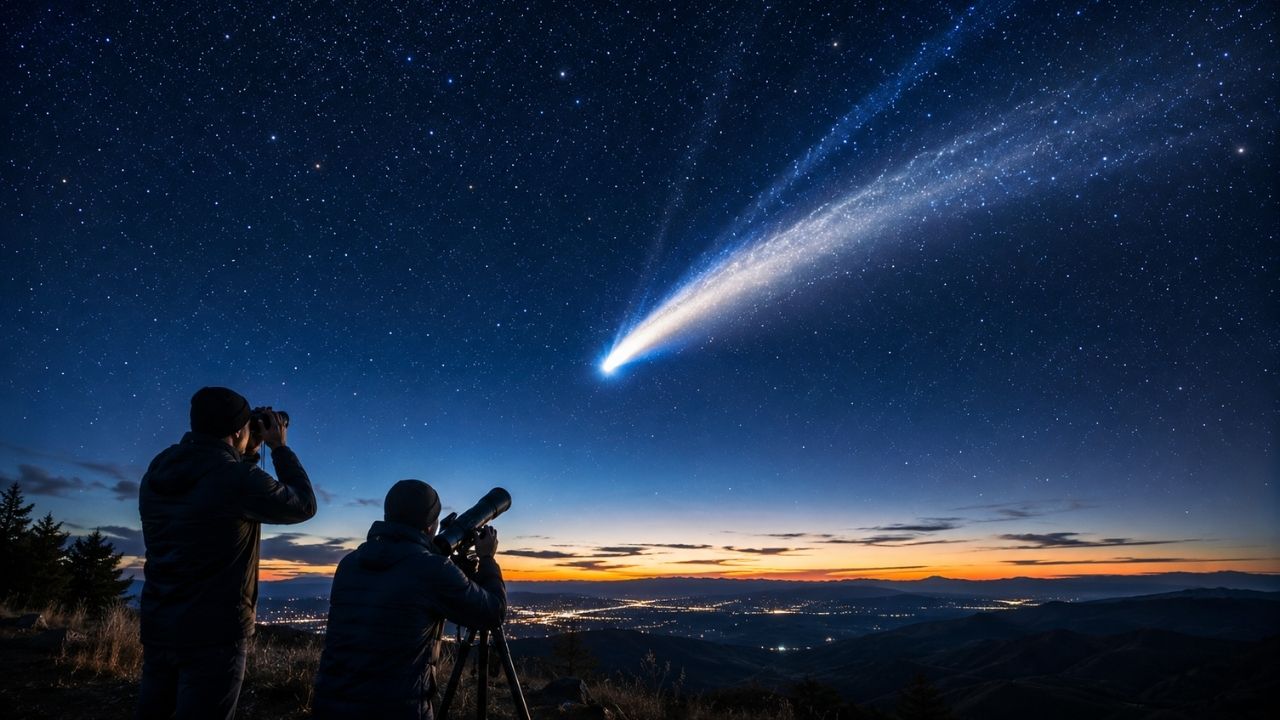

Periodic visitor known as Tempel 2 will reach perihelion on August 2 and make its closest approach to Earth the following day, when comet 10P/Tempel may reach a magnitude between 7 and 10, becoming a target for binoculars or small telescopes under a dark sky in the Southern Hemisphere in 2026.
Comet 10P/Tempel will make its closest approach to Earth on August 3, 2026, passing approximately 0.414 astronomical units, equivalent to about 62 million kilometers. The icy visitor can be observed with binoculars or small telescopes, especially in areas away from light pollution.
The information was published by the Daily Galaxy on July 22, 2026, based on data attributed to NASA and astronomical tracking systems. Ephemerides based on JPL Horizons place the closest approach on the night of August 3, while brightness predictions vary approximately between magnitudes 7 and 10.
Approach will occur shortly after perihelion
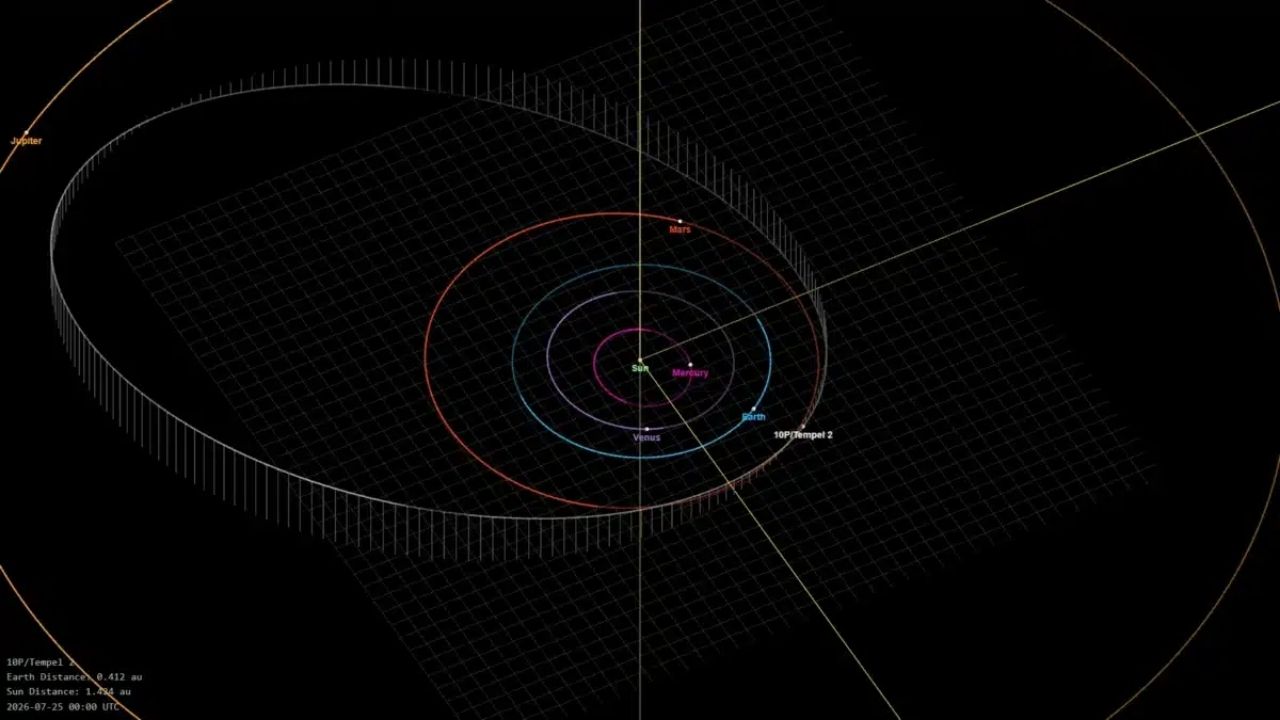
The comet 10P/Tempel will reach perihelion on August 2, at which point it will reach the closest point of its orbit to the Sun. The next day, it is expected to reach the shortest distance from Earth during this passage through the inner Solar System.
-
PET bottles left in the heat, frozen, or shaken can release more nano and microplastics into the water, according to a study with 8 leading brands and an increase of up to 9.29 times in particles under heat and agitation.

-
SpaceX sends “mechanic” robot with 3-meter arms to repair and extend the lifespan of satellites by up to eight years.

-
Xiaomi launches solar camera with 9,900 mAh battery, 4G, dual lenses, and artificial intelligence to monitor remote areas
-
At 50 years old, Silvio Santos’ daughter runs SBT, is part of a family with an estimated wealth of R$ 6.4 billion, and is trying to lead the network founded by her father into the era of streaming, 24-hour journalism, and multiplatform audience.


The approach does not pose a collision risk with the planet. Even at the closest point, the distance will be approximately 62 million kilometers, much greater than the space separating Earth from the Moon.
Predicted brightness varies according to the model used
The expected magnitude for the comet does not appear identically in all projections. Some estimates indicate brightness close to magnitude 7 at the beginning of August, while others work with a range between 8 and 10.
This difference occurs because the brightness of comets depends on the amount of ice and dust released during heating. Even knowing its orbit, astronomers cannot predict with absolute precision how the nucleus will respond to solar radiation.
Binoculars may be necessary to locate the object
Comet 10P/Tempel is not expected to produce a spectacle easily visible to the naked eye. To find it, observers will likely need binoculars with good aperture or a small telescope pointed at the correct region of the sky.
Observation will be favored by dark locations, an unobstructed horizon, and low humidity. Urban lights, clouds, and the proximity of the Moon can completely hide such a faint object, even when it is at its brightest phase.
Southern Hemisphere will have more favorable conditions
Projections indicate that the period between the end of July and the beginning of August will be especially interesting for observers in the Southern Hemisphere. The comet should pass through regions near the constellations of Capricornus and Piscis Austrinus during its passage.
The exact position will change from one night to the next, requiring the use of star maps or updated apps. It’s not enough to look at a known constellation, as the comet will appear as a small diffuse spot moving slowly among the stars.
Observation should be done before dawn
The best time tends to occur in the hours before sunrise, when the sky is still dark and the comet is above the horizon. The available window may vary depending on latitude and local visibility conditions.
Those intending to observe should arrive at the location in advance to allow their eyes to adapt to the darkness. The use of very bright screens hinders this adaptation, so maps and apps should be consulted with reduced brightness.
Object was discovered in the 19th century
Comet 10P/Tempel was identified in 1873 by the German astronomer Wilhelm Tempel during observations conducted at the Marseille Observatory in France. Since then, its passages have been monitored by professional and amateur astronomers.
Also known as Tempel 2, the object belongs to the Jupiter family of comets and completes an orbit around the Sun in approximately 5.36 years. Its relatively short orbit allows different generations to record changes in the same celestial body.
Repeated passages modify its surface
When the comet approaches the Sun, part of the frozen material beneath its surface transforms directly into gas. This process releases dust and forms the coma, the diffuse cloud that surrounds the nucleus.
The repetition of this heating along the orbits can alter the appearance, activity, and even the rotation of the object. Studies conducted during different passages identified gradual changes in the rotation period of Tempel 2.
Nucleus preserves ancient material from the Solar System
Comets are considered remnants from the early period of the Solar System’s formation. Their nuclei gather ice, dust, and compounds that have remained preserved for billions of years in cold regions far from the Sun.
Therefore, each return offers a scientific opportunity to measure composition, activity, and orbital behavior. The value of comet 10P/Tempel does not depend solely on its brightness, but on the information it can reveal about the origin of small planetary bodies.
Activity may come from a small region of the nucleus
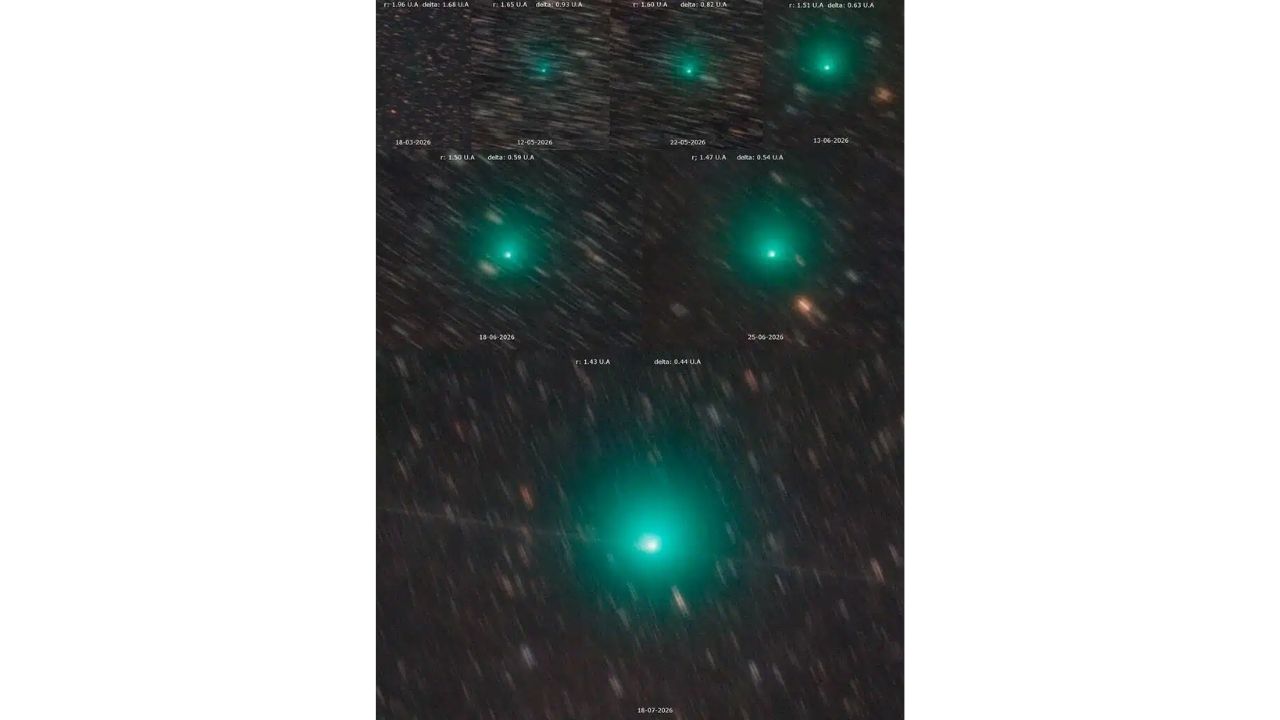
Previous research suggests that much of Tempel 2’s activity may be concentrated in a relatively small area near one of the poles of the nucleus. This localized source helps explain jets observed in past appearances.
The materials released can also slowly modify the rotation movement. Each jet acts as a very small force, but their accumulated effects over several passages can be measured by researchers.
Brightness should decrease after the approach
After passing the perihelion and the closest approach to Earth, the comet will gradually move away from the planet and the Sun. As a result, it should lose brightness and become increasingly difficult to locate.
The source estimates that the object could fall below magnitude 10 by mid-September. The beginning of August, therefore, represents a limited window, especially for those intending to observe it without large astronomical equipment.
Passage connects observers from different eras
The same comet seen by astronomers in the 19th century continues to return to the inner Solar System on a predictable trajectory. The instruments have changed, but the object still offers opportunities for comparison between records separated by decades.
The comet 10P/Tempel may not present a spectacular tail, but its approach offers an unusual experience for those who watch the sky. Would you try to locate this historic visitor with binoculars or prefer to wait for a brighter comet? Share your opinion in the comments.


