





 Portuguese
  English
  Spanish
  4 min of reading
  0 comments


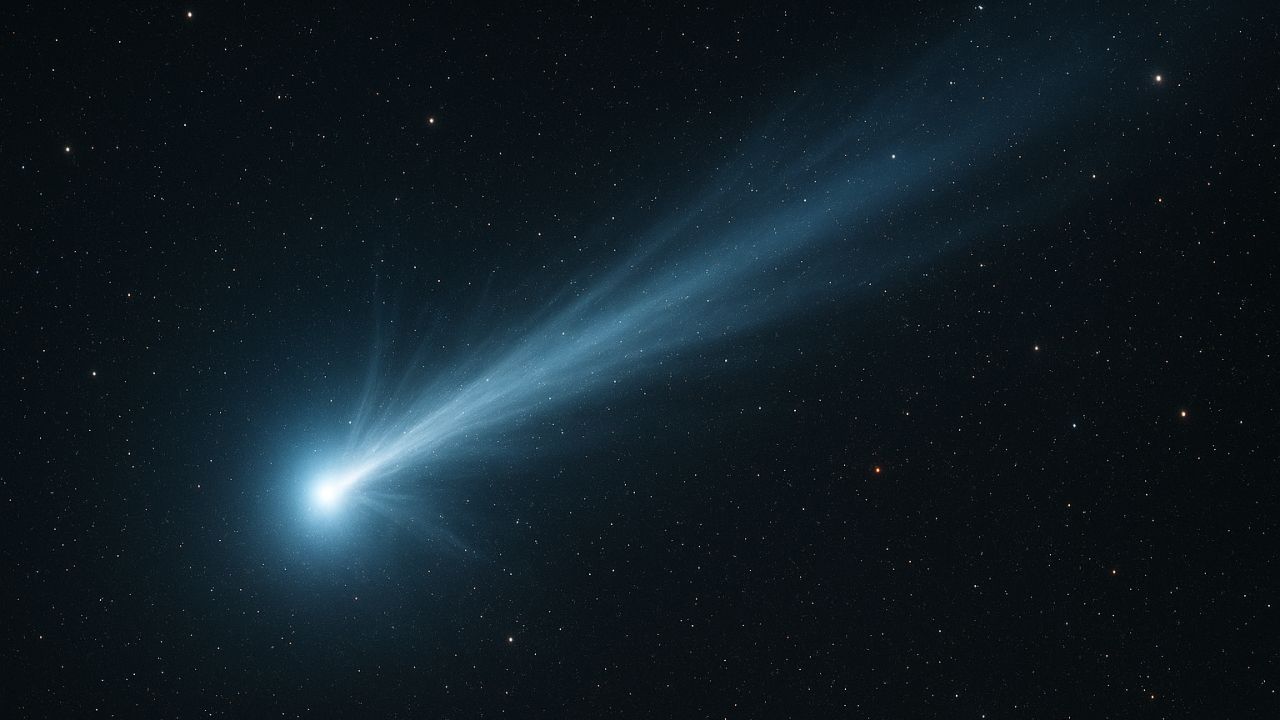
Comet 3I/ATLAS May Have Ice Volcanoes: New Hypothesis Explains Jets of Ice and Gases Detected in 2025, Suggesting Complex Internal Structure and Interstellar Origin.
Recent observations indicate that 3I/ATLAS — an interstellar object detected on July 1, 2025 — could host active cryovolcanoes, ejecting jets of ice and gases as it approaches the Sun.
Astronomers from different observatories are combining visual and spectroscopic data to support this hypothesis, which surprises the scientific community.
The new interpretation of the behavior of 3I/ATLAS may provide fresh clues about the nature of comets coming from outside our solar system — and, therefore, gains special attention.
-
NASA engineer creates project for a “nearly theoretically viable” engine capable of reaching 99.99% of the speed of light, but this problem must be solved first.
-
Bahia becomes a key player in the new BRICS plan for a sovereign data center and brings Brazil closer to the competition for the future of cloud computing and AI.

-
Giant and invisible structure that has been around for decades emerges near the Solar System and could change what astronomy knows about the birth of stars.
-
Research gives new weight to the quipu and suggests that the Inca Empire developed an advanced method for organizing and processing data, with a structure of knots and strings that now brings the artifact closer to logics used in computing.

What Was Already Known About 3I/ATLAS?
Origin and Discovery
The comet 3I/ATLAS was identified on July 1, 2025, by the telescope of the ATLAS project, installed in Chile — and since then it has sparked great interest as it is only the third confirmed interstellar object to cross the Solar System.
Basic Structure and Composition
From the beginning, observations from various instruments — including the Hubble Space Telescope — have shown that 3I/ATLAS has a icy nucleus and is surrounded by a bright coma of gas and dust, a typical feature of active comets.
Estimates suggest that its nucleus may measure between about 440 meters and up to 5.6 kilometers in diameter.
Unusual Composition
Studies conducted by the James Webb Space Telescope (JWST) and other instruments indicate a coma dominated by carbon dioxide (CO₂), with detection of water (H₂O), carbon monoxide (CO), water ice, and dust.
This ratio of CO₂ to water is one of the highest ever observed in comets — which suggests that 3I/ATLAS may have formed under conditions different from those of traditional Solar System comets.

Why Does the Hypothesis of Ice Volcanoes Change Our View?
Difference Between Sublimation and Cryovolcanism
Until now, it was believed that the comet’s activity was primarily due to sublimation — a process in which ice directly transitions to the gas state as the comet warms.
However, new data suggest that the release of material may occur in punctuated and intense episodes, like those of a cryovolcano — a geological eruption of ice and gases.
Indications of a Complex Internal Structure
If 3I/ATLAS hosts cryovolcanoes, it indicates that its interior may contain pockets of ice and volatile compounds that have remained frozen for billions of years — and that now react actively to stimuli such as solar heating.
Such characteristics bring 3I/ATLAS closer to distant bodies in our Solar System (like those in the Kuiper Belt), although its origin is interstellar.
Rewriting What We Consider “Normal” in Comets
The hypothesis of ice volcanoes broadens the definition of a comet: 3I/ATLAS shows that not all behave the same way.
This reinforces that comets from other stellar systems may have trajectories, compositions, and activity mechanisms very different from traditional comets — enriching our understanding of the diversity of celestial bodies in the universe.

Recent Evidence
- Images obtained by NASA probes and ground-based telescopes showed jets of gas and ice directed at specific regions of the comet — something compatible with cryovolcanism.
- Spectroscopic analyses detected the presence of water, CO₂, CO, and water ice — a combination that suggests rich internal regions in volatiles.
- Comparisons with primitive meteorites show similarities with materials condensed in the early stages of planetary systems, reinforcing the idea that 3I/ATLAS retains primordial ice from another stellar system.
What Still Needs to Be Confirmed?
Despite the evidence, the hypothesis of ice volcanoes is not yet definitive. Scientists warn that:
- The activity could alternatively be explained by localized sublimation or by sporadic exposure of ice — not necessarily by cryovolcanism.
- There is a need for more observations over time, especially spectrophotometry and detailed images of the coma and jets’ evolution, to confirm whether the outbursts are periodic or result from internal phenomena.
Why the Discovery Matters — And What It Reveals About the Cosmos?
The possibility that 3I/ATLAS has cryovolcanoes changes our perception of interstellar comets.
It suggests that bodies coming from distant systems may carry ice and volatile compounds preserved for billions of years — offering a window to study planet formation outside our Solar System.
Moreover, it reveals cosmic diversity: not all comets are alike — even coming from outside, they can have varied histories and compositions. This reinforces the notion that the universe has many ways to give rise to icy and active bodies.
Finally, studying objects like 3I/ATLAS helps expand our understanding of cosmic chemistry, the origin of ices, and even about the ingredients that favor life — as many of the detected compounds are considered pre-biotic.
Source: Olhar Digital and Arxiv







-

Uma pessoa reagiu a isso.