





 Portuguese
  English
  Spanish
 3 min of reading
  3 comments


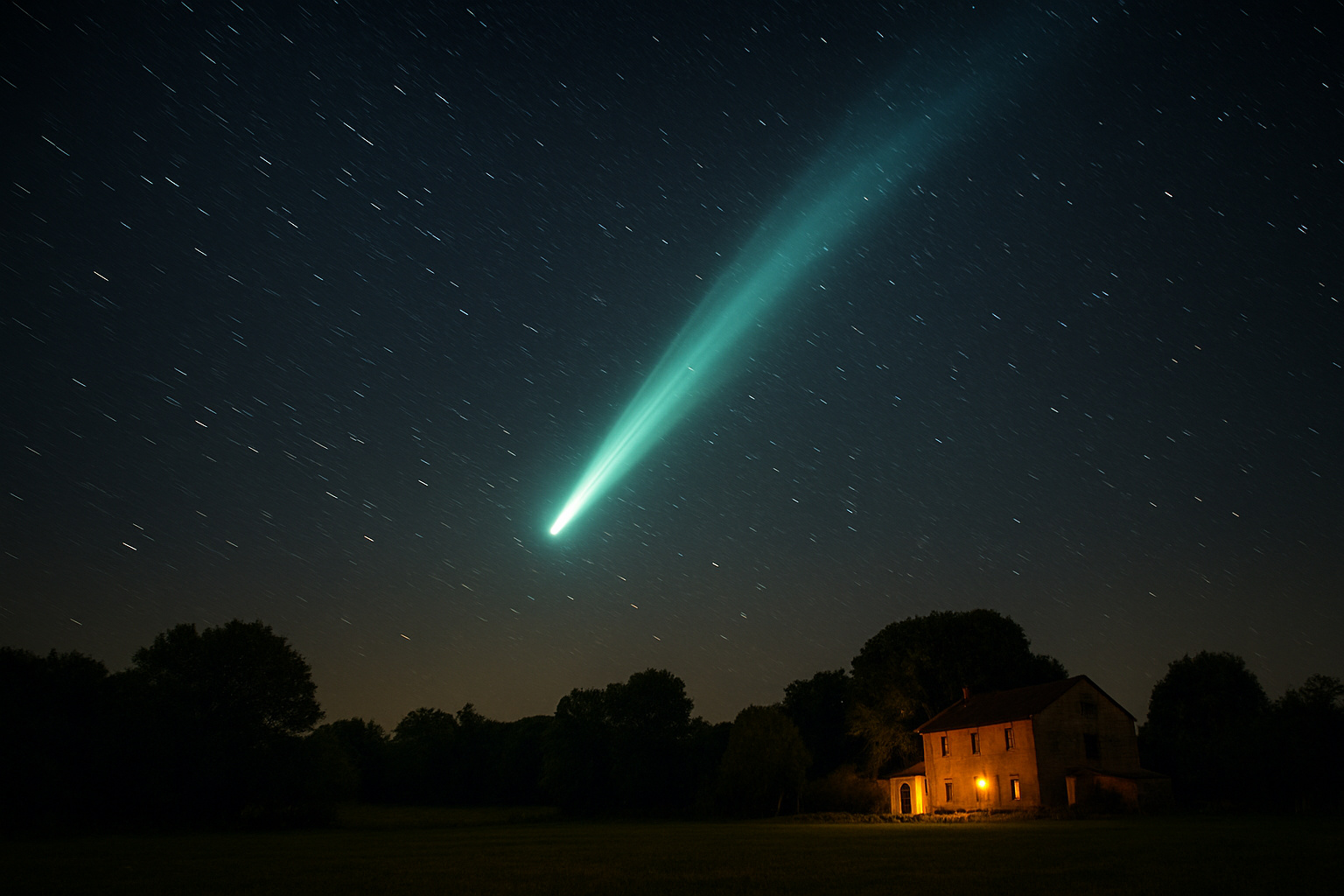


Recent Discovery Gains Worldwide Highlight With Detailed Records in the Interior of São Paulo
A significant astronomical discovery occurred in September 2025. The comet C/2025 R2 (Swan), identified early in the month, was photographed in the dark sky of Piratininga, in the interior of São Paulo, on September 18, 2025.
The collaborator Demilson Quintão, from the Astronomy Observatory of Unesp Bauru, used the Seestar S50 telescope to capture the scene. The session took place at the Coffee Museum farm, located 13 km from Bauru.
Technical Observation Under the Paulista Sky
In addition to Quintão, Guilherme Bellini and Rodolfo Langhi, the observatory’s coordinator, participated in the observation. However, the final editing was done by Bellini.
-
With a cost per shot close to zero, the DragonFire laser could change naval warfare in 2027 and provide British ships with nearly unlimited defense against drones.

-
A British startup creates tires that generate electricity in electric vehicles when passing over potholes, speed bumps, and cracks.

-
Scientists have created robots made with living cells that have their own nervous system, swim on their own, explore the environment, and self-organize without any genetic engineering, and now they want to do the same with human cells.

-
Students create a solar-powered ambulance that operates without a plug, without fuel, and still keeps medical equipment running in remote areas.


He combined several exposures to achieve clarity. This way, the stars appeared with a sequential effect, while the comet appeared sharp in motion against the starry background.
Discovery Confirmed by Astronomers
The C/2025 R2 (Swan) was identified on September 11, 2025, by the astronomer Vladimir Bezugly. He was analyzing images from the Swan camera, installed on the Soho (Solar and Heliospheric Observatory) spacecraft.
At that time, its brightness reached magnitude 7.5. Shortly after, Bezugly communicated the discovery to astronomer Martin Mašek.
Thus, in Cerro Paranal, Chile, Mašek confirmed the detection with the help of a robotic telescope. The data revealed magnitude 7.4 (V filter), an apparent diameter of 3.7 arc minutes, and a tail extending 2.8 degrees, at an angular position of 114°.
On September 12, 2025, observer Michael Mattiazzo visually confirmed the comet with a 15×70 binocular. Therefore, he estimated the brightness at magnitude 7.3, reinforcing the discovery.
Trajectory Recorded and Perihelion Reached
Although the official discovery occurred in September, records from the Stereo-A spacecraft showed the object between August 13 and 17, 2025. Consequently, the observation arc was extended to 33 days.
Based on the elements released by the Near-Earth Object Confirmation Page, astronomers located the comet in Brazil on September 12, 2025.
That night, it was in the Virgo constellation, 4° west of the star Spica. Furthermore, the C/2025 R2 (Swan) reached perihelion — the closest point to the Sun — at 0.5 astronomical units, equivalent to 75 million kilometers.
Most Relevant Technical Data
- Discovery: September 11, 2025, by Vladimir Bezugly.
- Confirmation: Martin Mašek, in Cerro Paranal, Chile, and Michael Mattiazzo, on September 12.
- Magnitude: varied from 7.5 to 7.3 in the initial records.
- Record in Piratininga: September 18, 2025, processed by Guilherme Bellini.
- Perihelion: reached on September 12, at 0.5 AU from the Sun.
Scientific Importance of the Discovery
The observation of C/2025 R2 (Swan) in Brazil reinforces the significance of collaborations between professional and amateur astronomers.
Thus, each stage — from detection to image processing — highlights how astronomy relies on cooperation and precision.
Moreover, the nominal confirmations from Bezugly, Mašek, and Mattiazzo guarantee the reliability of the records. Therefore, the comet is not just a visual spectacle. It represents a crucial study object to expand knowledge about the solar system.
What to Expect from Future Observations?
The case of the comet C/2025 R2 (Swan) demonstrates how astronomical discoveries quickly gain worldwide attention. At the same time, it raises expectations regarding the next possible records.
Meanwhile, experts believe that new technologies will allow more detailed analyses of the tail, brightness, and trajectory.
Therefore, the question remains: should the scientific community intensify immediate observations or compare the data with previous comet records to deepen the studies?








Achei que o cometa c/2025 A1 era a coisa celeste mais fake do momento até me deparar com essa imagem do cometa Swan gerada por Inteligência Artificial.
Cadê a imagem verdadeira??
Inacreditável.
Conseguiu com tanta nitidez e nenhuma estrela e o planeta Marte 🤔