





 Portuguese
  English
  Spanish
  6 min of reading
  7 comments


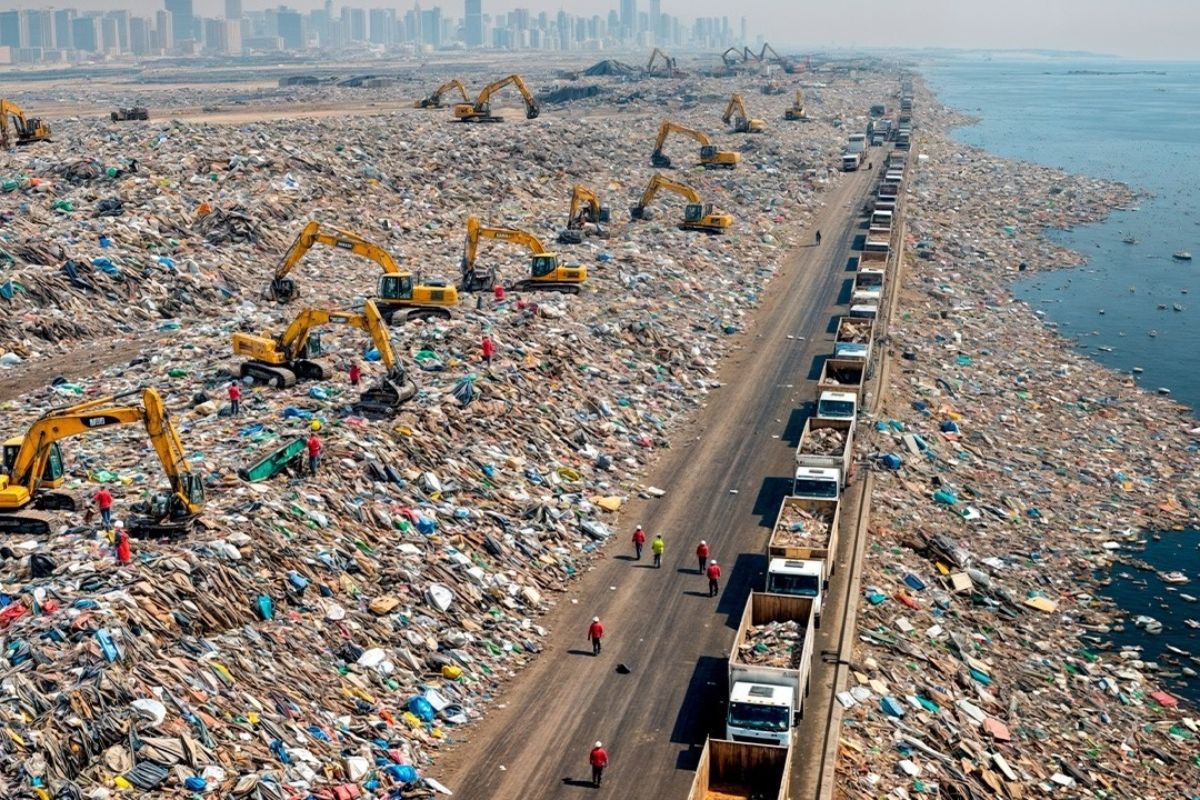


Tons of Plastic Are Collected, Shredded, Filtered, Heated, and Molded in a Continuous Flow That Combines Optical Sorting, Extrusion at 520 ºC, Standardized Pellets, and an Industrial Line Capable of Transforming Waste into New Bottles in Just a Few Hours.
Every year, millions of tons of plastic are discarded worldwide, some of which end up in the oceans and remain in the environment for centuries. At the same time, a relevant fraction of this material enters an industrial circuit where tons of plastic are treated as valuable raw material, capable of returning to the form of bottles, packaging, and other consumer products. Between disposal and the shelf, there is a technical chain that combines collection, sorting, grinding, melting, and blowing under high pressure.
Inside specialized plants, tons of plastic arrive in loaded trucks, are compressed, unloaded in minutes, and form mountains of bottles under the sunlight. From there, what from a distance looks like just mixed waste is reorganized into controlled streams of PET and HDPE, filtered by machines, sensors, cameras, and jets of compressed air. The goal is simple yet sophisticated: deliver clean, homogeneous, and consistent plastic that can withstand temperatures above 520 ºC and return to the market as a new bottle.
From Trash to Industrial Conveyors: The Origin of Tons of Plastic

The journey begins as soon as the consumer finishes using the packaging and discards it in common trash bins or selective collection points.
-
With a façade that resembles a giant zipper, the building in Milan creates a sense of strangeness, featuring lighting that transforms engineering and attracts the attention of residents and tourists.

-
The Brazilian city has 319 crooked buildings built on sandy soil without proper deep foundations, houses the largest beach garden in the world, with over 5 km, and is still considered the birthplace of surfing — meet Santos, in São Paulo.
-
New Zealand builds a shimmering building that vibrates, featuring a 62-seat cinema, moving sculptures, and an environment where sound, light, and energy are felt in the body.
-
Two colored cubes of 2.5 m transform a public bathroom into a selfie spot in Western Australia, costing up to 75% less than traditional construction and helping to reduce vandalism in public spaces.

In supermarkets, schools, offices, or residential neighborhoods, tons of plastic accumulate daily in bags, containers, and recycling centers.
In some places, such as states that adopt deposit return systems, the empty bottle gains direct monetary value, which increases the return rate.
Specialized trucks collect these volumes, compress the loads, and arrive at transfer stations carrying up to around 20 tons of plastic per trip.
In just a few minutes, all the content is dumped onto conveyors or tipping mechanisms, forming piles of bottles that represent both a potential environmental problem and a stock of raw material for the industry.
This is the point where waste logistics becomes a manufacturing process.
Mechanical and Manual Sorting: Organizing the Plastic Chaos

Before turning into new products, tons of plastic need to be carefully sorted.
The first filter is mechanical: a large rotating steel drum, filled with holes, receives the mix of packaging.
As the assembly rotates, sand, dust, and small fragments fall through the openings, while larger bottles continue to the end of the drum.
The result is a pre-separation by size that prepares the flow for finer stages.
Next, the material enters the manual sorting line.
There, workers positioned on both sides of the conveyor remove intruders like cans, thin bags, cardboard, and unwanted plastics.
In parallel, automatic cutters remove caps and labels, magnetic sensors separate metals, and what remains is a flow predominantly composed of PET and HDPE bottle bodies.
From there, the amorphous waste begins to approach a controlled industrial input.
Grinding and Optical Sorting: When Artificial Intelligence Takes Over
After the initial sorting, the bottles go to the grinding chamber. Inside, hundreds of steel blades spin at high speed, shredding the pieces into flakes of a few centimeters.
The noise is constant, and within moments a large quantity of packaging converts into a flow of “plastic sand” shining under the factory lighting.
A single machine can process thousands of pounds per hour, quickly reducing entire mounds of bottles to fragments.
With the ground material, optical sorting comes into play. High-speed cameras scan each flake and, in milliseconds, classify color and type of plastic.
When the system identifies clear PET, green PET, HDPE, or foreign materials like glass and ceramics, it triggers extremely precise jets of compressed air.
Each shot targets a single fragment, diverting it from the main flow without altering the rest.
At scale, an optical classifier can handle more than 10,000 fragments per second, with efficiency exceeding 95 percent, replacing the work of hundreds of people in repetitive manual sorting.
Extrusion at 520 ºC: The Point Where Plastic Rebirths

With the flakes already cleaned and separated, the tons of plastic finally enter the phase where they cease to be waste.
In the extrusion system, temperatures exceed 520 ºC, completely melting the fragments. A large auger spins inside the heated cylinder, mixing and pushing the melted plastic forward, under increasing pressure.
Before moving on, the viscous flow passes through fine metal screens that capture the last solid impurities.
Then, the molten material is cut into millions of small pellets, immediately cooled in water.
The result is uniform, compact, and shiny pellets, the standard form of plastic raw material that can be transported, stored, and used in various production lines.
What began as crushed bottles is now a calibrated input, ready to be heated again and molded precisely.
Pre-Forms and Blowing: From Pellets to New Bottles
In the next stage, the pellets go to the production of pre-forms, which function as “mini bottles” in raw state.
The material is heated to about 480 ºC and injected into molds that produce pieces similar to test tubes, with a thick and short body and a neck already molded with threads.
These pre-forms concentrate the material needed to be stretched and blown to reach the final shape.
In many production chains, factories specialized only in pre-forms send these pieces to beverage industries.
On filling lines, the pre-forms undergo controlled heating to about 120 ºC, achieving the ideal elasticity.
Inside a metal mold with the design of the final bottle, a jet of compressed air above 40 bar expands the plastic, which adheres to the internal walls with millimeter precision.
In just a few seconds, the test tube transforms into a fully formed bottle, ready for cooling and inspection.
Quality Control, Packaging, and Logistics at High Speed
As soon as they leave the mold, the bottles are still hot and go through cooling tunnels with cold air or water, stabilizing dimensions and thickness.
Then, they enter conveyors where high-speed cameras inspect each unit, looking for micro-cracks, bubbles, neck deformations, and transparency failures.
Samples are sent to the lab for pressure, drop, and torsion tests, simulating conditions harsher than those encountered in actual use.
Only the approved bottles move on to packaging.
Machines group hundreds of units, wrap them in sturdy plastic film or reinforced cardboard boxes, and assemble complete pallets, which are moved by forklifts to cargo trucks.
The pace is so high that a modern line can produce up to thousands of bottles per minute, supplying beverage, food, cleaning product, and cosmetic filling lines in just a few hours.
In a closed loop, what once was trash returns to the market with a new identity.
Energy from Waste: When Tons of Plastic Become Fuel
Not all tons of plastic follow the path of recycling into new bottles.
In some countries, part of this material is directed to energy plants, where urban waste is burned in high-temperature furnaces.
This process reduces the volume of waste by up to 90 percent and generates steam to power electric turbines.
In places with little space for landfills, the “waste-to-energy” technology emerges as an alternative to deal with large volumes of plastic that do not enter conventional recycling routes.
Models of this type are already adopted at scale in some regions, while other countries still face investment costs, energy prices, and environmental debates.
The combination of mechanical recycling, chemical recycling, and energy recovery from discarded tons of plastic is likely to define which systems will be more efficient and sustainable in each context in the coming years.
From the trash can to the filling line, tons of plastic pass through an industrial chain that mixes manual sorting, computer vision, extrusion at 520 ºC, high-precision molds, and automatic inspection.
In the end, the transparent bottle that reaches the shelf is the result of a rigorous sequence of steps involving engineering, logistics, and economic decisions on how to treat a material that weighs heavily in pollution while supporting entire segments of the modern industry.
When we understand this journey, it becomes clearer that each discarded package is more than a waste: it is a fraction of a global flow of tons of plastic that can become an environmental problem or a valuable raw material, depending on how the system is organized.
Given this, the question for you is: knowing everything that happens for a simple bottle to be reborn, would you change the way you discard and choose products made with tons of recycled plastic?




Pra mim, a reportagem foi alentado. Eu desconhecia a existência de reciclagem nesse nível e fiquei torcendo para que no Brasil já existam indústrias com esse tipo de trabalho. Lendo sobre essas atividades, me iludo e penso: “Talvez o mundo dos meus netos sobreviva.”
Tenho projeto socioambiental De Pet Para Pets, em parceria Rotary Club União e Sabesp, num trabalho voluntário que tem por objetivo, compra rações animais abandonados e resgatados. Coletamos muito material plástico/tampinhas/ garrafas e gostaríamos de vender essa matéria prima p indústria do plástico. Se puder ajudar com informações, agradeço. Cordialmente, Jornalista, Ambientalista e Protetora **** Angélica Monteiro. MTB. 13213.
Eu tento fazer um pouco do sustento ambiental em minha casa temos costume de reciclar 99% do platicos e outros tipo de reciclagem são td separado e entregue para o pessoal que trabalha catando , só vai para o caminhão lixo orgânico