





 Portuguese
  English
  Spanish
  4 min of reading
  0 comments


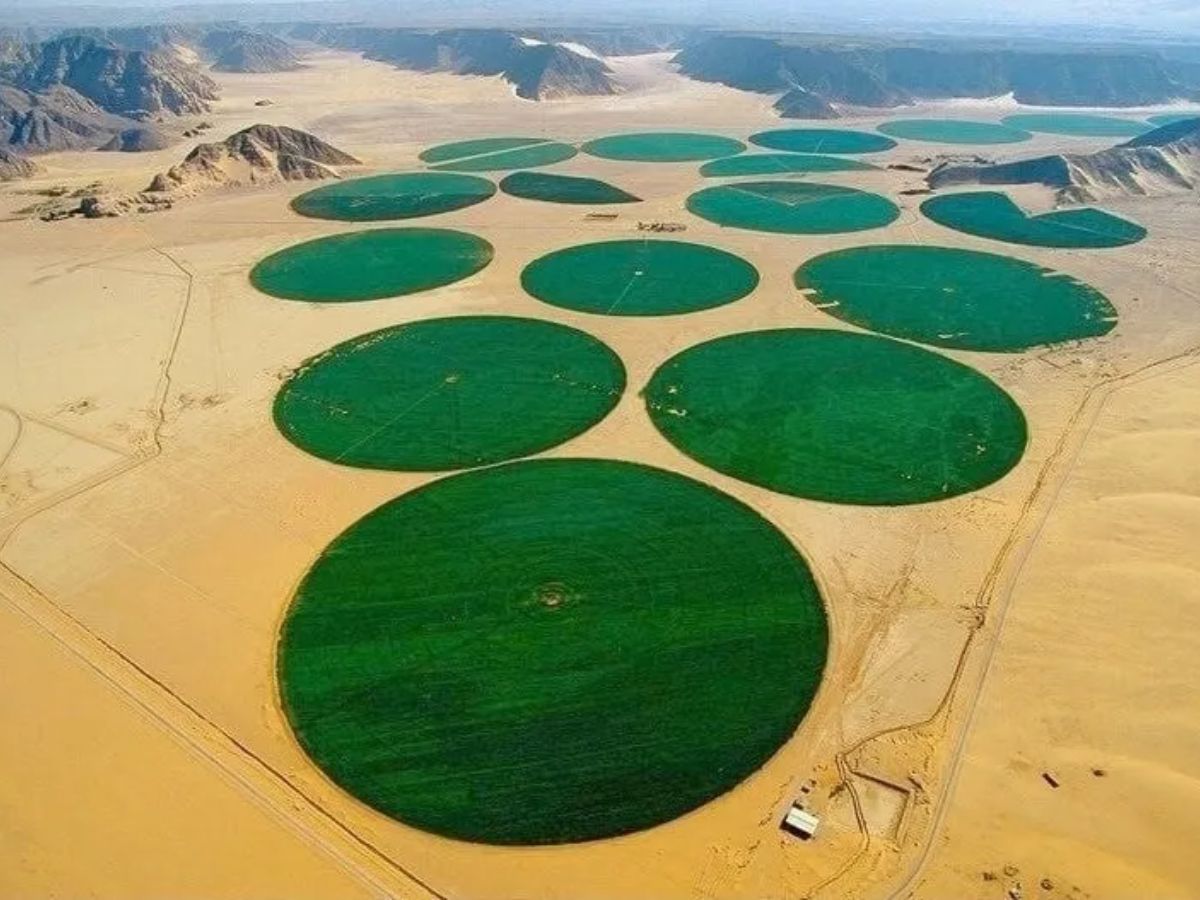
From Extreme Heat to High-Precision Harvests: How Saudi Arabia Is Cultivating in the Desert with 50-Hectare Pivot Systems
Saudi Arabia, a country known for its vast desert territory and the largest oil reserves on the planet, is undergoing a quiet revolution of monumental proportions. Amidst scorching temperatures, averaging between 35 °C and 50 °C in the summer and a scarcity of rivers and lakes, the Arab nation is managing to grow food and thrive in the heart of the desert.
This transformation is the result of one of the largest agricultural irrigation projects in the world: the Wadi As-Sirhan Basin system, which utilizes center pivot irrigation technology to make previously barren areas arable.
An Emerging Agricultural Giant
With over 35,000 km² of arable land currently — a number that starkly contrasts with the merely 400 km² of the 1960s — Saudi Arabia is betting on innovation to ensure food security. The Wadi As-Sirhan project represents about 7,800 km² of this total and is a key player in the production of fruits, vegetables, eggs, fish, and flowers.
-
China is building a city in Brazil: a complex with an investment of R$ 5.5 billion comes to light, but allegations involving workers draw attention.
-
While Argentina buys old war equipment, Brazil is keeping an eye open and joins the select group of nations with advanced military technology by investing $5.2 billion, producing 36 Gripen fighters in the country, and reducing operational costs.

-
Brazil on alert? Why invading Brazil is a NIGHTMARE for the USA: 8.5 million km², 213 million inhabitants, Amazon covering 60% of the territory, trillion-dollar war, and resistance that even 13,000 aircraft could not control.

-
How to build a floating island from scratch with reeds, giant blocks, and stakes in the lake in a process that needs to be repeated almost every day.
The initiative arose from the need to reduce external dependence: the country currently imports about 70% of all the food it consumes.
The technology used, developed in the United States in the 1940s, allows for precise aerial irrigation, with the rotation of metal circular structures over areas of up to 50 hectares. The result is impressive green circles that now stand out in satellite images, contrasting with the ochre tones of the Saudi desert.

Fossil Water: The Invisible Cost of the Green Miracle
However, behind this technological feat lies a challenge that could compromise the future of this agricultural model: the depletion of underground water reserves, also known as fossil water. These aquifers, formed thousands of years ago, do not replenish with rainfall, which is extremely scarce in the region. The water used for irrigation in Saudi Arabia dates back to the last ice age — it has remained buried at great depths for about 20,000 years, making it a finite and irreplaceable resource.
Studies indicate that more than 80% of fossil water has already been used, which poses a critical timeline of just 50 to 60 years before these resources become completely unviable.
An Inevitable Change: Diversification and Technological Surveillance
Aware of the unsustainability of this model in the long term, the Saudi government has adopted strategic measures. Among them are:
- Banning wheat cultivation, which is highly water-intensive;
- Agricultural satellite monitoring, with sensors to control water usage;
- Studies on the viability of more water-efficient crops;
- Expansion of agricultural properties abroad, in locations such as the United States, China, and Senegal.
Additionally, the country launched the ambitious Vision 2030 plan, which aims to diversify the economy and reduce dependence on oil, investing in sectors such as technology, tourism, and renewable energies.
Tourism and Culture: The New Oil?
Since 2019, Saudi Arabia has opened its doors to international tourism, issuing visas for visitors from various countries. This move is part of an effort to soften the image of a closed country, attract foreign investment, and stimulate new revenue sources — such as ecotourism, religious tourism (in Mecca and Medina), and the appreciation of its vast archaeological heritage, including Neolithic rock paintings found in the region of Al-‘Ula.

The Future of the Kingdom: Reinvention or Obsolescence?
Saudi Arabia has reached where few imagined possible: transforming deserts into agricultural fields. However, the ecological cost of this feat may be too high. The depletion of underground water threatens the country’s largest agricultural project and reinforces the urgency for sustainable strategies.
The success of the Saudi kingdom in the coming decades will depend less on oil and more on its ability to innovate, preserve, and diversify. The desert has already been conquered once by technology. The question now is: will it be possible to conquer it again — this time, sustainably?
Do you think Saudi Arabia will be able to reinvent itself in time? Leave your comment below.







-

Uma pessoa reagiu a isso.