





 Portuguese
  English
  Spanish
  3 min of reading
  0 comments


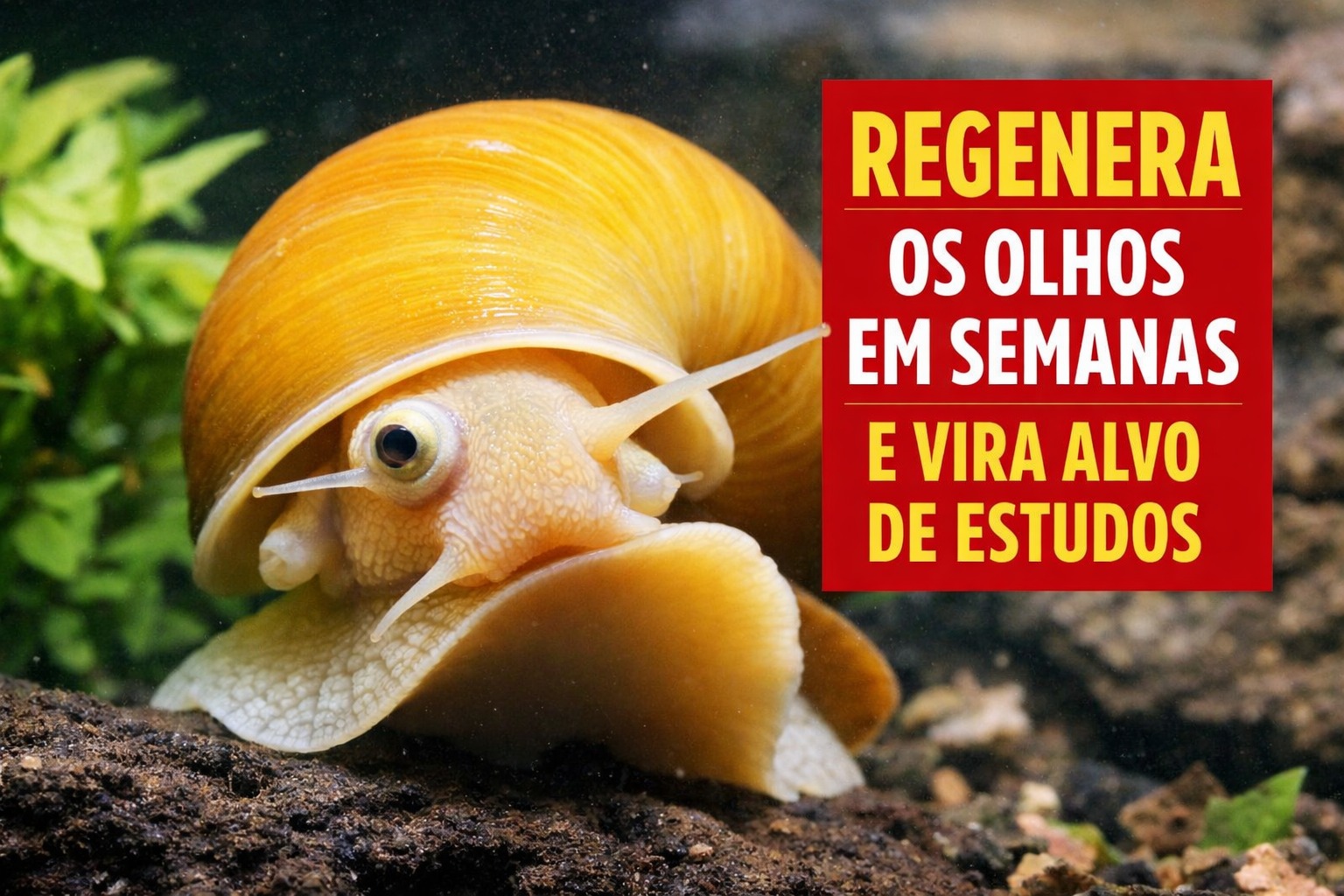
Research Describes How Golden Apple Snails Regenerate Amputated Eyes in About a Month, Process Linked to the Pax6 Gene and Observed in Structures Similar to the Human Eye
Humans have been seeking to recover lost vision for decades, while golden apple snails, native to South America, can regenerate amputated eyes in about a month, a phenomenon described by researchers in a recent study.
Ocular Regeneration Observed in Golden Apple Snails
In a study published in August in Nature Communications, scientists detailed how golden apple snails develop a new eye after the complete amputation of one.
The process begins quickly, with sufficient healing in the first 24 hours to prevent fluid loss and infections at the amputation site.
-
With a cost per shot close to zero, the DragonFire laser could change naval warfare in 2027 and provide British ships with nearly unlimited defense against drones.

-
A British startup creates tires that generate electricity in electric vehicles when passing over potholes, speed bumps, and cracks.

-
Scientists have created robots made with living cells that have their own nervous system, swim on their own, explore the environment, and self-organize without any genetic engineering, and now they want to do the same with human cells.
-
Students create a solar-powered ambulance that operates without a plug, without fuel, and still keeps medical equipment running in remote areas.


After this initial phase, the organism sends undifferentiated cells to the injured area, initiating an intense cycle of cell multiplication and progressive specialization.
Over about a week and a half, these cells start to form initial ocular structures, establishing the basic components needed for vision.

Complete Formation Occurs in Just 15 Days
According to the study, all eye structures are present in 15 days, although they continue to mature functionally in the weeks following the initial process.
This pace contrasts sharply with human limitations, even after advances such as ocular prosthetics and rare surgeries involving tooth implants in the eyes.
The ability to fully regenerate vision remains beyond human reach, despite decades of medical and biotechnological research.
Structural Similarities to Human Eyes
Despite their unusual appearance, the eyes of golden apple snails share relevant characteristics with human eyes, according to the researchers involved in the work.
Both are classified as camera-type eyes, composed of a single lens, protective cornea, and retina with photosensitive cells.
Ocular development in both species is regulated by the pax6 gene, which is considered essential for eye formation.
In an experiment described in the study, snails with both copies of this gene deactivated developed completely without eyes.
Investigation of the Pax6 Gene and Future Implications
Now, scientists want to verify whether the pax6 gene also directly acts in the ocular regeneration of golden apple snails.
The hypothesis is that understanding this mechanism could indicate ways to assist humans with serious ocular diseases or injuries.
“If we find a set of genes important for ocular regeneration, and these genes are also present in vertebrates, in theory, we could activate them to enable ocular regeneration in humans,” said Alice Accorsi.
The lead author of the study is a biologist at University of California, Davis, the institution to which the work is affiliated.
The researchers emphasize that the study focuses on basic cellular and genetic mechanisms, with no immediate clinical applications anticipated.
Nevertheless, the discovery expands understanding of regeneration in animals and reinforces the potential for comparative studies for future medical approaches.
With information from Smithsonianmag.






Seja o primeiro a reagir!