





 Portuguese
  English
  Spanish
  7 min of reading
  0 comments


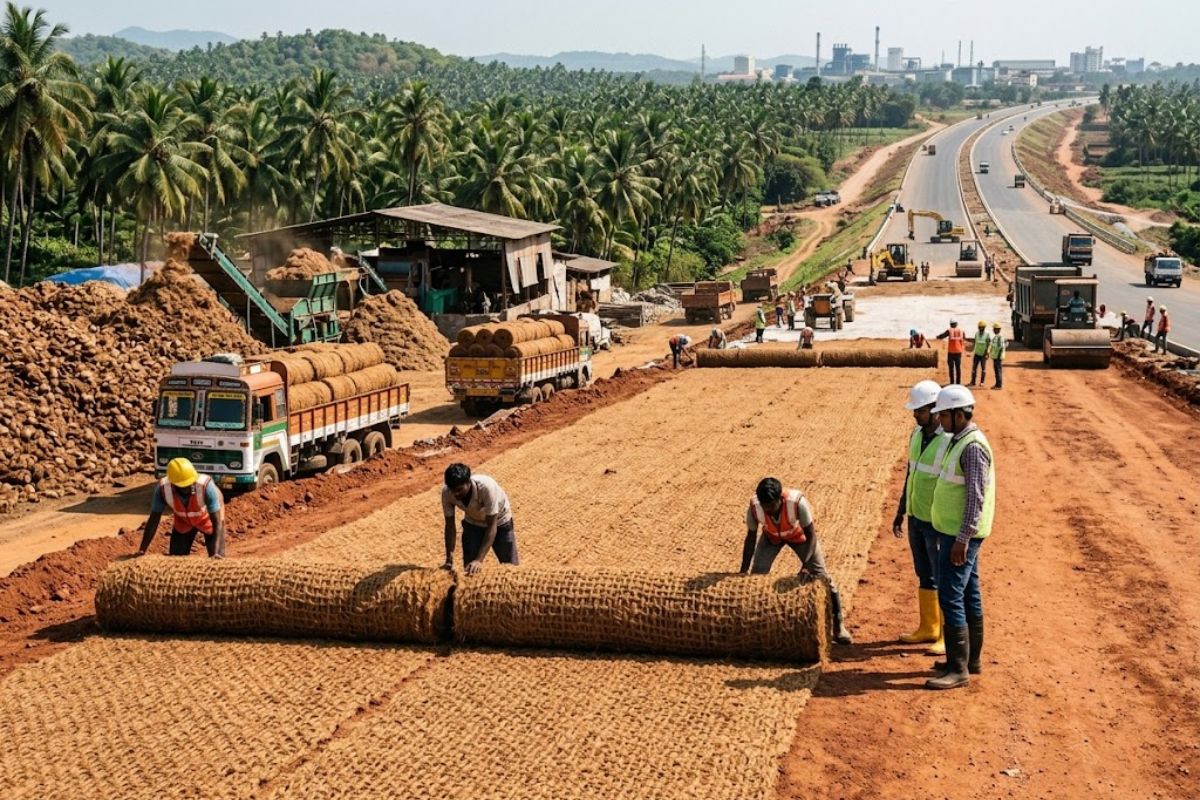
Indian Engineers Utilize Millions Of Tons Of Discarded Coconut Fiber In India To Manufacture Geotextile Fabric, Stabilize Fragile Soils, Control Water And Erosion And Support Giant Roads Under Heavy Rain, While An Entire Industrial Chain Transforms Shell, Oil And Coconut Water Into Lasting Local Regional Economic Value.
The Indian engineers are using coconut fiber to solve a problem that defines the lifespan of any road: the fragility of the subsoil. Instead of relying solely on heavy, expensive materials with a high carbon footprint, India applies natural geotextile fabric beneath the road base to distribute loads, control water, and reduce erosion in rural areas marked by heavy rains and limited budgets.
The result is impressive because the solution seems contradictory at first. A soft, lightweight, and biodegradable material supports giant roads where trucks, machinery, and continuous traffic flow. It is precisely this contrast that makes the process so strong: the discarded shell of a common fruit enters a complex industrial chain and ends up as an invisible structural element beneath heavy construction.
From Plantation To Job Site, India Transforms Coconut Into Engineering Raw Material
The journey begins in the south of India, a region that accounts for more than 60% of the country’s total coconut production. More than 19 billion coconuts are harvested annually in a warm and humid climate, where the fruit goes far beyond food.
-
A retired IT professional built a 22-meter boat in his backyard in Oklahoma with a school bus engine, light pole masts, and handmade watertight doors to become the redneck version of Jacques Cousteau.

-
China is building a city in Brazil: a complex with an investment of R$ 5.5 billion comes to light, but allegations involving workers draw attention.
-
While Argentina buys old war equipment, Brazil is keeping an eye open and joins the select group of nations with advanced military technology by investing $5.2 billion, producing 36 Gripen fighters in the country, and reducing operational costs.

-
Brazil on alert? Why invading Brazil is a NIGHTMARE for the USA: 8.5 million km², 213 million inhabitants, Amazon covering 60% of the territory, trillion-dollar war, and resistance that even 13,000 aircraft could not control.

For local communities, it sustains a complete economy, connecting agriculture, industry, construction, and export. It’s not just about harvesting coconuts, but about fueling an entire production chain.
The coconuts destined for coconut fiber extraction are usually harvested between 11 and 12 months old, when the shell already offers long, strong fibers rich in lignin. On average, a mature coconut tree produces 50 to 80 fruits per year, and large plantations maintain continuous harvest cycles every 30 to 45 days. This pace is crucial because it ensures a constant supply for the industrial processing that later supplies the geotextile fabric used in giant roads.
The harvest still heavily relies on manual labor. Workers climb coconut trees ranging from 8 to 15 meters in height to cut entire bunches, while in more challenging areas, 8 to 10-meter cutting poles come into play. Each coconut weighs between 2.5 and 3.5 kilograms, requiring clear areas beneath the trees to avoid accidents. There’s tough physical logistics even before engineering starts.
After harvesting, the focus shifts completely. For the industry that interests Indian engineers, the value lies not in the water or the white pulp but in the thick outer shell, which measures 5 to 7 centimeters and represents about 35% to 45% of the total weight of the coconut. It is here that the base of the material that will later reinforce the roadway subsoil is found. What would be waste in many places becomes a technical input in India.
How Coconut Fiber Becomes Geotextile Fabric Capable Of Stabilizing Soil
After being separated, the shell is still far from being ready to go onto a road. It comes out of the peeling process wet, rough, and heavy, and this peeling process still heavily relies on manual labor. Coconuts are secured on metal stakes, and workers use specialized knives to remove the shell from the hard inner part.
A skilled worker can peel between 500 and 1,000 coconuts per day, while large collection centers can process tens of thousands daily. It’s a massive, repetitive, and essential step for the rest of the chain.
This initial shell contains millions of fibers united by a natural structure resistant to biological degradation, exactly the kind of characteristic that interests civil engineering. But before it becomes usable coconut fiber, the material needs to lose moisture.
The initial moisture content often exceeds 60%, and direct placement into machines would break the fibers and reduce their strength. Therefore, natural drying in the open air takes 2 to 4 weeks until the moisture content drops to about 15%. Without this step, the structural quality of the material collapses.
When the drying reaches the right point, extraction machines come into play. Axles and rotating rollers tear the shell apart and separate the long fibers from the pith and other impurities. Even so, the process is still not complete. To prevent mold and ensure safer storage, coconut fiber undergoes an additional 3 to 7 days of drying, reducing moisture to below 5%. This is the level considered critical for mechanical stability.
Only then does the phase that truly interests Indian engineers begin: spinning and weaving. The dry fibers are twisted into uniform filaments and sent to specialized looms. There, the geotextile fabric takes shape with interwoven warp and weft threads in regular meshes.
In industrial facilities, the average production ranges from 200 to 300 meters per hour, depending on density. The mesh openings typically vary between 10 and 25 millimeters, sufficient to allow water to pass while simultaneously maintaining soil stability.
On average, 100 kilograms of fiber yield between 250 and 300 meters of fabric with a width of 1 meter. It’s a natural material, but produced with rigorous industrial logic.
What Geotextile Fabric Does Below Giant Roads
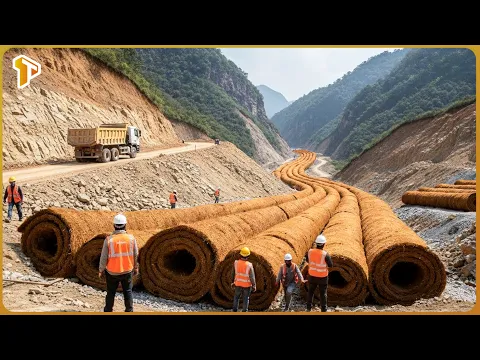

Most people look at asphalt and imagine that the road’s resistance depends solely on the surface. But Indian engineers start from a different logic: what determines real durability is hidden beneath the visible layers.
If the subsoil fails, the structure above cracks, sinks, or collapses. It is precisely at this point that geotextile fabric enters as a silent layer, placed between the fragile terrain and the upper structural base.
Before application, the subgrade needs to be leveled and compacted to eliminate irregularities, sharp stones, and objects that could tear the mesh.
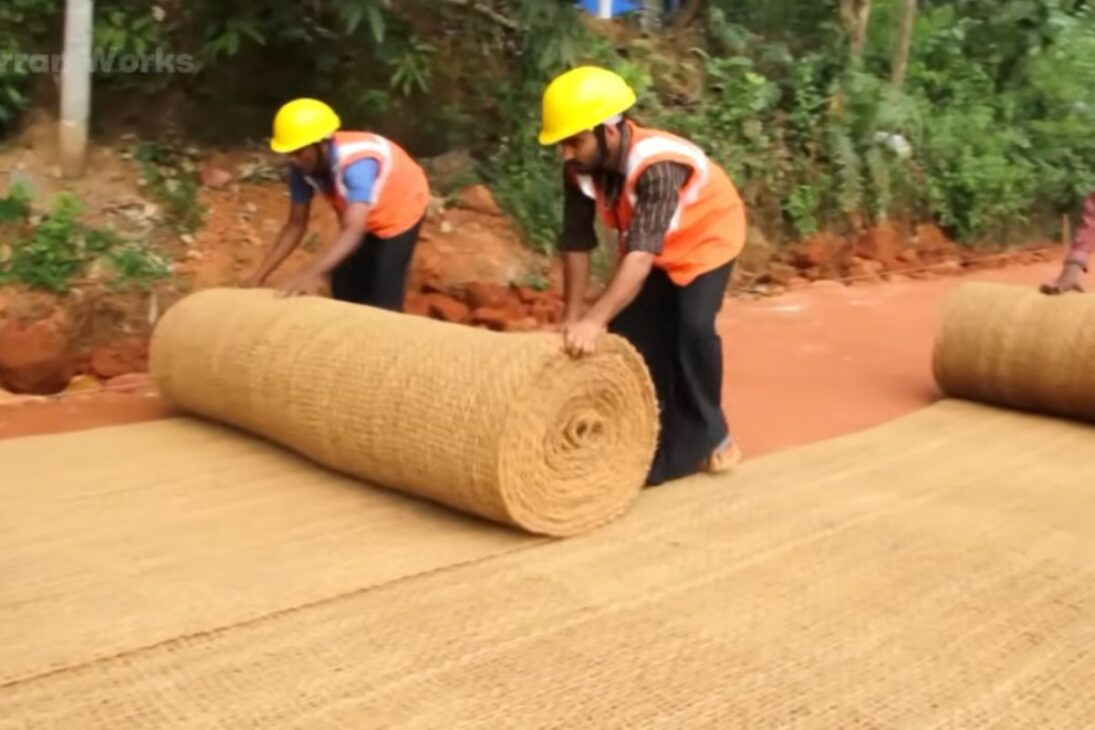
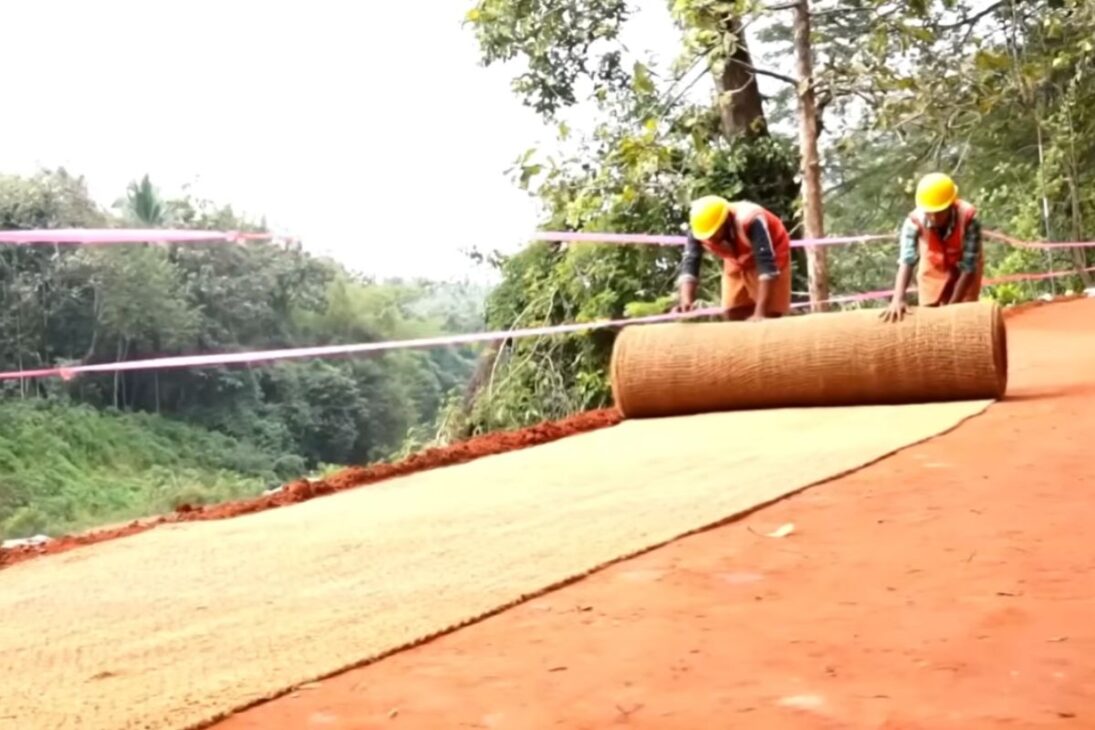
Then, the rolls are unrolled along the centerline of the work, pressed against the ground without folds and with slight overlap at the joints to form a continuous layer.
After that, gravel, soil, and crushed stone are spread and compacted on top before the final paving. None of this is visible to drivers, but that’s where the road truly begins.
The technical function of geotextile fabric is multifaceted. It helps control water flow, stabilizes the soil base, distributes loads, and reduces erosion.
In rural areas of India, where there are fragile foundations and heavy seasonal rains, this makes a huge difference. When water seeps uncontrolled and the soil loses cohesion, the road cracks sooner.
When the load concentrates in a few points, the base gives way. The fabric works precisely to reduce these risks. It’s a discreet but decisive piece for the lifespan of the work.
This explains why a biodegradable material can participate in the construction of giant roads. The strength of the solution does not come from a rigid appearance but from its ability to separate layers, allow drainage, and reinforce the foundation.
The road above gains greater load capacity, develops fewer cracks, and better withstands adverse weather conditions. In practice, Indian engineers are using nature to solve a classic weakness of heavy infrastructure.
Why Indian Engineers Invest In This Solution And What More Coconut Delivers
The answer lies in the sum of need, abundance, and cost. India has fragile soils in many rural areas, a tropical climate with heavy rainfall, enormous demand for roadworks, and often tight budgets. Instead of relying solely on imported geosynthetics and petroleum derivatives, the country uses a domestic resource already available on a large scale. The solution is not romantic; it is functional.
There is also a broader economic logic. The same chain that generates coconut fiber for geotextile fabric feeds other parallel industries. The pulp can be destined for coconut oil production, either by mechanical pressing or cold pressing, while coconut water goes to processing, cooling, light pasteurization, and export. Even the cake leftover from oil extraction is used as animal feed or organic fertilizer. Hardly anything is wasted, and this improves the overall value of the chain.
This model strengthens the position of Indian engineers because the raw material is not isolated from a larger economy. Coconut already moves food, cosmetics, pharmaceuticals, and export, and civil construction becomes another branch of this structure.
Thus, what was once treated purely as waste now sustains giant roads, generates local income, and reduces dependence on fossil materials. It is a rare case where engineering, agriculture, and industry advance together.
Furthermore, the coexistence of industrial production and manual weaving shows that the solution can operate on different scales. In some rural areas of India, the geotextile fabric is still handcrafted on simple looms, with production of only a few dozen meters per day but with great adaptability to the terrain. In factories, the industrial pace ensures volume for larger works. This flexibility helps explain why the model spreads so strongly.
Indian engineers demonstrate that innovation doesn’t always arise from harder, more expensive, or more artificial materials. In many cases, it emerges when a country looks at its own waste, understands the limitations of its soil, and transforms coconut fiber into geotextile fabric to support giant roads with less dependence on synthetic inputs. India is not just repurposing shells; it is building a technical, economic, and environmental response from a resource it already had in abundance.
The question remains: can this model based on Indian engineers, coconut fiber, and geotextile fabric become a reference for other agricultural regions of the world, or does it depend too much on the specific conditions of India? Leave your opinion in the comments.






Seja o primeiro a reagir!