





 Portuguese
  English
  Spanish
  5 min of reading
  0 comments


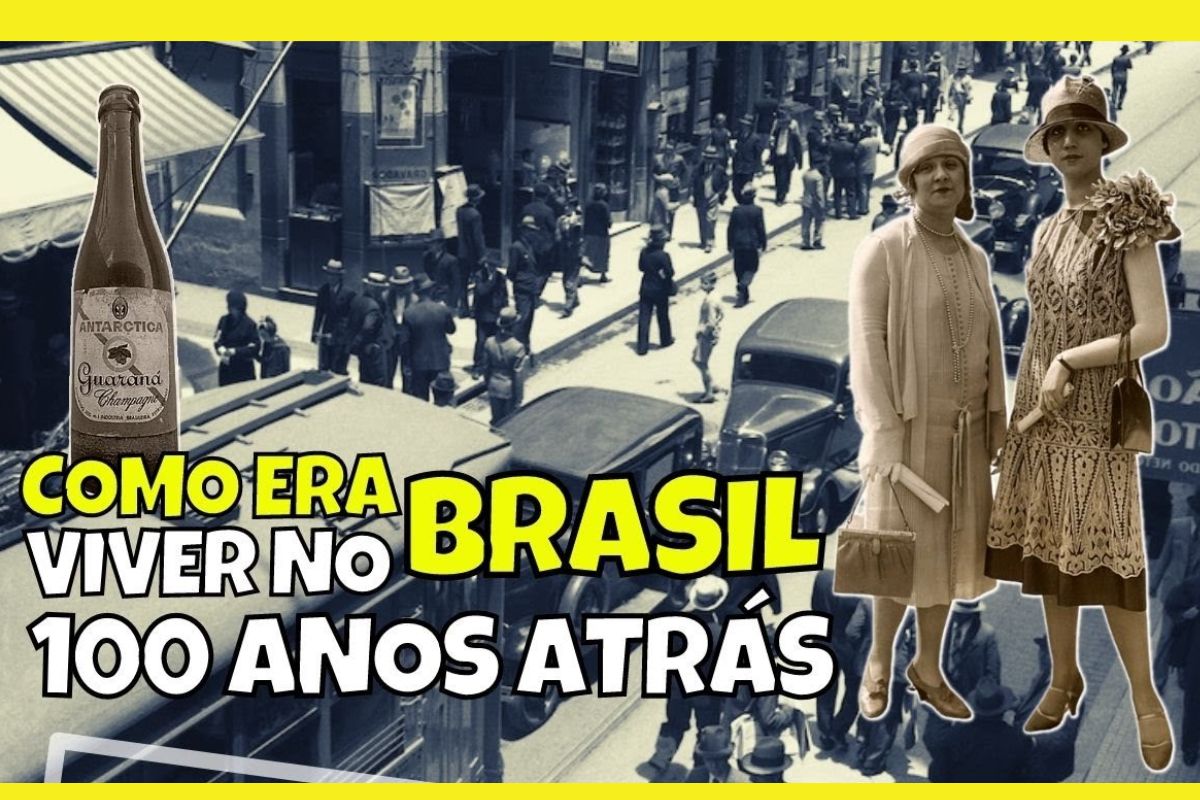
A Century Ago, Brazil Was Living in a Time Without Cell Phones, with Samba Beginning, the Spanish Flu Still Recent, and French Fashion Dominating the Tropical Heat of Rio de Janeiro A Fascinating Portrait of What Life Was Like in Brazil 100 Years Ago, Amid Political, Social, and Cultural Transformations That Shaped the Modern Country.
Imagining what it was like to live in Brazil 100 years ago is to embark on a journey to a country trying to modernize, but still bearing deep marks of the 19th century. In 1921, radio was in its infancy, samba was taking its first steps, and the population was living under the recent impact of the Spanish flu, which had devastated entire cities.
It was a Brazil without television, without internet, and without telephones for most people. People got their information from printed newspapers, and the major metropolitan areas, such as Rio de Janeiro and São Paulo, were beginning to feel the weight of industrialization. Urban life and social everyday life were transforming rapidly, even under a strong contrast between luxury and poverty.
Brazil in 1921
At the beginning of the 1920s, Epitácio Pessoa was the president of the country, elected after defeating the writer Rui Barbosa.
-
A collector bought a black stone in Morocco in 2011 without knowing that he had in his hands a Martian meteorite 4.45 billion years old with ten times more water than any other fragment of Mars ever found on Earth.

-
European cities are building public climate refuges to cope with extreme heat.
-
Excavations for a highway uncovered an intact Celtic city with gold, jewelry, and ancient production structures.

-
Every pineapple you eat is actually up to 200 different fruits fused into one: discover the fascinating process in which each flower opens for just one day and produces the pieces that form the whole fruit over the course of 3 weeks.


The capital was still Rio de Janeiro, and Brazil had about 30 million inhabitants. The currency was the “réis,” a heritage of the 19th century.
Direct comparisons are difficult, but the lowest salary at the time was around 25,000 réis, equivalent to something well below the current minimum wage.
The country was experiencing a period of reconstruction after World War I and the Spanish flu, two events that had changed the world.
The streets were beginning to fill with streetcars, cafes buzzed with political debates, and the elite dreamed of a modern Brazil, inspired by Europe.
Brazilian Fashion: French Elegance in a Tropical Climate
The fashion of what it was like to live in Brazil 100 years ago revealed the direct impact of France on national customs.
Women embraced the aesthetics of the “flappers,” with shorter skirts, bobbed hair, and the definitive abandonment of the corset.
The female body was beginning to gain freedom, a symbolic milestone in the history of fashion and emancipation.
On the beaches of Rio de Janeiro, swimwear was already challenging conservative standards: light dresses, bare arms, and shorter fabrics, which was daring for the time.
Men, on the other hand, maintained their suits and ties even under the intense sun—a reflection of the desire to appear European in a tropical country.
Education: The Beginning of a Cultural Turn
Brazilian education in 1921 was deeply unequal.
About 70% of the adult population was illiterate, a statistic that revealed the social abyss. Public schools were concentrated in the capitals and divided classes between boys and girls.
The use of the ferule was still common, and discipline was seen as an essential part of learning.
It was also at this time that Brazil founded its first university, the Federal University of Rio de Janeiro (UFRJ), a milestone in higher education.
Little by little, the country was beginning to build a more organized education structure that would serve as a foundation for the following decades.
Music and the Birth of Samba
If there is something that defines what it was like to live in Brazil 100 years ago, it is the birth of a national symbol: samba. Around 1920, the rhythm gained strength in the hills of Rio and spread to the popular neighborhoods.
Artists like Noel Rosa and Lamartine Babo would give voice to Brazilian everyday life, transforming the people’s stories into eternal songs.
Without television and with few radios, music spread live, in parties, blocks, and cafes.
Samba, which began marginalized, would soon become the soundtrack of Brazilian identity.
Public Health and the Spanish Flu
A few years earlier, the country had faced one of the worst sanitation crises in history.
The Spanish flu devastated Brazil in 1918 and 1919, killing thousands of people in just a few weeks. There was a shortage of medicines, doctors, and even gravediggers.
Rio de Janeiro, then the capital, was the epicenter of the tragedy.
The doctor Carlos Chagas led the fight against the epidemic, creating hospitals and emergency care posts.
His actions were crucial in containing the spread of the disease and establishing new public health practices—a lesson that shaped the Brazilian health system in the following decades.
Carnival and Popular Culture
With the end of the epidemic, the country revived Carnival in grand style.
In 1921, Rio experienced one of the most memorable festivities of the early 20th century, still without samba schools, but with blocks and floats filling the streets.
The costumes began to expose more skin, reflecting the liberation of customs.
The “lança-perfume” was freely available and sold in pharmacies and regular stores.
It was an innocent Carnival, but explosive in joy and irreverence—a prelude to the spectacle that the world would come to know.
Work, Cities, and Inequality
The Brazilian economy was still predominantly rural, but São Paulo was emerging as an industrial metropolis.
Slave labor had been officially abolished just a few decades earlier, but Black people continued to be relegated to the heaviest and lowest-paying jobs.
In the major centers, having a typing course and knowing how to read was already enough to secure a stable job.
Mastering writing and the typewriter represented the passport to the future. Even timid industrialization was beginning to reshape the job market.
The Press and Everyday Life
Without radio in many homes, newspapers and magazines were the main sources of information.
The “Estado de São Paulo” and the “Diário do Rio de Janeiro” dominated the national scene, while women’s magazines like Revista Feminina taught recipes, fashion, and advocated for emancipation within the moral limits of the time.
It was a time when news circulated slowly, but had great power of influence.
The printed newspaper was a symbol of status and knowledge.
Notable Events of 1921


The year 1921 was fertile in transformations. Ford began assembling automobiles in Brazil, Nestlé opened its first factory in Araras (SP), and the Cruzeiro Esporte Clube was founded in Minas Gerais.
The Antarctica Paulista Company launched the soft drink “Guaraná Champagne,” which would later become the traditional Guaraná Antarctica.
It was also the year of the death of Princess Isabel, a symbol of the end of slavery.
And, in the streets of Rio, iconic buildings began to disappear, making way for urban modernization like the Monroe Palace and Praça Onze, the birthplace of samba.
What it was like to live in Brazil 100 years ago is to look at a country still seeking its identity between tradition and modernity.
Fashion, music, education, and politics revealed a people in transition, trying to find their place in a rapidly changing world.
And you? Could you live in a Brazil without cell phones, without internet, and with samba starting on the corners? Tell us in the comments: what surprises you most when imagining this era?







-

Uma pessoa reagiu a isso.