





 Portuguese
  English
  Spanish
  3 min of reading
  0 comments


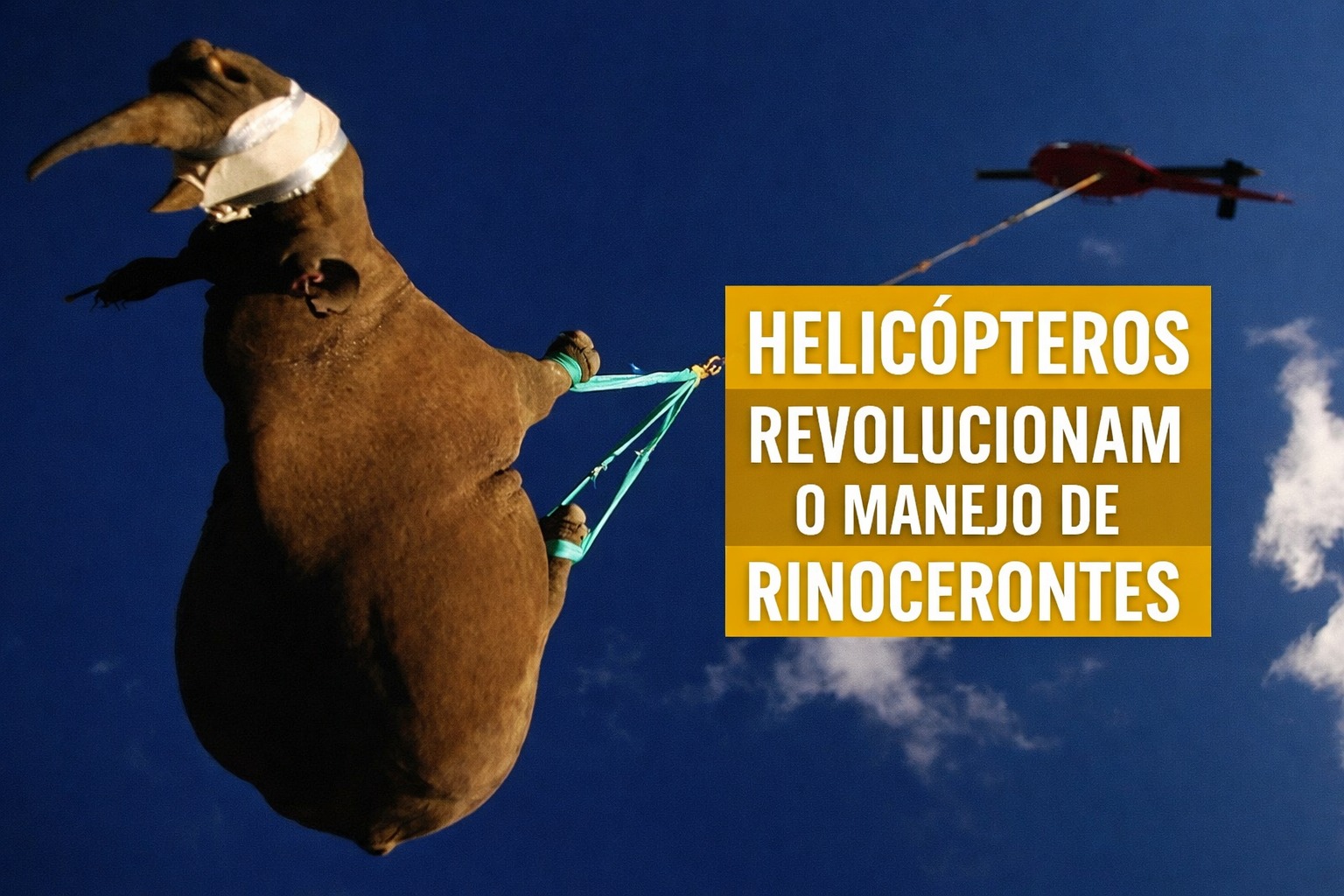
The Use of Helicopters Transformed Sedation, Transport and Management of Threatened Rhinoceroses, Allowing for Faster, Safer and More Frequent Operations in Extensive, Remote and Environmentally Complex Areas of Modern Sub-Saharan Africa
The capture and translocation of rhinoceroses have been profoundly transformed with the use of helicopters, which reduced risks, accelerated operations, and became essential for modern conservation of critically endangered species, especially in extensive and difficult-to-access areas.
Aerial Sedation as a Starting Point
The helicopter’s first role occurs in sedation, allowing for the location of rhinoceroses in vast areas, with dense vegetation or uneven terrain, where ground vehicles face severe operational limitations.
From the air, the pilot maintains constant observation of the animal while the veterinarian precisely applies the tranquilizer dart, reducing prolonged chases and minimizing the physiological stress on the rhinoceros.
-
With a cost per shot close to zero, the DragonFire laser could change naval warfare in 2027 and provide British ships with nearly unlimited defense against drones.

-
A British startup creates tires that generate electricity in electric vehicles when passing over potholes, speed bumps, and cracks.

-
Scientists have created robots made with living cells that have their own nervous system, swim on their own, explore the environment, and self-organize without any genetic engineering, and now they want to do the same with human cells.

-
Students create a solar-powered ambulance that operates without a plug, without fuel, and still keeps medical equipment running in remote areas.


This aerial control significantly decreases the risk of injuries caused by exhaustion or collisions, making sedation safer for both the animal and the teams involved.
Monitoring and Immediate Intervention
After sedation, the helicopter continues to play a central role by visually tracking the rhinoceros until it lies down, without the need for time-consuming ground tracking.
Within minutes, the team is guided to the exact location, allowing for quick interventions such as monitoring breathing, eye protection, and proper body positioning.
These procedures are critical for the survival of the sedated animal and directly benefit from the agility provided by continuous aerial observation.
Initial Limitations of Air Transport
The biggest revolution occurred in transportation, but the first methods posed high risks, involving suspended crates or rigid platforms that were aerodynamically unstable during flight.
Subsequently, nets began to be used to hoist immobilized rhinoceroses, but the irregular weight distribution and the compression of internal organs led to serious complications.
These limitations demonstrated that air transport needed safer solutions for large animals, especially in repeated operations.
The Inverted Lifting Method
The technical breakthrough came with the inverted lifting method, in which the sedated rhinoceros has its legs individually tied and is suspended upside down.
This lifting occurs for short periods, usually less than 10 minutes, keeping the airways clearer and reducing pressure on the lungs and internal organs.
The flight becomes more stable and aerodynamic, resulting in less physical stress for the animal and greater operational safety for the crew.
Logistical and Financial Impact of Helicopters
This technique allowed for the use of smaller and more affordable helicopters, replacing large military aircraft with civil models widely available for conservation projects.
Helicopters like the UH-1H Huey proved the viability of air transport, but had high costs and limited availability for frequent operations.
The adoption of lighter aircraft represented a logistical and financial leap, expanding the scale of rhinoceros translocations.
A New Operational Standard
An example is the Airbus AS350 AStar, which combines excellent power-to-weight ratio, reliability, and external load capacity, even with significantly smaller dimensions.
Thanks to the inverted technique, this model can safely lift rhinoceroses, increasing the frequency of operations and reducing operational costs.
This combination transformed air transport into a regular population management strategy, rather than just an ad-hoc emergency solution.
Large-Scale Conservation Driven by Helicopters
Organizations like the Black Rhino Range Expansion Project have demonstrated that the integration of aviation, veterinary care, and field teams supports safe operations over the years.
The helicopter has ceased to be an experimental resource and has become a central tool for conservation, allowing the movement of rhinoceroses to protected areas and diversifying populations.
By reducing time, stress, and risks, these aircraft have redefined the management of African megafauna, establishing themselves as a decisive advancement for the survival of rhinoceroses, even in the face of persistent challenges and complex operations.
With information from WWF.ORG.







-

-

-

3 pessoas reagiram a isso.