





 Portuguese
  English
  Spanish
  5 min of reading
  8 comments




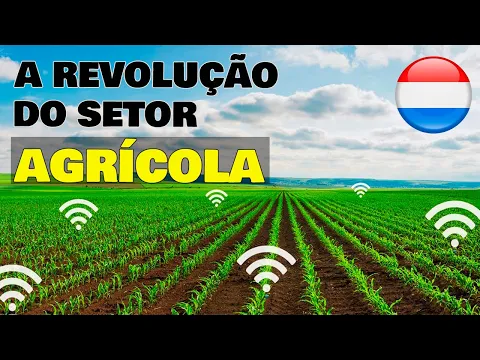
Understand How The Netherlands, With 25% Of Its Territory Below Sea Level, Became The Second Largest Agricultural Power On The Planet.
The Netherlands, a nation with one quarter of its territory situated below sea level and an extreme population density, has achieved a feat that defies conventional logic: it has become the second largest agricultural power in the world in export value. This extraordinary success was not achieved despite its adverse geography, but because of it. The centuries-old existential struggle to master water has forged a national culture of relentless collaboration and technological innovation.
In 2023, the country exported a colossal value of €123.8 billion in agricultural goods, according to data from Wageningen Economic Research (WUR) and Statistics Netherlands (CBS). This number, however, conceals a “dual helix”: a hyper-efficient domestic production system, focused on cutting-edge greenhouse technology, and an unmatched logistical dominance that positions it as the primary center for food trade and processing in Europe.
The “Miracle” In Numbers: Production Vs. Logistics
Diving deeper into the data is crucial to understand the Dutch model. Of the €123.8 billion exported in 2023, it is essential to make a vital distinction, as pointed out by Wageningen Economic Research (WUR) and Statistics Netherlands (CBS). The value of goods actually cultivated and produced within the Netherlands (domestic production) was €79.6 billion. The remaining €43.4 billion came from re-exports, products that arrive in the country and are repackaged, processed, or classified before going on to other markets.
-
These living root bridges and ladders are over 700 years old and help indigenous people survive in one of the rainiest regions in the world.

-
From sertanejo star to international investor: Ana Castela invests millions in a mansion in the USA, creates a themed accommodation in Orlando, and shows that the “boiadeira” also wants to grow away from the stage.

-
The 10 most stunning motorhomes in the world: a $3 million trailer with a rooftop nightclub and garage for a Ferrari, “palaces on wheels” with Italian marble, private cinema, and five-star hotel luxury for billionaires.
-
Trump wanted to spend $400 million on the White House, but the courts prohibited the million-dollar construction.


This division reveals that nearly 35% of the Netherlands’ status as an “agricultural power” is, in fact, a logistical dominance, centered on the Port of Rotterdam and Schiphol Airport. Even so, the €79.6 billion of internal production, generated in an area 200 times smaller than Brazil, still places the country among the largest exporters in the world. This is the true technological miracle, driven mainly by dairy, horticulture (flowers and plants), and meat.
The Genesis Of Efficiency: The “Polder Model”
The technological prowess of the Netherlands did not arise from a vacuum; it was forged over centuries by sheer necessity. With a quarter of the country below sea level, the fight against water is not a historical footnote; it is a matter of daily survival. Historically, the Dutch had to create their farmland from scratch, draining swamps and lakes to form the famous “polders”. This feat was achieved through complex systems of dikes and the pioneering application of windmills, used not to grind grain, but to relentlessly pump out water.
This colossal technical challenge was above all a governance challenge. Water does not respect property boundaries; the failure of a dike at any point drowns everyone. This forced the creation of the “water boards” (waterschappen), some of the oldest forms of democracy in the country, requiring absolute consensus and collaboration. This mindset, known as “Polder Model”, has become the “social software” of the Netherlands: collaboration is not a cultural choice, but a condition of survival, and is the direct precursor to its modern innovation system.
The “Golden Triangle”: The Brain Of Innovation
The cultural “Polder Model” evolved into an institutionalized innovation system, known as the “Golden Triangle” (Gouden Driehoek). This model is a symbiotic and formalized collaboration among three fundamental pillars: the Academy (providing cutting-edge research), the Industry (identifying market problems and applying solutions), and the Government (facilitating, partially funding, and regulating to promote competitiveness).
At the epicenter of this triangle is the Wageningen University & Research (WUR), consistently ranked as the world’s leading university for life sciences and agricultural research. As described by Optima H2020, WUR’s structure is uniquely designed to cover “strategic and applied research for industries, governments, and stakeholder groups”. Projects at WUR are implemented “in close collaboration with companies,” ensuring that scientific research does not remain theoretical but rapidly transforms into practical commercial results in the “Food Valley,” the “Silicon Valley” of food.
The Food Factory: Greenhouse Technology

This innovation ecosystem executes the “hardware”: a hyper-intensive agricultural production system that decouples food production from geographical constraints. While half of the Dutch territory is utilized for agriculture, a crucial area of this production occurs under glass. The country has around 24,000 acres of high-tech greenhouses, which function more as plant factories than traditional agriculture.
In these environments, everything is controlled: LED lighting allows plants to grow 24 hours a day, the climate is optimized by artificial intelligence, and hydroponics (soil-less cultivation) is the norm, allowing for precise delivery of water and nutrients. The results are extraordinary. According to The Borgen Project, Dutch greenhouses achieve radical resource efficiency: they can grow in one acre (0.4 hectares) what traditional open-field agriculture would require 10 acres (4 hectares). Water efficiency is even more shocking: farmers use only 0.5 gallon (about 1.9 liters) to grow half a kilogram of tomatoes, while the global average for the same amount is 28 gallons (about 106 liters) — a reduction of over 95%.
The Dark Paradox: The Nitrogen Crisis
However, this model of extreme intensification has a severe environmental cost and represents the country’s greatest existential challenge: the nitrogen crisis. Agricultural success, measured in production and exports, has generated a hidden cost. A long process of intensification has led to increasing nitrogen emissions, primarily ammonia ($NH_3$) from livestock manure. The Netherlands has the highest livestock density in the European Union, and the problem is the concentration of millions of animals and their waste in an area too small to absorb them.
This environmental crisis has turned into a political and social crisis, putting the country in violation of EU environmental standards. Court rulings forced the government to propose drastic measures, including buying and closing thousands of farms and reducing livestock density by 30%. This has led to massive, at times violent protests from farmers, exposing the physical limits of the Dutch model: the country ran out of space, not to cultivate, but to dispose of the waste from its production.
Efficiency Vs. Sustainability
The Netherlands’ success as an agricultural power is a masterclass in need-driven innovation. They turned their greatest weakness, an adverse geography, into their greatest strength, creating a system where technology and collaboration overcome the lack of land and resources. The “Golden Triangle” and greenhouse efficiency offer a vital model for a world that needs to feed more people with less.
However, the nitrogen crisis shows the dangerous limit of this model. The Netherlands proves that it is possible to produce more with less, but also that extreme intensification, focused solely on production per hectare, generates severe environmental consequences. What can Brazil, an agricultural giant based on scale, learn from the Dutch efficiency model? And how can it balance the need for production with environmental impact?
Is The Netherlands’ Intensive Technology Model The Future Of Global Agriculture, Or Does The Nitrogen Crisis Prove It Is Unsustainable? We Want To Know Your Opinion: Should Brazil Focus More On Technology Like The Netherlands Or Expand Its Area Sustainably? Leave Your Comment Below.





Isso só funciona em país, onde as pessoas são honestas e civilizadas… não é para o Brasil!
Este termo “abaixo do nivel do mar” é um absurdo pseudo científico amplamente divulgado pela imprensa. Trata-se de países muito próximos ao nível do mar, se estivessem abaixo estariam alagados por não possuírem capacidade de escoar as águas pluviais (água escore de cima para baixo). Um exemplo natural é o Rio Amstel, que passa por Amsterdam e vai em direção ao oceano, isto não seria possível se os locais por onde o Amstel passa fossem “abaixo do nivel do mar”.
Então pra quê bombear ininterruptamente, coisa feita desde a época do papiro!?
ESSE PESSOAL DO AGRO TEM QUE PARAR DE RECLAMAR, É O SETOR QUE MAIS TEM BENEFÍCIOS E PREVILEGIOS