





 Portuguese
  English
  Spanish
  4 min of reading
  1 comment


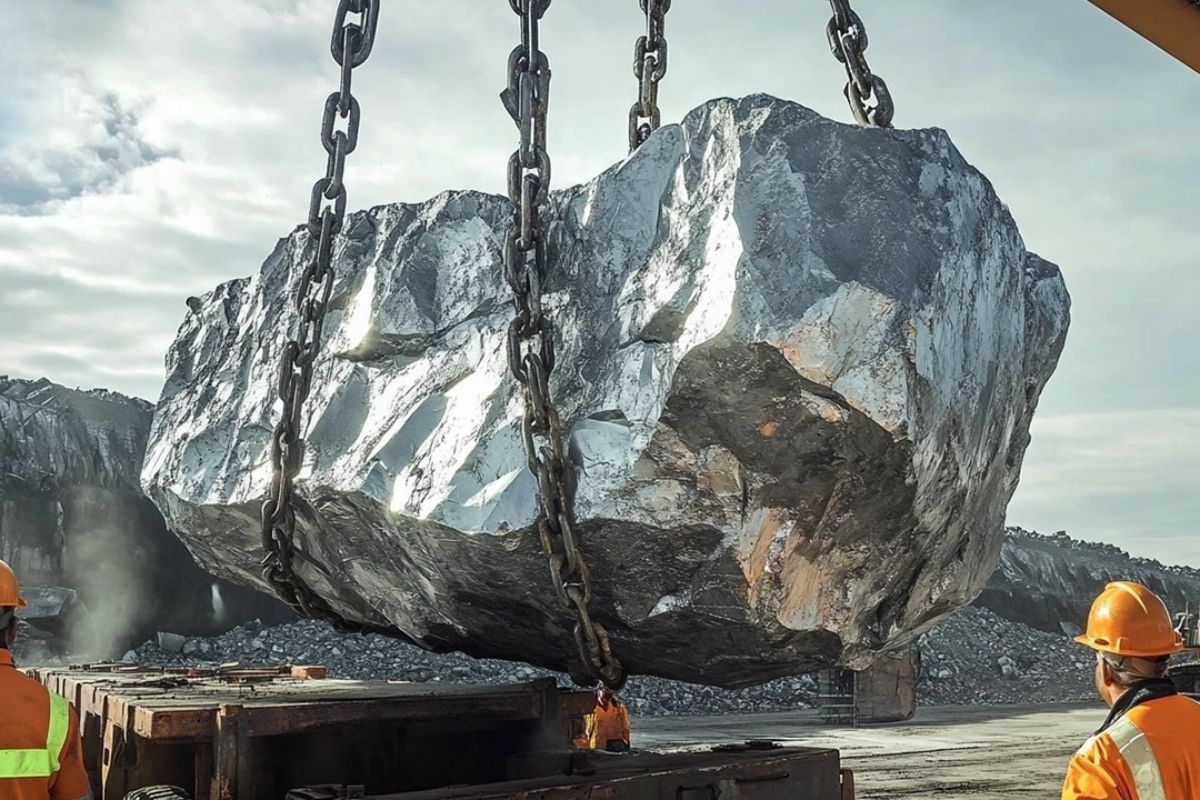


Pure Aluminum Is One of the Most Produced and Consumed Metals on the Planet, Essential for Aircraft, Cars, and Power Cables, but Its Creation Requires Billions in Investments and a Colossal Electricity Consumption.
Pure aluminum is born from a process that combines large-scale mining, chemical engineering, and an impressive energy consumption. Every day, about 200,000 tons of this metal are produced worldwide. Only the United States consumes more than 4 billion and 600 million kilograms per year. To meet this demand, the industry needs to process millions of tons of ore, in an industrial cycle that starts in the mines and ends in high-precision electrolytic furnaces.
Modern civilization depends on this lightweight, durable material. It is present in the fuselages of aircraft, in automobile bodies, and in high-voltage cables that power entire cities. Unlike iron, aluminum forms a protective oxide layer that makes it immune to corrosion, which explains its longevity and its strategic value for global engineering.
The Origin of Aluminum and the Challenge of Isolating It
Pure aluminum was identified in 1807 by British chemist Humphry Davy, but isolating it was a task that took decades.
-
Archaeologists find a colossal 2,000-year-old vessel at the bottom of the sea near Alexandria linked to the elite of Egypt and reveal a pleasure barge from the last dynasty of the pharaohs that the sea has hidden for centuries.

-
United Kingdom clears 40 tons of shells and concrete into the sea in an innovative project that promises to restore a marine ecosystem lost for over 200 years and improve water quality.
-
With emergency diversion to abandoned mining craters, engineers save villages from a devastating flood that was advancing through the desert and threatening to destroy entire communities in a matter of hours.
-
It seems simple, but it enriches: from R$ 500 to R$ 6,000 per piece and up to 10 days of handcrafted production, how is the couple from Praia Grande making a high income with hyper-realistic miniatures and turning a hobby into a money-making machine?


Danish Hans Christian Ørsted was the first to extract the metal, but with an expensive and inefficient process.
In the early 20th century, aluminum was worth more than gold, such was the difficulty of obtaining it.
The revolution came in 1886 when American Charles Martin Hall and Frenchman Paul Héroult independently discovered the electrochemical process that allowed the separation of the metal.
The technique, which uses molten cryolite and electric current, is still the basis of modern production.
From then on, aluminum became accessible and boosted the aerospace, automotive, and electrical industries.
The Reddish Rock That Holds the Metal
In nature, pure aluminum is not found in isolated form.
It concentrates in bauxite deposits, a reddish rock rich in aluminum oxides.
The largest reserves are in Australia, Guinea, Brazil, and Jamaica. At the Handley mine, owned by Alcoa, about 23 million tons of bauxite are extracted annually.
The extraction is done using explosives and heavy machinery. Up to 900 tons of ammonium nitrate are used monthly to break through layers of rock five meters thick.
Each detonation releases between 50,000 and 100,000 tons of ore. To produce a single ton of aluminum, four tons of refined bauxite are required.
The operational cost is extremely high, and the scale of production is only possible with giant equipment, 270-ton trucks, and excavators costing 20 million dollars.
From Ore to Alumina: The Chemical Step
After extraction, bauxite goes through the Bayer process, which separates aluminum oxide from impurities.
The ore is crushed in rotary drums with steel balls until it becomes a fine powder, which is then mixed with a caustic solution.
This chemical reaction dissolves the aluminum and forms a substance called alumina, a type of pure white sand.
Alumina is then transported to refineries, where it will undergo the electrolytic process.
Each ship that supplies a smelter can carry 100,000 tons of this material, and a single industrial plant can produce 35,000 tons of metallic aluminum every three days.
The Electricity That Transforms Alumina into Metal
To convert alumina into pure aluminum, electrolytic processing is used.
The electrolytic cells are filled with molten cryolite, which reduces the melting point of the oxide from 2050 °C to about 950 °C. High-intensity electric currents pass through the mixture, separating oxygen from aluminum.
The process requires a colossal amount of energy: about one third of the total cost of the metal comes from the electricity consumed.
A large-scale production plant uses more than 340 megawatts per year, enough energy to supply 300,000 homes.
During electrolysis, the molten aluminum accumulates at the bottom of the cells, from where it is continuously removed and pumped to refining furnaces.
The Liquid Metal That Becomes Structure

The molten aluminum is filtered and purified to remove gases and impurities. It is then poured into molds and slowly cooled, forming solid ingots.
The result is a high-quality pure aluminum, ready to be transformed into industrial components.
These ingots feed sectors that depend on lightness and strength, such as aviation, construction, and energy.
Each kilogram of the metal represents a balance between science, engineering, and energy consumption, justifying its nickname of “electricity in solid form.”
Pure aluminum is an invisible pillar of the global economy. Its production cycle, from ore to smelting, shows the energy and technological costs necessary to maintain contemporary industrial pace.
It is present in practically everything that moves, connects, and transports the world.
Did you imagine that such a lightweight and common metal depended on so much energy and science to exist?





Impressionante. No estado do Pará temos a Hidro Paragominas que extrai a bauxita e processa .