





 Portuguese
  English
  Spanish
  3 min of reading
  0 comments


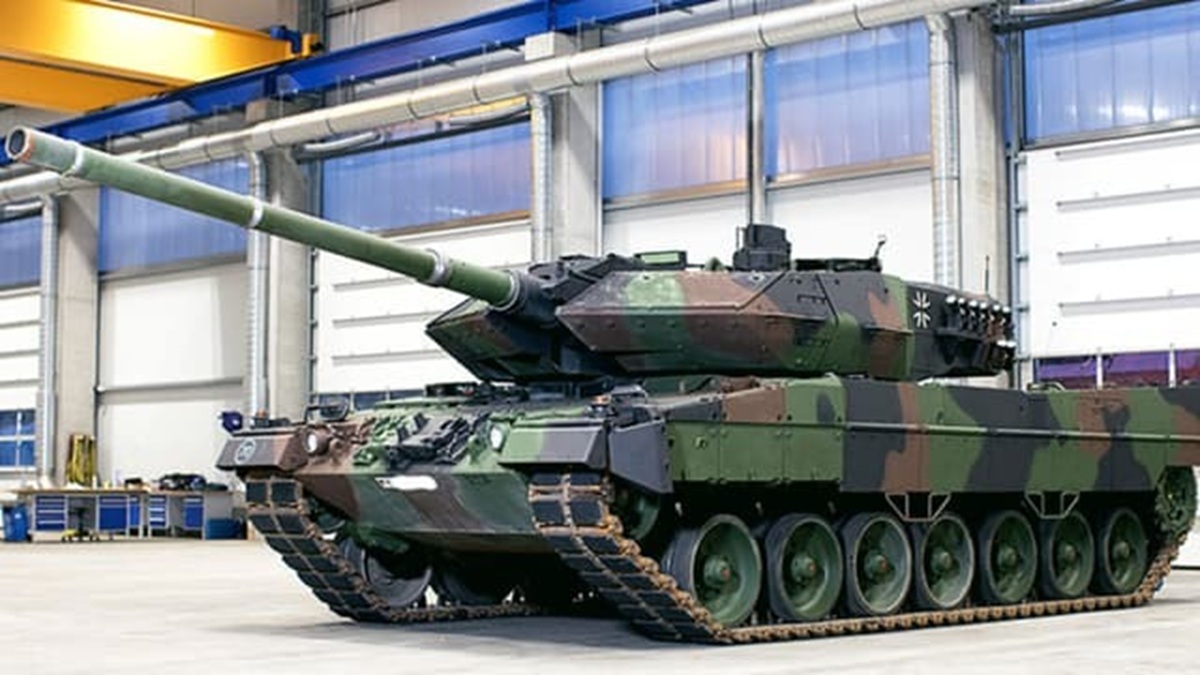
Condor Leopard 1 Tank, Developed by FFG, Combines Modernized Chassis, Unmanned Turret, and Rolls-Royce Engine to Face Ground and Aerial Threats.
The defense company Flensburger Fahrzeugbau Gesellschaft (FFG) from northern Germany is preparing to present its new Condor tank concept at the DSEi fair in London. The vehicle combines the strength of a support tank with the functions of an anti-aircraft gun. To achieve this, FFG utilized a modernized Leopard 1 chassis, integrating new technologies with proven combat components.
According to the company, the Condor was created to face rapidly evolving threats. It combines mobility, reliability, and adaptability—elements deemed essential in modern battlefields. At the core of the system is the Leopard 1 platform, reinforced with additional armor and digital networks.
Turret and Armaments
The tank is equipped on top with the unmanned Turra 30 – SA turret, manufactured by the Slovak company EVPÚ. The system is armed with a 30 mm automatic cannon and supports programmable explosive ammunition, ideal for targeting drones and aircraft.
-
Scientists drilled nearly 8,000 meters into the ocean floor above the fault that caused the 2011 tsunami in Japan and discovered that a layer of clay 130 million years old was responsible for making the wave much worse than any model had predicted.

-
Thousands of years after causing the largest eruption of the Holocene, one of the world’s largest supervolcanoes is rebuilding itself beneath the sea south of Japan, receiving new magma and alarming scientists with its transformation.

-
China has activated a magnet 700,000 times more powerful than the Earth’s magnetic field that operates for over 200 consecutive hours while consuming little energy, and now the world wants to know what Beijing plans to do with this technology in 2026.

-
Mercado Livre has started selling medications in Brazil with delivery in up to 3 hours, and the project that launches in São Paulo may expand to the entire country, transforming the way millions of Brazilians buy medicines.


Thanks to the dual-belt feed, the crew can alternate ammunition types while moving. This feature ensures agility by allowing a quick shift from anti-aircraft missions to fire support roles.
The managing director of FFG, Jörg Kamper, stated to the hartpunkt portal that the goal was to develop an efficient air defense system based on the Leopard 1, already available on a large scale. He also highlighted that the EVPU turret provides a secondary function to the vehicle, enabling support for infantry troops.
Dimensions and Additional Systems
The Condor measures 7.18 meters in length, 3.41 meters in width, and 3.05 meters in height. Its combat weight is below 40 tons. To enhance protection, FFG installed side and roof armor. Inside, the commander and driver now sit side by side.
The stabilized turret can accommodate different 30 mm cannons, including the Bushmaster Mk44. As secondary weapons, the tank is equipped with a coaxial machine gun and Spike and Konkurs anti-tank missiles.
EVPÚ also integrated a multi-mission radar, electro-optical sensors, and systems to detect fire from small arms or snipers. The turret elevates between minus 10 and plus 70 degrees, covering targets from the ground to low-altitude drones.
Mobility Upgrade
Mobility was another key focus in development. FFG replaced the obsolete powertrain of the Leopard 1 with a new configuration. At the center of the system is the Rolls-Royce Power Systems 8V199TE23 diesel engine, capable of generating up to 1,080 horsepower.
This engine works alongside a modified ZF 4 HP 250 automatic transmission and a two-stage cooling system developed by FFG itself. The upgrade ensures more power and torque, along with reduced fuel consumption. The assembly is also 300 kilograms lighter than the original.
Safety and Adaptation
The vehicle also received a dual-circuit brake system, already developed by FFG for the Leopard 1. This addition meets current traffic regulations, making it easier to register new armored vehicles.
The company emphasizes that the Condor offers a cost-effective solution for operators who need to rapidly expand their air defense and ground support capabilities. Furthermore, it highlights that the model maintains room for future upgrades, keeping pace with the evolution of threats on the battlefield.








-

Uma pessoa reagiu a isso.