





 Portuguese
  English
  Spanish
  5 min of reading
  0 comments


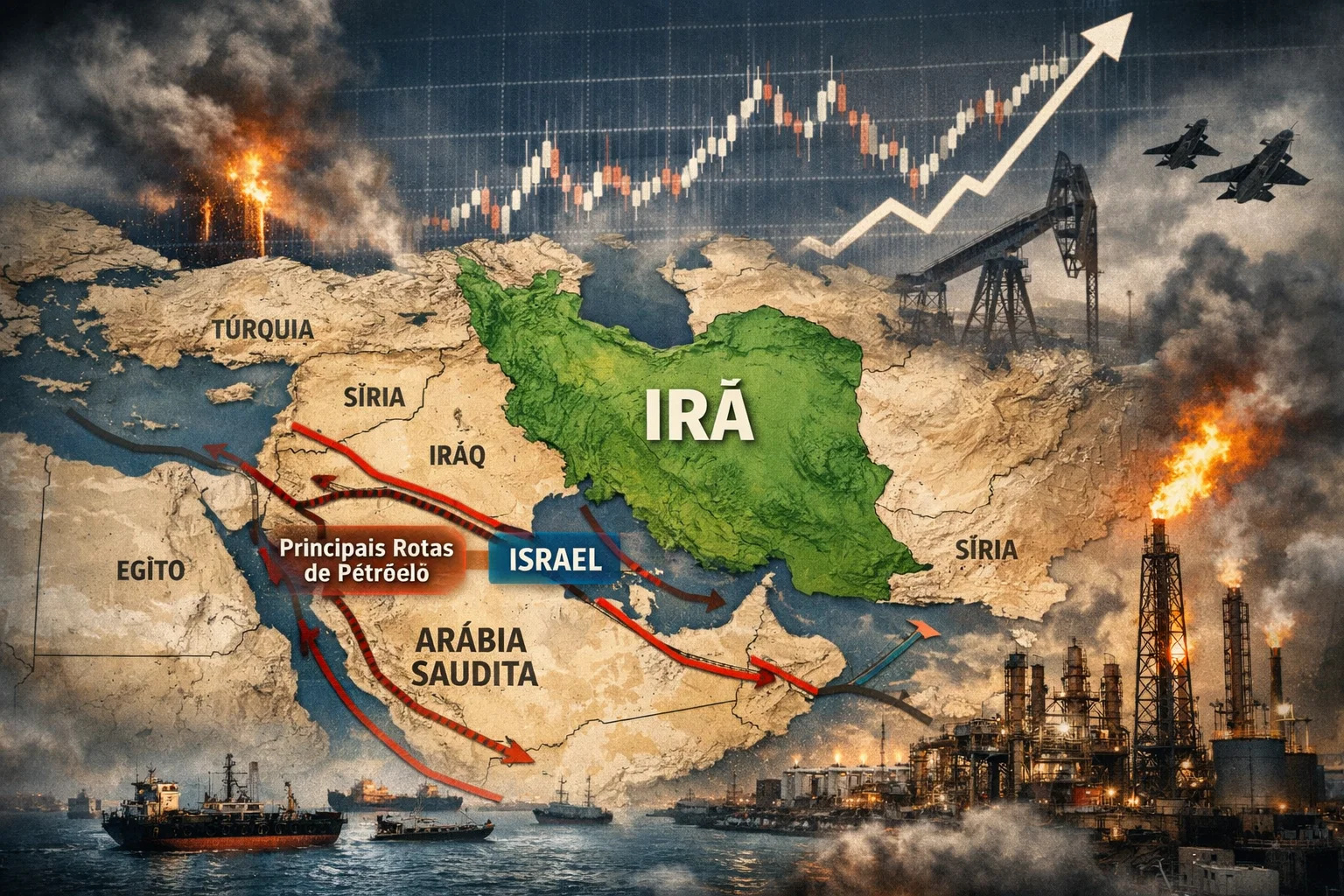
Military Escalation Involving The United States, Israel, and Iran Pressures Oil Prices and May Generate Economic Effects That Reach The Brazilian Electoral Dispute of 2026
The recent escalation of tension in the Middle East has put the global energy market on alert again. The reason is that military attacks involving the United States, Israel, and Iran have intensified the conflict in the region, causing a strong reaction in oil prices, an essential commodity for the global economy. This movement, although occurring thousands of kilometers away from Brazil, may have direct repercussions on the economic scenario and even on the Brazilian presidential election of 2026.
The information was reported by the portal “O Antagonista,” which highlighted analyses from experts on how the war in the Middle East may influence inflation, the cost of living for the population, and consequently, the political environment in the country on the eve of the electoral dispute.
Rising Oil Prices May Pressure Inflation and Cost of Living in Brazil
The international crisis has taken on new contours after the attacks carried out about a week ago by U.S. and Israeli forces against Iran, an episode that heightened tensions in the region and raised concerns among market analysts.
-
Oil surged to $115 a barrel due to the war in the Middle East, and diesel in Brazil has already risen to R$ 7.45 per liter, while the United States…
-
Brazilian city bets on the business environment to generate jobs and attract investments in the energy sector — secretary reveals strategy at Macaé Energy 2026.
-
50 viaducts, 4 tunnels, 28 bridges, and 40 kilometers of bike paths: BR-262 in Espírito Santo will receive 8.6 billion reais for the largest engineering project in the state’s history, inspired by the Immigrant Highway in São Paulo.

-
Brazil produces too much clean energy and doesn’t know what to do with it: over 20% of solar and wind capacity was wasted in 2025 while investors flee and 509 renewable generation projects were abandoned in the last year.


As a direct consequence of the conflict, oil prices have already increased by about 30% in international markets. Last Friday, the Brent oil price exceeded US$ 94 per barrel, reflecting fears of fuel supply disruptions.
According to experts, this type of movement tends to spread quickly across various areas of the economy. This happens because oil influences not only fuel prices but also the transportation of goods, industrial production, and even food costs.
In this context, the chief economist of XP, Caio Megale, warned in a report released in March that the recent increase may directly impact prices in Brazil.
“If the recent rise in Brent proves to be persistent, an increase in gasoline prices will be inevitable,” wrote the economist.
Therefore, if the commodity’s prices remain high throughout 2026, the effect may be felt throughout the entire production chain, driving up prices of industrial goods, food, and services. Consequently, the most immediate result would be an increase in the cost of living for the Brazilian population.


Higher Inflation May Affect The Perception of The Brazilian Electorate
In addition to the direct economic impact, experts also warn that rising inflation may alter the political climate in the country. This happens because the population’s perception of the economy tends to influence the behavior of the electorate.
According to political scientist Leandro Consentino, a professor at Insper, major international conflicts tend to have indirect effects on the internal policies of various countries.
“Any large-scale conflict impacts the domestic landscape of any country,” the expert stated. “At the moment, we are seeing economic impact, mainly concerning oil, which is likely to destabilize the narrative of the Lula government.”
The central concern is related to the impact on lower-income Brazilians, who tend to feel the effects of inflation more acutely. This is because basic expenses such as food, transportation, and energy represent a larger portion of the budget for these families.
Political scientist Eduardo Grin, a professor at FGV EAESP, highlights that this scenario could directly affect one of President Luiz Inácio Lula da Silva’s (PT) main electoral bases.
According to him, a significant increase in the cost of living could generate dissatisfaction among beneficiaries of social programs and workers with lower incomes.
“This would be very bad for voters who receive Bolsa Família, who earn up to two minimum wages, for whom the cost of living would be the most affected and who make up the major social and electoral base for Lula. I think Lula will hardly escape the effect of this,” the researcher stated.
Political Dispute May Exploit The Impact of The Economy on The 2026 Elections
While the government tries to maintain a narrative based on positive economic indicators, the opposition may take advantage of the issue to criticize economic management if prices continue to rise.
Among the opposition figures likely to explore this debate is Senator Flávio Bolsonaro (PL-RJ), frequently mentioned as one of the potential candidates in polls for the presidential election.
So far, the Palácio do Planalto has sought to highlight favorable economic results and defend popular agendas, such as the discussion about the work schedule 6×1. However, experts warn that external shocks can quickly alter this scenario.
According to Consentino, changes in the international energy market may affect key indicators of the Brazilian economy.
“Messing with oil at a time like this can certainly disrupt these indicators,” stated the political scientist.
Oil Prices May Also Increase Government Revenue
Despite the economic risks, some analysts point out that rising oil prices may also generate positive effects in the short term for public finances.
According to Caio Megale, the recent surge in commodity prices could result in higher tax revenues. According to estimates presented by the economist, the increase in oil prices — which rose from approximately US$ 60 to US$ 80 per barrel in response to the conflict involving Iran — may generate an additional net revenue of R$ 21.4 billion in 2026.
Still, the economist warns that the fiscal scenario remains cautious. This is because rising public debt and fiscal risks tend to become more relevant as the presidential election approaches.
Thus, the unfolding of the war in the Middle East and its impact on the global energy market may turn into an unexpected factor in the Brazilian political contest. After all, in a country where inflation has always been a sensitive issue, any significant change in the cost of living may directly influence the mood of the electorate.
Source: CNN Brazil








Seja o primeiro a reagir!