





 Portuguese
  English
  Spanish
  6 min of reading
  0 comments



Technology Developed in Germany Presents Molecular Solar Battery Capable of Storing Light for Days and Generating Hydrogen on Demand, Offering a New Strategic Alternative for Renewable Energy and Industrial Decarbonization.
Intermittency has always been one of the main challenges of solar generation. When the sun sets, electricity production drops. Now, scientists from the universities of Ulm and Jena in Germany have developed a molecular solar battery capable of storing light directly as chemical energy and releasing it days later in the form of hydrogen, even in the dark. The study was published in the journal Nature Communications on January 28 and presents a concept that could redefine strategies for renewable energy in the medium and long term.
The difference lies not only in the conceptual innovation but also in the numbers presented by the researchers. According to the scientific work, the system achieves efficiencies greater than 80% in the electron storage phase and about 72% in the conversion of accumulated energy into usable hydrogen. Additionally, the charged state remains stable for several days without significant dissipation. These data position the technology as a promising alternative to traditional green hydrogen production, which currently largely depends on electrolysis powered by renewable electricity.
Molecular Solar Battery Transforms Light Into Stable Chemical Reserve
The so-called molecular solar battery does not store electricity like a conventional lithium-ion battery. Instead, it captures visible light and converts this energy into electrons stored within a water-soluble macromolecule.
-
How the terraforming of Mars can transform the planet: artificial aerosols can increase the temperature by up to 35°C in 15 years, creating conditions for liquid water.

-
Scientists drilled nearly 8,000 meters into the ocean floor above the fault that caused the 2011 tsunami in Japan and discovered that a layer of clay 130 million years old was responsible for making the wave much worse than any model had predicted.

-
Thousands of years after causing the largest eruption of the Holocene, one of the world’s largest supervolcanoes is rebuilding itself beneath the sea south of Japan, receiving new magma and alarming scientists with its transformation.

-
China has activated a magnet 700,000 times more powerful than the Earth’s magnetic field that operates for over 200 consecutive hours while consuming little energy, and now the world wants to know what Beijing plans to do with this technology in 2026.
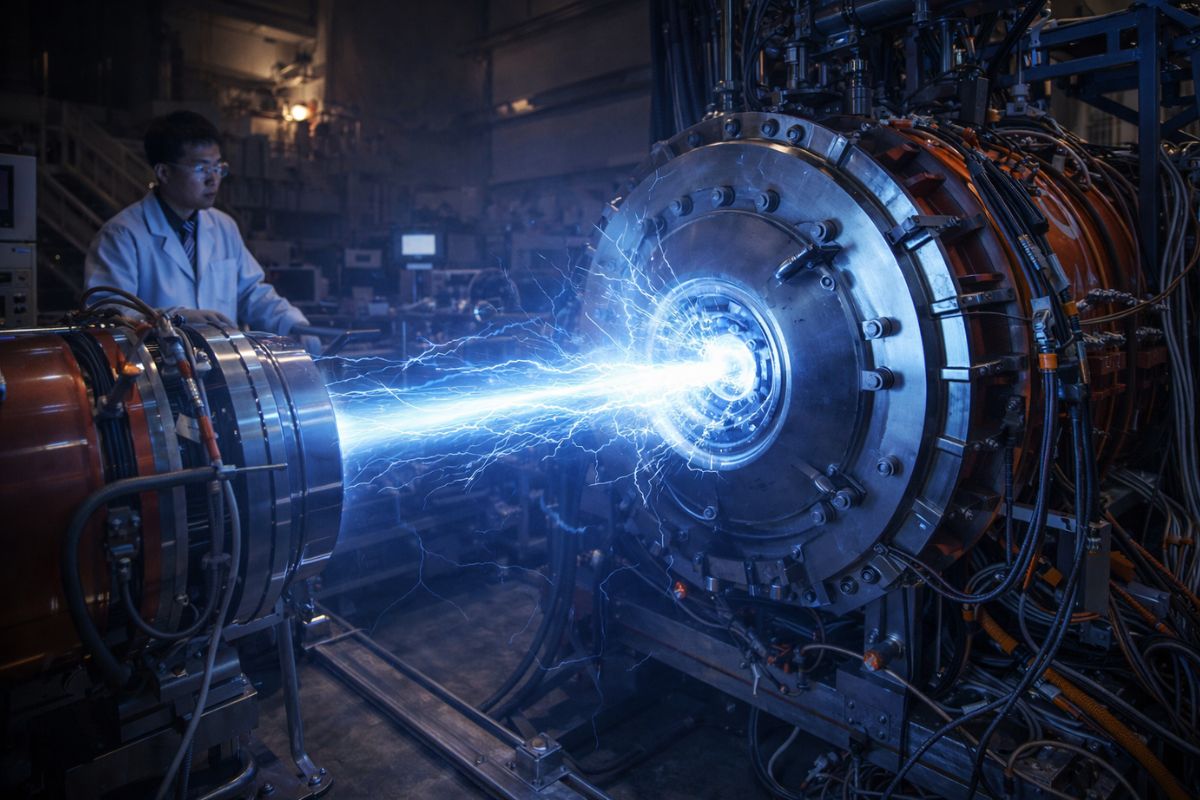

The core of the innovation is a copolymer with enhanced redox activity. It is a chemical structure designed to capture and retain electrons efficiently. During the “charging” phase, the system is exposed to light in the presence of a catalyst containing a luminescent ruthenium dye.
Under irradiation, electron transfer occurs to the polymer. According to the study published in Nature Communications, the efficiency of this step exceeds 80%, a value considered high for photocatalytic systems in aqueous media.
The most relevant aspect, however, is stability. Unlike many experimental solar systems, the charged state remains active for several days. This allows for a complete decoupling of the moment of light capture from the moment of energy use.

Light Stored Today, Hydrogen Released Later
The yield reported by the researchers is approximately 72% in the conversion of accumulated energy into usable gas. The process occurs entirely in the dark, as the energy is contained in the chemical structure of the polymer.
In practice, this means that the molecular solar battery can generate hydrogen on demand, regardless of the presence of light at the moment of production. This feature represents a significant advancement for renewable energy systems that struggle with climatic variability.
After discharge, it is simply necessary to neutralize the solution for the material to return to its original state. The redox reversibility allows for multiple cycles without the need for complex regeneration. An interesting detail reported in the study is the color change of the solution, which shifts from violet to yellow, acting as a visual indicator of the energy state.
Solar Battery: A New Model of Renewable Energy Beyond Conventional Electrolysis
Currently, most green hydrogen is produced through water electrolysis powered by renewable sources. According to the International Energy Agency, hydrogen plays a strategic role in the decarbonization of heavy industrial sectors, such as steelmaking, ammonia production, and chemical refining.
The traditional model, however, relies on robust electrical infrastructure and grid stability. This can limit applications in regions with lower energy capacity.
The approach of the molecular solar battery proposes a different path. Instead of converting light into electricity to then produce hydrogen, the system directly stores solar energy at a chemical level.
This integration between light capture and chemical storage reduces intermediate steps. For hydrogen-intensive industrial sectors, the ability to produce gas on demand can smooth out consumption peaks and reduce operational bottlenecks.
Additionally, decentralized systems can benefit from this technology. In remote areas or with limited infrastructure, combining solar capture and molecular storage can expand access to renewable energy.
Integration Between Macromolecular Chemistry and Applied Photocatalysis
The scientific value of the study lies in the convergence of two areas that rarely unite with a clear practical application: macromolecular chemistry and photocatalysis. The use of a water-soluble copolymer as a storage medium is relevant from both an environmental and operational standpoint. Many experimental systems use organic solvents, which can hinder large-scale applications.
The presence of the luminescent ruthenium catalyst is essential for the efficient absorption of visible light. Although ruthenium is not an abundant metal, its application in the laboratory demonstrates the conceptual viability of the system.
Another important point is the stability of the charged state for several days. In many experimental solar systems, energy is quickly lost if not immediately used. In this case, prolonged retention expands operational flexibility.
Green Hydrogen as a Strategic Vector in the Energy Transition
Hydrogen is considered an essential energy vector for achieving global climate goals. The Intergovernmental Panel on Climate Change highlights the need to reduce industrial emissions to limit global warming.
Green hydrogen, produced from renewable sources, can replace fossil fuels in industrial processes that are difficult to electrify. However, the cost of production remains a challenge.
Technologies like the molecular solar battery can contribute by proposing alternative forms of storage and on-demand generation. By storing light directly as chemical energy, the system creates a controllable reserve that can be converted into hydrogen when needed. This flexibility can be particularly useful in industrial chains that require a continuous supply of gas.
Challenges of Scalability, Cost, and Durability of the Solar Battery
Despite the promising results, the technology is still in the experimental stage. The study demonstrates proof of concept in the lab, but transitioning to industrial applications will require further testing.
Among the main challenges are the scalability of the system, the reduction of material costs, and the assessment of durability in prolonged cycles. Replacing ruthenium with more abundant alternatives may be necessary to enable commercial applications.
Additionally, it will be necessary to analyze the performance of the system under real conditions, with environmental and operational variations. Even so, the numbers presented — efficiency greater than 80% in charging and about 72% in hydrogen production — indicate that the concept has a solid scientific foundation.
When Engineering Transforms Poetry into Energy Solution
Storing the sun for later use has always seemed like a poetic metaphor. The molecular solar battery turns this idea into applied engineering. By storing light as stable chemical energy and releasing hydrogen on demand, the system offers a new perspective for renewable energy. It does not immediately replace existing technologies, but broadens the range of possible solutions.
If it overcomes cost and scale barriers, it could complement traditional electrolysis and strengthen industrial chains that rely on green hydrogen. The advancement presented by the universities of Ulm and Jena shows that energy innovation does not depend solely on more efficient panels or larger batteries.
Sometimes, the revolution happens at the molecular level. And in this case, light ceases to be just an instant flow and becomes a strategic reserve ready to be transformed into hydrogen when demand arises.









Seja o primeiro a reagir!