





 Portuguese
  English
  Spanish
  2 min of reading
  0 comments



The Largest Active Iceberg in The World, A-23a, Has Started Moving Again After Decades A Drift. Understand The Phenomenon That Kept It Spinning In The Ocean
The iceberg A-23a broke away from the Filchner-Ronne ice shelf in Antarctica in 1986. Since then, it has remained stuck on the seabed, immobile for years. With an area of about 3,360 square kilometers — equivalent to the Spanish island of Mallorca — it is the largest active iceberg in the world. Its weight is impressive: nearly one trillion tons.
Identification follows criteria from the United States National Snow and Ice Data Center (USNIC). The letter “A” indicates the quadrant of origin.
The number “23” represents its position among the records from that quadrant since 1978. The letter “a” shows that the original block fractured, and this is the largest remaining piece.
-
An engineer designs a solar plane to fly on Mars at an altitude of 1,000 meters and a speed of 300 km/h, covering 16,000 kilometers in a Martian year, 900 times the distance traveled by the Ingenuity helicopter in three years on the planet before experiencing a rotor failure, and NASA is already funding the feasibility study.

-
A new phenomenon of contactless magnetic friction intrigues scientists and questions a theory that has been valid since the 17th century.

-
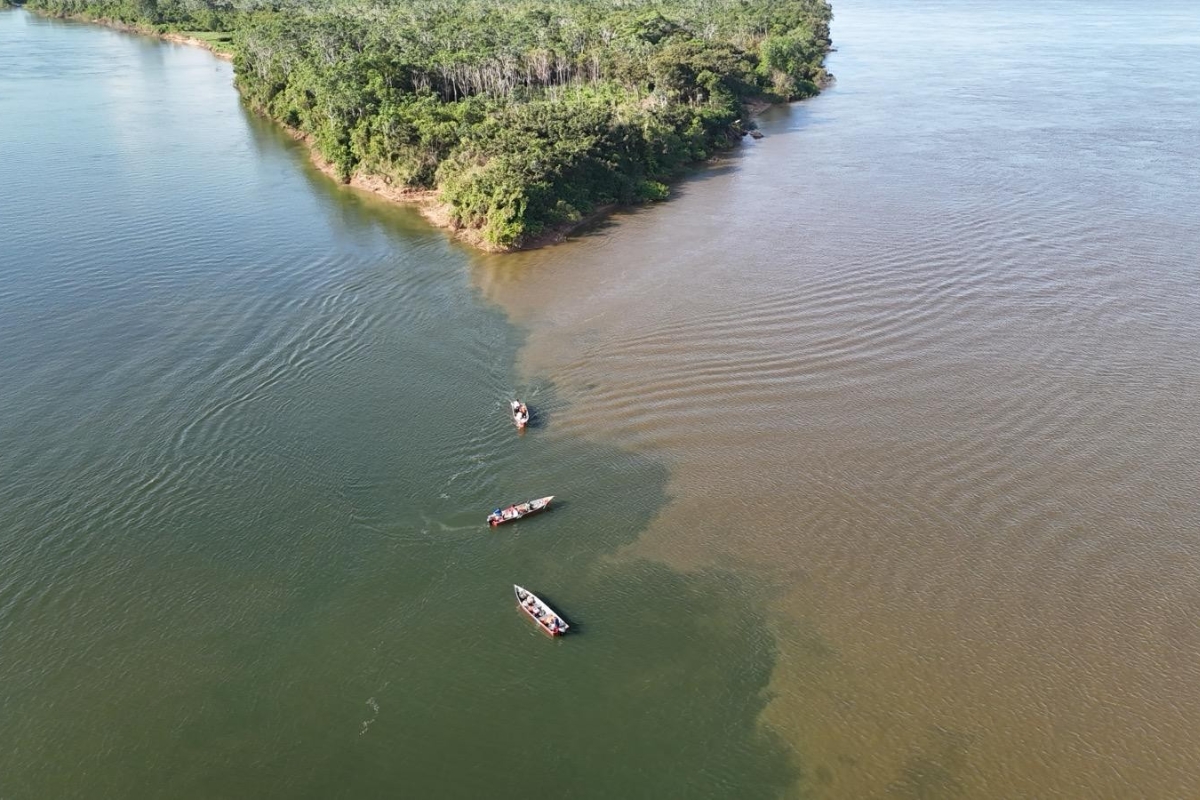
An impressive phenomenon in Northern Brazil causes rivers of different colors to flow side by side, revealing secrets about sediments, currents, and biodiversity.
-
While many schools are still struggling with the basics, a teacher in China went viral for having elementary school students build a two-stage rocket using plastic bottles, water, and pressurized air in a science class that caught the attention of the entire world.


Slow And Impressive Movement
Since 2020, A-23a has started to slowly move northward. Despite its static appearance, the iceberg hides a significant part of its structure underwater — about 300 meters.
The visible portion rises up to 100 meters above sea level. Its size and weight make its movement a true spectacle of nature.
Last year, the iceberg attracted attention for spinning like a whirlpool near the South Orkney Islands. The cause has been identified as the Taylor Column — a physical phenomenon described in 1920 by Sir Geoffrey Ingram Taylor.
It occurs when a marine current encounters an obstacle on the ocean floor, such as the Pirie Bank, which is 100 kilometers wide. This forms a swirling mass of water that can trap large objects.
At the end of 2023, the iceberg escaped the vortex and began heading toward South Georgia Island. Scientists feared that the impact might affect local wildlife. The area of the iceberg is larger than that of the island, increasing the risks.
New Stop, New Questions
On March 1st, A-23a stopped again. This time, 73 kilometers from the island. The exact cause of the release from the whirlpool has yet to be fully explained, but it is believed that the currents changed, destabilizing the Taylor Column.
The iceberg’s future remains uncertain. After decades of being stationary, then caught in a vortex and nearly colliding with an island, it remains a silent presence, adrift. The world continues to watch its next steps.
With information from Tempo.com.






-

-

-

-

-

-

43 pessoas reagiram a isso.